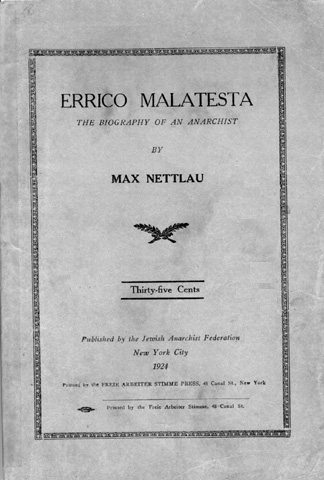
Errico Malatesta
The Biography of an Anarchist
A Condensed Sketch of Malatesta from the book written by
by Max Nettlau
Published by the Jewish Anarchist Federation
New York City. 1924
Introduction
|
|
The short sketch of Malatesta's life is based on the exhaustive study of Max Nettlau, published in Italian translation by "Il Martello" in New York under the title Vita e Pensieri di Errico Malatesta, and in German translation issued at Berlin by the publishers of the "Syndicalist." Max Nettlau, the profound scholar of the Anarchist movement, biographer of Michael Bakunin and author of Bibliographie de l'Anarchie, lives in Vienna, and like so many intellectuals in Europe, in distressing economic condition. May I express here the hope that he will find sufficient encouragement to continue his valuable task in the Anarchist movement? He was in contact with the most remarkable men and women in the revolutionary movement of our time and his own reminiscences should prove of great value to the younger generation.
The American publishers refuse to print the Biography on the pretext that it would not pay. No doubt, should an upheaval occur in Italy and Malatesta's name appear in the foreground, the same publishers would be only to eager to get hold of the manuscript. Meanwhile our comrades of the Jewish Anarchist Federation offer the short sketch as a homage to Malatesta on his seventieth birthday.
In a very sympathetic review of the Vita e Pensieri in the New York "Nation", Eugene Lyons states that Malatesta's life symbolized the romantic age of rebellion. True, but it is not the romance of self-conscious knight-errantry, of adventure for adventure's sake. It is rather the inevitable unfolding of a character unswerving in its devotion to a philosophy of action. Even at the peaks of his adventures Malatesta has remained kindly, retiring, modest in his habits.
Against the background of a Europe misruled by renegade Millerans, Lloyd Georges, Mussolinis, Eberts, Pilsudskis, and other of the fraternity of ex-idealists, the personality of Errico Malatesta attains an idyllic grandeur. At the age of seventy he can look back upon fifty years of intensive revolutionary work, thirty-six of them spent in busy exile. His life has a consistency, an almost apocalyptic directness which more than explains the adulation with which he is regarded among the comrades. It coincides, moreover, with a concentrated half century of social development. Its threads are woven closely into lives of the leaders during this period - Mazzini, Bakunin, Cafiero, William Morris, the brothers Reclus, James Guillaume, Stepniak, Kropotkin, and many others. It is a life that bridges the time of the Paris Commune and the Russian Revolution. Its course consequently has a tremendous significance.
When Malatesta returned to Italy in October, 1919, after being smuggled out of England on a coal boat by the head of the Italian Seamen's Federation, all the ships in the port of Genoa saluted his arrival, the city stopped work and turned out to greet him. His arrest soon after and the events in Italy which have forced him temporarily into the background of national life are recent enough to be generally known. Despite his age, Malatesta is still a vigorous social rebel, and the most stirring chapters of his life may still have to be written.
Hippolyte Havel
Errico Malatesta was born in Santa Maria Capua Vetere in 1853, Dec. 4, that is in Santa Maria, a little town occupying the site of Capua of antique fame, at two miles distance from the castle of Caserta.
Capua, in 1860, had a civilian population of about 10,000 and a large garrison. Being the administrative centre of the province called Terra di Lavoro, it may have harbored a numerous bureaucracy and appertaining quantities of lawyers and landed proprietors, the owners of the surrounding country. Caserta, on the other hand, with the Bourbon castle and large domain, was the scene of aristocratic and court life. Between these Santa Maria, now of about 30,000 inhabitants, may then have been an open rural town of small proprietors and merchants, and probably a landless agricultural proletariat, to which the neighborhood of Capua and Caserta, and that of Naples also, gave certain educational, trading, and other opportunities. It is in fact the centre of commerce of the Campania, rather flourishing and quite absorbed by commercial life. Let Malatesta himself, even if he remains silent upon his later life, give us a picture of his childhood which, to judge from these surroundings, may have been very quiet, but which, if we examine certain parts of contemporary history passing at close proximity to him, made him witness very stirring events at an early age.
I ignore whether the Bourbon misrule was always held vividly before his mind by family and local experience and traditions or whether even then children of middle class families with predominant material interests --- his father may have been engaged in commerce --- grew up without seeing this side of his life, just as the social question is kept from their eyes. But he was a boy of six or seven when, in 1860, the old system completely collapsed; then, for a moment, Europe's attention was riveted to his very own birthplace, for the garrison of official Capua marched against his own Santa Maria, held by none other than Garibaldi in person who fought a pitched battle and drove them back; official Capua was soon besieged and had to capitulate. A boy is not likely to miss or forget such days.
Even if young Malatesta had no special revolutionary initiative before he left Santa Maria - after frequenting the lyceum there - for the University of Naples, as an intelligent youth of liberal ideas he must easily have arrived at relatively advanced ideas, feeling the revolutionary patriotism so generally spread at that time. I see him recorded as a Mazzinist (by Angiolini, 1900), as inclining towards Garibaldi by Fabbri, 1921) but I should consider him at least a very unorthodox partisan of either. Mazzini represented apparently more unswerving republicanism and a higher social idea than Garibaldi, and in that sense Malatesta may have been attracted by him as being the most advanced revolutionist he then knew of. But there is no trace in all we know of Malatesta to show that the special ideas of religious mysticism and that peculiar pseudo-socialism which is in reality as anti-socialist as anything could be, which both are unseparable from Mazzini, though they do not affect his practical political thought - that these Mazzinian fallacies were ever accepted by Malatesta who seems to have jumped into internationalism and anarchism so neatly and quickly as if they had been familiar to him all along.
What he saw during these years of the social misery around him, whether this or the general political discontent, or friends, societies, a local propaganda or what else first propelled him into advanced movements, he may yet tell himself with many other details of his early life of which we can only give such a fragmentary and hypothetical account. But there can be a little doubt that an article in the "Questione Sociale" (Florence), about January, 1884, translated in the Geneva "Revolte" (Feb 3, 1884), most fortunately preserves a description of Malatesta's youthful mental evolution from abstract republicanism to living socialism. The article intends to point out a similar way to the young republicans of the eighties and in some respect may be compared to Kropotkin's "Appeal to the Young." Here only the biographical parts can be quoted as some length:
"More than fifteen years ago [about 1868] I was a young man, studying rhetorics, Roman history, Latin and Mr. Gioberti's philosophy. In spite of all the intentions of my masters to that purpose, school did not stifle within me the natural element, and I conserved in the stultifying and corrupting surroundings of a modern college a healthy intellect and a virgin heart.
"Being of loving and ardent nature, I dreamed of an ideal world where all love each other and are happy; when I was tired of my dreams and gave myself over to reality, looking around me, I saw here a miserable being trembling of cold and humbly begging for alms, there crying children, there swerving men and my heart became glaced.
"I paid closer attention and became aware that an enormous injustice, an absurd system were weighing down humanity, condemning it to suffer: work degraded and nearly passing as dishonorable, the worker dying of hunger to feed the orgies of his idle master. And my heart was swelled with indignation. I thought of the Gracchi and Spartacus, and felt within myself the soul of a tribune and of a rebel.
"Not since I heard it said around me that the republic was the negation of these things which tortured me, that all were equal in a republic, since everywhere and at all times I saw the word republic mixed with all the revolts of the poor and the slaves, since in school we were kept in ignorance of the modern world in order to be made stupid by means of a mutilated and adulterated history of ancient Rome and were unable to find some type of social life outside of Roman formulas --- from these reasons I called myself a republican, and this name seemed to me to resume all the desires, all the wrath which haunted my heart. I did perhaps not very well know what this dreamed republic ought to be, but I believed that I knew it, and that was sufficient: to me the republic was the reign of equality, love, prosperity, the loving dream of my fancy transformed into reality.
"Oh! what palpitations agitated my young breast! Sometimes a modern Brutus, in imagination I plunged a dagger in the heart of some modern Caesar, at other times I saw myself at the head of a group of rebels or on a barricade crushing the satellites of tyranny, or I thundered from a platform against the enemies of the people. I measured my size and examined my upper lips to see whether my mustache had grown; oh! how I was impatient to grow up, to leave college to devote myself entirely to the cause of the republic!
"At last the day I had wished for arrived and I entered the world, full of generous intentions, hopes and illusions. I had so much dreamed of the republic that I could not miss to throw myself into all attempts where I saw were it only an inspiration, a vague desire for a republic, and it was as a republican that I first saw the inside of the royal prisons...
"Later on reflection survived. I studied history, which I had learned from stupid manuals, full of lies, and I then saw that the republic had always been a government like any other or a worse one, and that injustice and misery ruled in republics and in monarchies and that the people are shut down by cannon, when it tries to shake of its yoke."
He looked at America where slavery was compatible with a republic, at Switzerland where Catholic or Protestant priest rule had been rampant, at France where the republic was inaugurated by the massacre of 50,000 Parisians of the Commune, etc. This was not the republic he had dreamed, and if older people told him that in Italy the republic would produce justice, equality, freedom and prosperity, he knew that all this had been said beforehand in France also and is always said and promised.
He concluded that the character of a society cannot depend on names and accessories, but of the real relations of its members among themselves and with the whole social organization. In all this there was no essential difference between a republic and a monarchy. This is shown by the identity of their economic structure, private property being the basis of the economic system of either. History showed that popular rights (in republics) were unable to alter this. A radical transformation of the economic system, the abolition of the fact of individual property must be the starting point for a change. So he felt horror from the republic, which is only one of the forms of government which all maintain and defend existing privilege, and he became a Socialist.
These clear statements can be supplemented by the following impressions written after Garibaldi's death (Garibaldi, signed E.M., in the "Revolte" of June 10, 1882):
... "I have combatted for a long time Garibaldi and Garibaldinism and always remained their decided adversary. Since I entered the Socialist movement I met on the road of the International in Italy this man, I will rather say this name, relying upon all his formidable glory, his immense popularity and uncontested greatness of character. Since he was more dangerous than other great adversaries by his unconscientiously equivocal attitude, his adherences quickly withdrawn or adulterated - I was soon persuaded that as long as Garibaldi was not eliminated, Socialism in Italy would remain an empty humanitarian phraseology, an adulteration of true Socialism - and I fought him with the conscience of fulfilling a duty, perhaps even with the exaggeration of a neophyte, and a man from the South in the bargain. Well, when I heard of his death, I felt my heart contract; I felt once more the same pangs of pain which befell me, quite young then, when the death of that other great Italian figure, Guiseppe Mazzini, was announced, though I was engaged in polemics against his program."
From the rest of this article I extract only this: ... "22 years after the Marsala expedition a pope and a king are still in Rome! I believe that Garibaldi could have crushed papacy in 1860 and made the Italian republic; and if this had led to civil and foreign invasion, so much the better! The movement of 1860 could have become a real revolution and Italy would have renewed the miracles of France in '92. I believe that since that time Garibaldi could have several times liberated Italy from monarchy, and that not only he has not done this, but he served for a long time as the safety valve of the monarchy." (The reason is because, however audacious in war, he was timid in politics, etc.)
From these occasional statements we may perhaps infer that young Malatesta never fell under the full influence of one of the advanced parties as such, that he rather conceived a republicanism of his own, comprehending from the beginning also the desire for social justice, and that when he first compared this Socialist republicanism with the existing republican parties, the result was unsatisfactory, and only the heroic revolutionary Socialism of the Paris Commune appealed to him: he found there what he had seen before in his dreams. In short, he was one of those in whom love for freedom and altruism were greatly and equally developed and who thereby are enabled sooner than others to arrive at Anarchist and Socialist conceptions, since these ideas in dim outlines already germ in their conscience.
In Angiolini's History of Socialism in Italy (1900), an indifferent compilation from reliable or questionable sources, we read that Malatesta, in 1870, a student of medicine and a Mazzinian like all young people then, was arrested in a tumult at Naples, underwent his first condemnation and was suspended from the university for one year, and the accidents of his life from this time hindered him to resume his studies.
In those years, I am told, meetings of students who had some reason for discontent, would often lead to the formation of street processions, demonstrating before government or university buildings, etc., and students whom the police would arrest repeatedly were finally suspended from their studies for certain periods of time.
This may have been Malatesta's case, and when we shall see in what events he took part during the six years following his entrance into the movement (spring 1871 to spring 1877), there will be no wonder that a quiet interval to resume these studies never occurred, and less so in the years following of prison and exile. I have never inquired how his family faced this situation; I can only say that his private affairs never occupied the public. I believe that material matters were quite indifferent to him, not in the sense of this being distracted, spiritualized or what not - he is the most sensible, practical man - but because real wealth, a career, leisure even, had no attractions for him, and he was always sufficiently handy and skilled, to work when necessary to get the cost of his frugal living. In 1877 the act of accusation, if correct, describes him as a chemist; he is also a mechanic, an electrician and has put his hand to other kinds of work. Three things he never would exert: paid politics, paid journalism, and paid labor officialism; but he had unloaded ships, looked out for the most unskilled work in the building trade, and so on. Thus the loss of a formal university career was nothing to him, his intellectual progress went on without that. Henceforth he gave all his energy to the cause, never retained by any ties, and his unpretentious private life need not occupy us further.
During the time of the Commune of Paris, March to May, 1871, Malatesta, the young republican student, in a cafe at Naples made the acquaintance of Carmelo Palladino, of the International section, a young lawyer who, seeing his inclination towards Socialism, took him aside and further initiated him into the ideas. Malatesta then joined the workers' group which continued the former section, other students of his friends also joined; the section took to life again, a school was formed, public agitation was resumed.
Of Palladino little is known, except that he settled sometime later in his native place of Cagnano Varano, in the secluded Monte Gargano region, where he died many years later in a tragic manner. He visited Bakunin with Afiero at the end of 1872 and is also mentioned by him as being in Locarno in 1874, after the failure of the Italian insurrection of that year. Malatesta speaks of him with sympathy and esteem; between themselves they evidently secured Naples (the section) for the advanced cause, and even won the support of Carlo Cafiero, an acquisition of the greatest value to their ranks.
For some time later (Malatesta tells) Cafiero returned to Naples from London as a London member of the International with certain powers given by him by the General Council; in fact, he was to found a section at Naples and was astonished to find that the section at Naples and was astonished to find that the section existed already. From these reasons his reception was rather cool, but in one or two months' time he saw for himself that the section was right and wrote to London in that sense.
Carlo Cafiero, born in Barletta (Apulia), 1846, of a rich and reactionary local family, after a clerical education and a beginning training for the diplomatic service, threw up this career, yet retained some mystical leanings which covered a deep yearning for altruist, even ascetic practice. Under these circumstances his casual presence at a large labor meeting in London called his attention to the International, and Marx, and specially Engels, who then took into his head to convert Italy and Spain to Marxism by means of Bignami, Cafiero, Lafargue, later on Mesa and a few others, did all they could to make him the man who would stamp out Bakunin's influence in Italy. Cafiero, boundlessly devoted to any cause which he once embraced, had a somewhat capricious mentality and was difficult to handle; Fanelli, Gambuzzi and Tucci agreed with him, but most is said to have been achieved by Malatesta, young as he was, perhaps because Cafiero found in him more than in any other a man who would really resort to action, as the events of 1874 and 1877 proved. The final touch was given by Bakunin in 1872.
It results then that Malatesta entered the movement by a way of his own, impressioned by the Parisian revolution and meeting an intelligent propagandist, Palladino, grown up in the Naples Socialist milieu first implanted by Bakunin's efforts. Most other Italian Internationalists of that time entered the movement also in 1871, but a little later, moved by the horrible repression which followed the fall of the Commune of Paris and full of indignation over Mazzini's attitude who not only condemned the Commune, but considered this the right movement to attack, nay to excommunicate and insult the International and Socialism in general. Many of those who up till then almost made a divinity of Mazzini now left him with disgust. Garibaldi maintained a correct attitude and wrote generous words, declaring the International to be the sun of the future, etc. But his insufficiency in political and social matters was more and more felt and many of his adherents left him in a friendly way, turning their efforts henceforth towards the rising International.
The situation within the International and within all these local movements was rather complicated and can but briefly be resumed here. The General Council, directed by Marx and Engels, had already begun to introduce an arbitrary regime by replacing the public congress by a private conference (1871) and by trying to impose in this way certain ideas peculiar to the Socialism of Marx, notably the necessity of political action, which in practice meant electioneering and parliamentary tactics, the reduction of Socialism to Social Democracy. Against this the Jurassians protested at Sonvillier and issued their appeal, the so-called Circular of Sonvillier (November, 1871), Bakunin wrote in all directions to explain this protest which e.g. the section of Naples seconded by a letter of Palladino to the General Council. It was difficult to make these interior dissensions understood by the new sections who were sometimes older societies whom a few enthusiasts had been able to induce to join the International and who had now practically to inaugurate their work by protesting against the inner dealings of a society, the exterior prestige of which they did not wish to impair and of which they were as yet not even formal members. And all of course felt that propaganda, organization, federation and action were required and not squabbles with persons in London, who had no practical experience whatever of the Italian situation. There was the strongest inclination on the part of all these young revolutionists, many of whom had seen fighting and conspirations before, to throw all formalities overboard, to do without the General Council of London, to declare themselves Internationalists of their own right and to go to real work. Bakunin, whom the Marxists still denounce as the man who undermined the International, in reality almost wrote his fingers off in these months, wrote that monument of patience, the letter of forty pages in 4° to the Romagna sections (al Rubicone [L. Nabruzzi in Ravenna] e tutti gli altri amici), Jan. 23, 1872, and very many other letters and manuscripts, to induce the sections to comply with the formalities required and to join in a regular way. He did so, of course, because he still believed in regular congress and a fair and open discussion with Marx on principles and considered it important, in the presence of reaction and persecution all around, that all shades of Socialist opinion should live side by side in the International, with mutual toleration from the "unique front," as the present term calls it.
Sometimes sections were formed or local republican societies declared themselves in favor of the International and a third way was found when in the Romagna, the Emlia, Tuscany mixed labor unions were created, all adopting the name of a local Fascio operaio; they might contain Garibaldians and Socialists at the beginning and would rapidly develop towards the International; moreover their leading spirits would, by conferences, inaugurate a movement of federation of always larger proportion.
No detailed report exists of the Rimini Conference (August 1872), only an oblong sheet, Associazione Internatoinale dei Lavoratori. 1a Conferenza delle Sezzioni Italiane (rimini, 1p.), containing the resolutions which were also printed in the Bollettino dei Lavoratori (August 31), then secretly issued at Naples.
For the conference in a well remembered resolution had protested against attempts by the General Council to impose upon the International a special authoritarian theory, namely that of the German communist party; it declared to break all solidarity with the London General Council, while affirming its economic solidarity with all workers, and it convened a general anti-authoritarian congress to meet in Switzerland on the very day of the proposed Hague congress of the International. While Marx considered this as Bakunin's supreme move to supersede the International, it was in reality an independent, headstrong act of the young Italians which Bakunin and his friends in other countries never endorsed and which was not acted upon. The Italians did not take part in the Hague Congress where only Cafiero assisted as a spectator, and they met their comrades from other countries only when they returned from the Hague and all met in Switzerland, Malatesta included.
It is not feasible to explain here the story of the inner dissensions of the International, nor even the echo they found in Italy with anything near to completeness. These are not old forgotten party squabbles, but debates, moves and countermoves which bear great resemblance to those of our very time, and it is regrettable that some only, Malatesta among them, have this past chapter of Socialist history and experience before their mind, while to others it remains unknown or worse than that, distorted by partial accounts (to use a mild term), which have been disproved long since but which are always carelessly revived.
* * * * *
Malatesta of foreign places saw first Zurich, where the Russian students' Socialist movement flourished that year, and he saw the Jurassian Internationalists, refugees of the Commune and the Spanish Anarchist delegates, etc. I ignore at what time he began to read Spanish; but I have myself seen some few rests of the Spanish papers sent to Italy at that time, the Barcelona Federacion, a Mallorca paper, etc., and I am convinced that Malatesta by such readings and the acquaintance of the delegates - of whom T.G. Morago may have struck him most - early conceived a lasting interest in the Spanish movement.
Of these pleasant days in the Swiss Jura, when all co-operated to obliterate by strengthened solidarity the miserable impression of the Hague Congress, Malatesta remembers the little detail, that children of the locality took Bakunin to be Garibaldi. Of Malatesta himself the sober Jurassians had the best impression; he always was for determined, straight attack, not for any roundabout ways.
In this way, under friendly and happy auspices, Malatesta entered the inmost circle of the most advanced movement of the time, the youngest of all and well liked, if the name Banjamin, by which Bakunin's diary designs him, had any such meaning.
The Italian Congress was convened on January 10, 1873, to meet on March 15 at Mirandola, where Cleso and Arturo Cerretti lived. But the local section was dissolved, C. Cerretti arrested and the corresponding commission invited the delegates to meet at Bologna where a first meeting took place on March 15 in a factory. On March 16 Andrea Costa, Malatesta, Alcesto Faggioli, A. Negri and other delegates were arrested, but the congress succeeded to meet in yet another place; 53 delegates of 50 sections. Local federations of Naples, Florence, Ravenna, Rimini, Turin, Mirandola, Modena, Ancona, Siena, Pisa, Rome; sections of Forli, Faenza, Lugo, S. Potito, Fusignano, Fermo e circondario, Menfi, Sciacca (Sicily), Osmimo and other small localities.
As this is not a history of the Italian International, I may not record the resolutions modifying the organization, nor the very interesting theoretical and general resolutions, some of which show either Bakunin's own hand or the largest possible influence of his ideas. In any case it was resolved not to take part in an international congress unless convened to propose the following reforms: (1) Integral restoration of the old introduction to the platform of the International; (2) solidarity in the economic struggle to be declared the unique tie between the associates, leaving to each federation, section, group or individual full freedom to adopt the political program which they prefer and to organize themselves in conformity with it publicly or secretly, always provided the program be not opposed to the object of the association, the complete and direct emancipation of the proletarians by the proletarians themselves. (3) Abolition of all authority and central power within the society and consequently full freedom of organization and complete autonomy of the sections and federations.
The congress, from given considerations, declared itself atheist and materialist (ateo e materialiste) and anarchist and federalist (anarchico e federalista) and recognized no political action except such which, in unison with all the workers of the world, directly leads to the realization of the principles exposed, rejecting all co-operation and complicity with the political intrigues of the bourgeois, may they call themselves democrats and revolutionists. It was further declared that, if the workers of other countries differ from these ideas unanimously accepted by the present congress, this is their full right and will not prevent our solidarity with them, provided they abstain from wishing to impose their ideas upon others.
The publication and circulation of these resolutions were delayed by the arrests; finally the Belgian Federal Council proposed to invite the Jurassian Federation to convene the general congress --- hence the Geneva Congress held in September, 1873.
Andrea Costa wrote in 1900 (Bagliroi di socialismo. Cenni storici, Florence) that, though the Socialists of Naples had already been molested, the present arrests were the signal of stupid and vile persecutions which lasted for seven years [and which, if they then ceased for Costa who entered politics, for anarchists continue until this day]. Then for the first time the International was charged to be a criminal body (associacione di malfattori), but the tribunal not yet endorsed these governmental views and the arrested were all discharged after two months of prison, but other arrests followed, at Lodi, Parma, Rome, etc.
Cafiero and Malatesta passed 54 days in prison, which lead up to the beginning of May; Cafiero then went home, to Barletta (Apulia), to realize his fortune of considerable size but impaired by such hurried sales of land and the bitter animosity of his family, etc. He foresaw that he might be altogether deprived of the use of it, when the revolutionary destination to which he had devoted it in his mind became known. Of Malatesta we know nothing for five or six week, but then he went to Locarno and passed some time, some weeks perhaps, with Bakunin.
During the summer of 1873 a Spanish revolution seemed imminent, and finally, urged on by his Spanish friends, Bakunin resolved to go there himself. But only Cafiero could give the necessary money and his affairs at Barletta were not yet terminated. So Bakunin and Malatesta decided to impress the importance of the matter further upon him, and since this could hardly be done by letter, Malatesta traveled to Barletta, where he was arrested three days after his arrival - and kept in prison for six months, to be discharged afterwards, of course without any trial. This may cover the time from the middle of July, 1873, to January, 1874, since he remembers that news from Alcoy - where a movement took place on July 9 - precipitated his journey.
At that time - as Z. Ralli (Zamfir C. Arbure, a Roumanian, then in the Russian movement) remembers - he and Malatesta copied a very long theoretical letter by Bakunin to Spain, full of references to anti-statish, federalist tendencies and events in Spanish history. But they, Bakunin and Malatesta (who would have gone to Spain with Bakunin), also keenly watched the present Spanish events which were disappointing in a high degree. Bakunin, writing in July, 1874, in a private document, bitterly speaks of the lack of energy and revolutionary passion in the leaders and in the masses. Malatesta, who in 1875 in a Spanish prison and elsewhere saw men of these movements, gives some criticism of events in San Lucar de Barrameda and Cordova in an article in the New York "Grido degli Oppressi" (Spanish translation in the Brooklyn "Despertar" of April 1, 1894). P. Kropotkin heard other accounts of the failure from P. Brousse and Vinas. It is not possible to enter here upon this subject to which the report given by the Spanish Federation to the Geneva congress (1873) gives a first introduction; other information is found in an often translated short history of the Spanish movement by Arnold Roller (1907).
Malatesta thus missed this experience and missed also half a year of development in the Italian movement. During this time a number of provincial congresses were held to found ten regional federations, those of the Romagna, Umbria and the Marches, Naples, Piemont, Liguria, Venetia, Lombardy, Tuscany, Sicily and Sardinia. Not all of these federations had a formal existence, nor did some of them, and their papers, last very long. For whatever the International began to build up, the government very soon demolished, not by bringing any legal charges against the societies and their members, but simply by administrative measures, dissolution and arbitrary arrests of known propagandists, as that arrest of Malatesta in Barletta, where certainly not a soul but Cafiero ever knew or heard anything of the Spanish plans. But these dissolutions etc. had no lasting effect, since the active members kept together and soon found another way to organize a local society. This outlawry by the government necessarily led to that state of mind which considered further patient propaganda quite impossible or useless and which pressed for revolutionary action. In this way the events of 1874 were brought under way.
* * * * *
The insurrectionary movement of August, 1874, large in conception, small in actual execution, were the necessary outcome of ever increasing tension and expectancy on the part of most of those who since 1871 had so frankly accepted the social revolution as their ultimate aim. Propaganda was almost made impossible by persecutions and we must not forget that all the complicated labor questions of later years, involving reforms and legislation, had not arisen in Italy at that time, large industries were only beginning and hardly did exist in the more revolutionary parts, middle and southern Italy. There were mainly numbers of intelligent skilled workers, more or less isolated, and masses of very poor and ignorant workers, laborers, small farmers, and peasants. A movement would be quicker decided upon and prepared then than in years later and the failure of the Paris Commune and of the Spanish movements of 1873 was rather an incentive for the Italians to try to do better. After putting aside Mazzini and Garibaldi as insufficient and ineffective to deal with the social problem, the International was or felt under a moral obligation to make a revolutionary effort by itself, and so this was prepared since the end of 1873.
The movement of 1874 had probably some very vital defects; it depended on a multiplicity of prearrangements, appointments, a given order of initiatives, etc., and a few arrests or accidents obstructed this complicate mechanism. It could not have been ready for action when the popular riots took place, for the rifles (as the trials shows) appear only to have been acquired in the latter part of July; whether Cafiero's journeys - for he contributed most of the money - caused any delay, I cannot say. It is extremely likely that the example of Bologna would have been followed in many other localities where preparations had been made; as it is, all was probably done in most places to undo these preparations and to destroy their traces. Some say that Costa was too optimistic and too superficial in reckoning upon support promised. The initial ferment, an immediate question attracting the people and rousing the indifferent was evidently wanting and everything fell flat. But the attitude of the prisoners during their many months of arrest and the trials contributed greatly to rebuild the prestige of the International.
Among those who kept faith and did the best they could was Malatesta in the South.
On August 20th Cunilia Belleria, Bakunin's young Ticinese friend, writes from Locarno to Bakunin at Splington: A friend from Naples arrived here [Carmelo Palladino]. He says that nothing can be done. Those whose address you want are hiding or in prison. Malatesta is expected here; if he does not arrive today, this would be a bad sign. At the Naples post office for twelve days a police officer is waiting for people who would call for letters addressed to D. Pasqualio, care of Nicolo Bellerio [Malatesta's address, the same which Bakunin's diary of 1872 contains, as mentioned above].
He was expected in vain; for traveling north he was arrested at Pesaro, between Ancaria and Rimini, being perhaps (as he thought) already betrayed or recognized when leaving Naples. He then passed long months of preventive imprisonment at Trani in Apulia.
The smallness and almost idyllic character of the few real events of August 1874 did not impair the popularity of the International. Success was not the only god worshipped then and in magnis voluisse sat est was still recognized - a generous intention ranks before success. Had not Mazzini's practical attempts all failed and was Garibaldi ever less beloved on account of the failures of Aspromante and of Mentana? And the government treated the matter as the Bourbons themselves would have treated an ancient political conspiracy; endless months of preliminary arrest were followed by monster trials, the Bologna trial terminating only on June 17, 1876 after three months' duration. This and the cheerful and plucky attitude of the accused created interest and sympathies and these trials are the most impressive and thereby the most important feature of the whole movement of those years. By implicating on the shallowest pretenses republicans and democrats, occasion was given to call Garibaldi and the old Mazzinian leaders like Aurelio Saffi as witnesses for the defense (at Florence); all this and the shabby police evidence and before all the youth, unblemished character, courage, defiance and yet altruist gentleness of the accused and able critical and rhetorical efforts of the defending lawyers - all this created an atmosphere of general sympathy and all the official evidence and the prosecutions' denunciations of socialism met with contempt.
The series of trials had an ugly beginning however. At Rome (May 4-8, 1875) sentences of ten years penal servitude and similar terms of simple prison were pronounced; but another trial had to be ordered - May 11-18, 1876, only a year later - which ended by acquittals. The Florence trial (June 30-August 30, 1875) - of which the republicans published a long report, Dibattimenti; Rome, 1875, 529 pp. - was simultaneous with Malatesta's trial at Trani (Apulia) early in August, seven accused; acquittal August 5. The good news from Trani thus cheered up everybody at Florence and though a poor man was sentenced to nine years hard labor for an alleged act of violence, and two received a nominal sentence for the possession of arms, all the others were acquitted. A trial of 33 Umbrian internationalists, at Perguia, ended similarly (September 24), also later trials of Leghorn and at Massa Carrara. The prisoners from the Marches and the Abruzzi (Aquila) were tried with the Bolognese and Romagnols in the largest of all trials, that of Bologna - March 15 to June 17, 1876 - where Costa was the leading spirit.
On August 29 Cafiero wrote to Bakunin; "the effect of the trial of Malatesta and Co. in the three Apulias is incredible. The jury - the richest men of the province even - immediately after the verdict shook hands with the accused who were received in triumph". These news from Malatesta or from local friends - for Trani is the town next to his native Barletta - were also sent by Cafiero the "Plebe" (Lodi) and reproduced in the Jura "Bulletin" (September 5). The trial lasted five days [August 1-5], the whole population was interested in it, not only the educated classes. The jury was composed of the richest landowners and there was military display. The public prosecutor told the jury verbatim: if you do not find these men guilty, they will come some day to abduct your wives, violate your daughters, steal your property, destroy the fruits of the sweat of your brows, and you will be left ruined, miserable and branded with dishonor. The jury after the verdict mixed with the cheering crowd and publicly and privately in Trani the acquitted met with the most cordial expressions of sympathy. If only the government would multiply the trials, Cafiero concludes, they may cost years of prison to some of us, but they will do our cause immense good.
About this time Malatesta made a few days visit at Locarno, discussing with Cafiero the reorganization of the Alliance. Cafiero and his Russian wife with whom was also S. Mazzotti, lived then at the Baronata in the very poorest way, caused by Cafiero's financial ruin.
It may have been at that time (about September 1875) that Malatesta's journey to Spain was discussed or arranged, for the purpose of rescuing Charles Alerini from the Cadix prison. Alerini, a Corsican, had entered Bakunin's intimate circle when the latter was at Marseille, October, November, 1870, trying to reorganize the movement that had failed at Lyons in September. when Bakunin was in great danger of arrest, Alerini helped him to escape from Marseille and now Bakunin seems to have been anxious to repay his action. For Alerni since April 1871 was a refugee in Spain; he was one of the Hague delegates of 1872 where Malatesta knew him as a brisk lively Southerner. With Paul Brousse and Camille Camet he also was of that small French group in Barcelona which in 1873 published the "Solidarite Revolutionaire". Whilst Brousse made his way to Switzerland, the revolutionary events of that summer sent Alerini and so many other Spanish internationalists and other rebels to prison for a number of years.
Of this journey which took place that autumn or a little later Malatesta speaks in a humorous spirit. The local comrades at Cadix considered the rescue easy. He was immediately admitted at the prison as if he had entered a hotel and passed the whole day with Alerini and 30 or 40 comrades, prisoners from Cartagena, Alcay and Cadix (1873). Finally, Malatesta boldly asked the chief warder to let Alerini walk out with him to see the town. Some pieces of gold jingling in his hand disappeared in the other's palm and next day Alerini, in company of two warders, was permitted to join him. The local comrades had arranged for a ship, the warders were made drunk, but - Alerini hesitated and would not go. There was nothing left that night but the considerable trouble for Malatesta and Alerini - to restore their drunken warders to their prison home. On the day following Alerini seemed more disposed to go away, this time a single coin of gold and one warder were sufficient, a sober man this time, but upon whom a sleeping draught appeared in the evening. Alerini was free to go and seemed determined to leave, but was found lingering in a room outside and simply would not go - so Malatesta gave it up. Alerini may have had a local sweetheart or was disinclined to re-enter revolutionary life; his time was over in fact.
I am almost sure that in this journey Malatesta also visited Morago at Madrid, possibly also in prison, if not in hiding, a much more serious man than Alerini. The Spanish International kept together through all these years as a secret association, yet meeting at many conferences, printing secret papers etc.; a Barcelona paper, Revista Social, edited by Vinas, was for years the only outward sign of the movement. P. Kropotkin took great interest in the Spanish International in 1877 when he intended to go there to join a proposed movement. He went there in fact in July, 1878, under somewhat different circumstances and received lasting impressions. All this would have interested Malatesta also, had not new action and new prisons retained him in Italy.
The inner history of the Italian movement since the repression in 1874 is usually repeated from F. Pezzi's book (1872) who was in the position to know diverse plans or proposals reanimated in 1875 chiefly among the Swiss exiles. Malatesta thinks very small of these matters which came to nothing. That a Comitato Italiano per la Rivoluzione Sociale continued to exist or was reconstituted in Cafiero's circle becomes evident from a letter from Cafiero to Bakunin of August 27, 1875. When however Malatesta, the prisoners of Florence and others were gradually liberated since the latter part of 1875, a reconstruction of the International, if possibly by a public congress, was of course the move under preparation, though the large Bologna trial was still outstanding and regard for the prisoners, I take it, demanded discrete action until the trial was over.
* * * * *
Malatesta passed this winter at Naples (1875-1876); in an occasional article, A proposito di Massoneria ("Umanite," Oct. 7, 1920), he tells of this period of his life:
I was a freemason when I was a little younger than now - from October 19, 1875 to March or April 1876.
I returned to Naples... [after the acquittal at Trani]... we were acquitted in spite of our most explicit declarations for Anarchism, collectivism (this term was then used) and revolutionarism, because at that time the bourgeoisie, especially in the South, did not yet feel the socialist peril and it was often sufficient to be an enemy of the government to have the sympathy of the jury.
I returned under the spell of a certain popularity and the Mason wanted to have me among them. A proposition was made to me. I objected my socialist and anarchist principles and was told that masonry was for infinite progress and that anarchism could very well enter within its program. I said that I could not have accepted the traditional form of the oath and was told that it would be sufficient for me to promise to struggle for the good of humanity. I also said that I was not willing to submit to the ridiculous "probations" of the initiation and was told that they should be disposed with in my case. Briefly put, they wanted me at any cost and I ended by accepting - from this reason also that I was struck by the idea to repeat Bakunin's attempt which had failed, to lead back Freemasonry to its ideal origins and to make a really revolutionary society of it.
So I entered Freemasonry . . . and became quietly aware that it served only to advance the interests of those brethren who were the greatest frauds. But since I met there with enthusiastic young men who were accessible to socialist ideas, I stayed there to make propaganda among them and I did so to the great scandal and rage of the big heads.
But when Nicotera became Premier and the Lodge decided to meet him with band and banners, Malatesta could but, as he says, "protest and leave". (From that time their relations were only hostile).
About that time Malatesta for the only time in his life went out of his way to serve another cause, that of the Herzogovina insurrection against the Turks. He spoke of this movement with Bakunin in 1875 and remembers that Bakunin recalled the strong attitude of former British statesmen on such occasion, maybe of Lord Pamerston and others. Bakunin must have known of his idea to go there himself and had Mazzotti tell him of the good people in England who make socks for the heathen negroes and have no eyes for the half naked poor at home; Mazzotti remembered as Malatesta's reply that whenever Carthago was attacked, Rome was defended.
This movement had the strong support of Garibaldi; Celso Cerretti was there, also Alcesto Faggioli (after the Bologna trial). In July 1875 Stepniak, D. Klemens and Ross went there of which the last returned soon, completely disenchanted; as he soon met Cafiero in Rome, it is just possible that Malatesta then heard this side of the question which was also alluded to in the Jura "Bulletin". But there was no help for it and some rivalry with the Garibaldians and the desire to do some harder fighting than in 1874 may also have had their effect. In those years the Mazzinists and Garibaldians were already completely drifting away from inner action with republican arms and were cleverly made to spend their enthusiasm and sometimes give up their lives in the service of Italy's unofficial foreign policy. Already in 1870 Garibaldi had balanced the blow struck at the prestige of France by the occupation of Rome, when he immediately afterwards assisted France in the war and since then the rough and ready Garibaldians fought for Italy in the Balkans and in Greece, whilst the more cultivated Mazzinians undertook the more literary and educational propaganda in the Italian-speaking districts of Austria.
However, all this was veiled, as usual, by clouds of fine words and generous feeling knows no reasoning and so, between Gladstone and Garibaldi, Malatesta also went to Trieste, but was sent back to Italy. He tried again and arrived at Newsatz (Croatia), on the way to Belgrad. He was sent back forcibly again from place to place and took 30 days to reach Udine where the Italians kept him in prison for a forthnight, mistaking him for an absconding custom officer. Then he had to return to Naples by administrative order and on the way there stayed a short time in Florence.
During the next three months at Naples (between July and October 1876) Malatesta, Cafiero and Emilia Covelli constantly met; Covelli, a friend of Cafiero from childhood, an ardent internationalist, was a gifted writer who had given particular thought and study to economic questions; he edited 'L'Anarchia' (Naples, August 25-October 6, 1877), one of the best papers of the International which, by the way, in 1876-77 had a good organ in the 'Martello' of Fabriano and Tesi (end of July, 1877). Was it Covelli's influence that led them to consider the economic side of their ideals? In any case Malatesta tells that in their walks along the seashore they then arrived by themselves at the idea of communist anarchism.
This was a new step forward, for until then the economic description applied to anarchism was collectivist. This meant: collective property and that the worker should receive the full product of his labor. But - they now asked themselves - how to determine this? A general standard would have to be established to which all must submit - this implies authority - and moreover since physical force, skill, etc., are different, the weaker and the less able would be the victims of such a system - which means inequality and a new form of exploitation, the creation of new economic privilege. Hence the products of labor should also be collective property and accessible to all in the measure of their wants. This is designated communism, only the word had then been discredited by the authoritarian character of Cabet's and other systems.
It is remarkable that in the beginning of 1876 the same idea (accepted by the Florence congress in October) was incidentally mentioned in a diminutive pamphlet published in Geneva by Francois Dumartheray, a refugee from Lyon. Dumartheray, Perral and others had for years belonged to a small and very advanced Geneva section called "L'Avenir" where those ideas had matured and Dumartheray was in 1879 one of Kropotkin's comrades and helpmate on the 'Revolte'.
These ideas originated for yet another time in Kropotkin's mind when he was working for anarchist propaganda in Switzerland. They are formulated in his Idee anarchiste au point de vue de sa realisation pratique, read before the Jurassian sections October 12, 1879, whilst Cafiero resumed then in Anarchie et Communisme, laid before the Jurassian congress of October 9-19, 1880. from that time they were generally accepted except in Spain.
Even among the Icarians themselves in those years a free communist tendency sprang up (represented by the paper 'La Jeune Icarie,' etc.); there the young generation denied to the earlier Icarian settlers the exclusive right to the fruits of their gardens and from trees which they claimed as individual property.
Leaving the Icarian episode apart, these parallel developments may be described as the first important new steps of anarchism since Bakunin's retirement; the adoption of the tactical principle of propaganda by deed was a second step, and the replacing of formal organizations by free groups will soon mark a third one. The desire to eliminate all possibilities of authority and to realize the most complete freedom, inspired all these developments; also, I believe, the feeling that action on a very large scale (like the Commune of Paris) was less near at hand than expected some years ago and that extension and intensification of the propaganda was necessary before all. These modifications were not always accepted and appreciated by the older comrades, but there was no ill feeling. Only traces of the old ideas remained, so in Malatesta's case an adherence to the earlier ideas on organization and a belief in the near (and not only the remote) possibility of collective action.
* * * * *
The insurrectionary movements of 1874 and 1877 differed fundamentally. In 1874 a general rising was expected, by some at least, ad the example of Garibaldi in Sicily and Naples, of the Spanish political revolution of 1868 and of the Commune of Paris was still before all. In 1876-77 the purpose was before all effective Socialist propaganda by an example set to the country population which could not be reached by other means. The idea was further that the local movement, if it could expand and hold out a certain time, would be seconded by similar outbreaks in town and country and thus lead to a general movement.
By accident Stepniak (Sergei Kravtchinski), returned from Montenegro, then lived at Naples and was already known to the internationalists. He was interested in the proposed insurrection and, having been an officer of artillery, he composed a manual of military instructions for the band. Stepniak, a Russian lady and Malatesta took a house at San Lupo, near Cerreto (Benevento Province), nominally for an invalid lady, but it was to serve for storing weapons (April 2). On the 3rd the weapons arrived there in large cases. The house was, however, watched by gendarmes (April 5), and when some internationalists approached it, firing began; of two wounded gendarmes one died later; some arrests took place, and the others, hardly the fourth part of those expected, took to the mountains at night time, being joined afterwards by a few more who were unarmed.
According to the report written by Angiolini, the 27, conducted by guides, led by Malatesta and Ceccarelli (35 years, merchant born at Savignano, died 1886 in Cairo), always conversing with Cafiero, feeding and sheltered in farms, between April 6 and 8 marched by the mountains of the Monte Matese Chain, by Pietrarvia, the Monte Mutri, Filetti and Buco to Letino, entering in silence, with the red flag and invading the municipal building where the council was sitting. They declared the king deposed in the name of the social revolution and demanded to hand over the official papers, weapons, etc., and cash. The clerk, demanding some authorization, received a document, signed by Cafiero, Malatesta and Ceccarelli, saying: "We the undersigned declare to have occupied, arms in hand, the municipal building of Letino in the name of the social revolution." Then rifles, confiscated tools and the little cash were distributed among the village people, an apparatus to calculate the flour grinding tax was broken, and the whole of the papers, those concerning charity excepted, were burned. After this speeches were made, which the inhabitants, says Malatesta's letter of 1877, received with full sympathy.
Then the local priest, Raphaele Fortini (60 years) made a nice speech, calling them the true apostles sent by the Lord to preach his divine laws.
Then they left for the neighboring village of Gallo, meeting on the way the parish priest Vincenzo Tamburi (40 years) who returns preceding them and tells the people to fear nothing. Here the municipal building is opened by force and the same measures are taken at Letino.
But troops began to surround them and they got no support in the two localities mentioned, though the letter of 1877 tells of demands of peasants for bread and money - which were promptly satisfied - in another village, etc. However, the band on the 9 and 10 was always confronted by soldiers in other villages. On one of these nights Malatesta entered the little town of Venafrom, to buy food. He was surrounded by soldiers who then gave an alarm, but the darkness of night saved them; they entered a forest. The rest of the time rain or higher up snow made them miserable, they could not cross a high mountain for another district further east (Campobasso). Their weapons are useless, the powder all wet, and they deliberate whether to disperse or to keep together. Dispersed, nearly all would be helpless, not knowing the local dialect and topography. Two leave, but are arrested also. The 26 return to a farm, the Nasseria Caccetta, three miles from Letino and a peasant denounced them to the soldiers who arrive by surprise (night of 11 and 12) and arrest 23 in a defenseless state, 2 others near by and one at Naples.
When writing the letter in 1877 Malatesta expected a quick trial, the occasion of good propaganda work. But sixteen long months of prison were before them. 26 internationalists were in the Carceri giudiziarie of Santa Maria Capua Vetere. Malatesta's only chance from that time hence to pass some time in his native town. 8 were kept at Benevento, later Caserta. Stepniak from this group was transferred to Santo Maria and at the end of the year was expelled from Italy; he had Marx, Comte and Ferrari's books sent to him. The band was cheerful and on August 25 sent credentials to Costa for the Verviers Congress of the International signed by all their names as sections of Mount Matese (published in "La Anarchia," Naples 22, 1877).
The act of accusation is dated September 21, the court pronounced upon it on December 30. Then the king died and a general political amnesty was granted by the Crispi ministry in February, 1878. But since a gendarme had died of wounds received from the shots exchanged on April 5 near Stepniak's house on the outskirts of San Lupo, the opinion of the court was divided as to whether the amnesty covered this homicide. Just the reactionaries among the judges who still adhered to the Bourbons, expressed the opinion that this homicide was a political act and not an ordinary crime - otherwise Garibaldi would also be a murderer, since facts like these occur in every political movement. It was resolved that the jury was to decide; they would first be asked: guilty or not of killing the gendarme; if guilty, second question: whether this act was connected or not with the insurrection; if connected, the amnesty would cover it.
In April 1878 they were removed to the prison of Benevento and tried there in August. The general feeling was one of indignation against this tampering with the amnesty and though the firing at the gendarme was admitted, the jury brought in a verdict of not guilty. This finished the whole case.
Among the lawyers arrayed for the defense we find Dr. S. Merlino who was from about that time for many years one of the most active comrades, sharing Malatesta's London exile.
After his liberation (an old comrade tells me) Malatesta came to Santo Maria where his parents had left some property, houses where poor people dwelled. These were quite happy and astonished when he signed cessions of his property without claiming any money for them.
He stayed for about a month at Naples and then left Italy for Egypt (about September 1878?). I ignore whether it was to take some rest, for life in Italy was made more unbearable to Internationalists than ever and he would have been exposed to arbitrary arrest upon any occasion and perhaps to domicilio coatto (internment). He had some experience of all this abroad also and it took nearly five years before he could enter Naples again.
Malatesta was only a short time in Alexandria, Egypt, where a very large Italian colony exists, when in Italy Passamante made an attempt on the life of King Umberto which led to a recrudescence of persecutions all over Italy from which he would not have escaped, if he had continued to stay there. As it was it drove him even from Egypt. A patriotic meeting of protest was called and a manifestation before the consular office to cheer Passamante was under preparation. But before this already Malatesta, Alvina and Parini were arrested. Parini, from Leghorn, was an old Egyptian resident and managed to remain there. Malatesta (and it appears also Alvina) were placed on a ship and sent to Beyrouth, Syria.
He did not wish to leave the ship, but the captain had orders to leave him there. What next? He ought to go to the consul who knew nothing and later on was furious that such people were sent to him from Alexandria; he had then received the order to keep him there. Malatesta refused to stay voluntarily and demanded arrest or to be sent to Italy, though he knew that he would be arrested there. The consul had also orders to prevent him from returning to Italy. Malatesta, suggested Cypress. No, there are the English who would at once set you free; that's impossible. Finally Smyrna was agreed upon. This will annoy the consul there, Malatesta says; never mind that, replies the Beyrouth consul.
Meanwhile Malatesta and Alvino (who had joined him from Jaffa) met the captain of a French ship "La Provence," an honest man who agreed to land them in France; the ship called in many ports and they would help to unload.
In this ship they arrived at Smyrna where the consular agent demanded the two Italians to be given up and the captain refused. He made only a short stay at Castellamare, near Naples, and sent the local police away. At Leghorn when unloading a spy tried to induce Malatesta to enter the town to visit the local comrades, but was exposed and confessed to have acted by order. Then the police demanded of the captain to give him up, alleging complicity with Passamante's affair. The captain said, this seems to be a political matter and he should only act by order of his ambassador. Meanwhile Malatesta was visited by comrades. Next day the captain received the French instruction that he might deliver them if he liked and upon his own responsibility, but that he could not be forced to give them up. After showing this to Malatesta he tore it up and sent the police away on the spot under the applause of the comrades present. They debarked at Marseille where Alvino remained whilst Malatesta proceeded to Geneva.
Here his long lie in exile really begins (end of 1878 or beginning of 1879). Up til then we see him less than others attracted by a roving internationalist life; from all travels he soon returns to Naples and is busy there and he would have continued to work in Italy, if it had been possible at all. In fact he does so whenever he can, in 1883, 1887, 1913, 1919. The Egyptian and Syrian episode shows that from the very first, when he returns to life again after sixteen months of prison and an acquittal - up till then, as far as I can see, he had spent three years in prison and had never been condemned by the sentence of any court of law - he is haunted down and exile is forced upon him.
* * * * *
At the time of Malatesta's arrival in Geneva the movement abroad which he had last seen at the Berne congress (1876) had also undergone various changes. But I will only mention the decline of the Jura as an international center. Here James Guillaume had retired to Paris (spring of 1878), after the "Bulletin" also the "Avant-Guarde" had disappeared and Brousse was expelled from Switzerland (autumn 1878). The local active members were singled out by the employers and given no work, nor could their co-operative association stand against this pressure. In Geneva another group, mainly Russians and French worked during these years, publishing the Rabotnik and the Travailleur; Elisee Reclus was with them. Then there was the small advanced French group of Perrare, Dumartheray and others and some local Swiss comrades like G. Herzig. From all these materials, some fresh, some exhausted, Kropotkin indefatigably built up the "Revolte" and the publishing centre called Imprimerie jurassienne. The "Revolte" was first published on Feb. 22, 1879, when Malatesta was in Geneva and the latter remembers having assisted at preparatory meetings.
Kropotkin himself tells how he and the comrades of the Geneva section met in a small cafe when the first number of the 'Revolte' had come out [2,000 copies]. "Tcherkesov and Malatesta lent us a hand and Tcherkesov instructed us in the art of folding a paper" (Temps nouveaux, February, 1904).
Cafiero was in Paris since his liberation after the Benevento trial; after his expulsion in the latter part of 1879 or in 1880 he went to Geneva and of course met Kropotkin there.
If their relations were always friendly, it is absurd to expect that they should agree upon everything and there is no reason to glide over nuances by smooth uniformity of description. Kropotkin used to tell that he felt that the 'Revolte' was not considered then a sufficiently advanced paper by Cafiero and Covelli and he remarked that with one exception neither these nor Malatesta then wrote in that paper. The single exception was a very strong article which Cafiero handed to him, as he fancied, as a kind of challenge, questioning whether he would dare to print it. He published it and later found that precisely this article, attributed to himself, was given as one of the reasons for his expulsion from Switzerland. Cafiero was not aware of this and Kropotkin never mentioned the fact.
Malatesta together with Ginnasi, Mercatelle, Solieri and Cajadio, was soon expelled from the canton of Geneva; the 'Revolte' of April 8, 1879, reporting this, stated that no reasons were given to them by cantonal authorities but that the Italian government had described them as "criminals" (malfattori). Francesco Conte Ginnasi (18 years from Imola) is thus described in the act of accusation against the Benevento band (September 1877), Vito Solieri (from Trasinetto, Imola, born in 1858) was among the arrested from Imola in August 1874; he is in London in 1881 and later one of the editors of the American Grido degli Oppressi of 1892.
The Geneva authorities devised these cantonal expulsions (see Revolte, March 5, 1881), but the Federal Council expelled Danessi as the printer of a poster, dated Italia, 14 marzo 1879, protesting against Passamante's execution and in connection with this affair ordered the police to look for Cercatelli, Malatesta, Ginnesi, Solieri and Cavino who were to be expelled from Switzerland when met with. They were never found, at least Malatesta had no idea then that he was actually expelled and was assured upon his question in 1881 by a Geneva comrade that he was not.
He went to Roumania, to a commercial town, Braila or Galatz, I believe, either with comrades or meeting friends there.
This journey may have had quite private reasons, simply to use an occasion to make his living there. If he had stayed there longer, he could have helped the beginning Socialist movement which was being built up just then mainly by men with Anarchist or Russian revolutionary ideas or sympathies. But these small beginnings may have altogether escaped from his attention. He told me that he was ill of fever there and left for Paris, where he met Cafiero (1879).
He worked there as a mechanic. After some time he and Cafiero were expelled; Cafiero went to Switzerland. Malatesta used the five days' delay to go to live in another quarter. He was next arrested at the manifestation of March 18, 1880, and then expelled under the name of Fritz Robert, a Jurassian comrade whose passport he had in his possession.
* * * * *
The Paris movement was briskly reviving then after all the years of enforced silence following the bloody repression of the Commune of 1871. The transported Communalists from New Caledonia were returning; the last phase of Blanqui began, from the elections of protest, to liberate him from prison - the prototype of the Cipriani elections in the Romanga a few years later - to his last paper called "No God, No Master" (Ni Dieu ni Maitre); even the Marxists, then called Guesdists, of the "Egalite," mixed a little with the more advanced groups, and Anarchism was first openly propagated in Paris and enthusiastically accepted by groups of workers mixed with students; soon the voice of Louise Michel, returning from transportation, was heard again and in the Lyons region, reached by these voices from Paris and those of Elisee Reclus and Kropotkin from Clarens and Geneva, Anarchism made rapid progress.
Of course the police stirred, weeding out the foreign revolutionists by expulsions (which drove many to London, among others those Gernmans and others who then helped to make Johann Most's "Freiheit" an Anarchist paper), assaulting meetings or processions and even supporting an Anarchist paper to give a standing to their spies and to provoke outrages as the chief of the police L. Andrieux told in full in his Recollections (1885).
Malatesta saw only the earlier part of this movement. Did he meet Jean Grave and Lucien Guerineau then who date from these years, the group in the rue Pascal? In any case he became friends for life then with V. Tcherkesov, the Georgian Anarchist, young in spirit and disposition and old in early recollections since he grew up aside of the Tshutin group from which came Karakazov, the tsaricide of 1866, passed through the whole Netchaev movement and trial and years of Siberia; in Paris and Switzerland he enjoyed some years then of life among comrades, passing years in the east afterwards and settling in London in 1892, from which time he was perhaps the nearest old international comrade of Malatesta in London.
Cafiero and Malatesta also sometimes visited James Guillaume (1879), who then had imposed upon himself such rigid rules of absolute retirement from the movement (which he re-entered 25 years after, 1903) that he would have preferred not to see these rules broken by such visits. He wanted to do the thing thoroughly, to live in Paris for purposes of work and study and to be let alone by the police at the price of such abstention from his former activity. It was amusing to hear him describe the late visits of the two romantic Italians who attached some attention in his now quite respectable surroundings.
After his arrest, expulsion and first departure from London (March, 1880) Malatesta appears to have passed some time in Brussels, at least two letters dated Brussels, April 18 and 25, are printed in the "Revolte" of May 1, 1880. At that time Jose Mesa, one of the few Spaniards who like F. Mora, Pablo Iglesias, etc., co-operated with Lafargue, Engles and Marx to introduce political Socialism in Spain and to vilify the Anarchist International of that country. Mesa then once more slandered the Spanish revolutionists in Jules Guesde's "Egalite"; a reply of the Spanish Federal Commission (printed in the "Revolte," April 3) was not inserted, but Mesa was allowed to publish new insults (April 14). Malatesta then demanded of Jules Guesde the publication of the Spanish reply, of a reply by himself or a settlement by duel. Pedro Eriz and Jose Vallverda on his part met John Labusquiere and Victor Marouck on Guesde's part and - the process verbal is printed in the "Revolte" May 1 - Guesde declared himself ready to publish Malatesta's reply. This he never did and Malatesta sent this reply (April 18) and a letter (April 25) to the "Revolte" (May 1), regretting to give all this trouble. The letter revindicates the far-away Spanish comrades who in those days when Moncasi and Otero were garroted and revolutionists hunted down in Sprain as they are just now once more, could not publish their names and relations which Mesa had wished to provoke them to do. Malatesta, their friend, as he says, stood up for them in their absence and claimed also "his part of honor and responsibility" in the Alliance revolutionnaire socialiste, the real object of the Marxists' irresponsible hatred. In the short sketch of Malatesta's life published in "Freedom" (London, 1920), I compounded Mesa and Guesde with their friend Lafargue, whose name is not mentioned, I regret this slip of memory, but Lafargue's and Mesa's attitude were always identical.
Some time after the amnesty (June, 1880) Malatesta returned to Paris, was arrested for living there in spite of his expulsion, and was sentenced to six months in prison, reduced to four by his option to pass this time in solitary confinement. He was kept quite miserably in the Sante and Roquette prisons and the Socialist dailies, Pyat's "Commune" and Guesde's "Citoyen" protested against this treatment (s. "Revolte,") Oct. 2, 1880). He remembers of these days the amusing detail that on the door of this cell was written: "Errico Malatesta dit Fritz Robert de Santa Maria Capua Vetere," which was too much for the wardens who called him alternatively Santa Maria or anything else from this long string of names. The regrettable point is that Fritz Rober who had lent the passport died soon, an excellent comrade according to the "Revolte" (August 20, 1881).
Malatesta after this would have been content to live in Switzerland where no expulsion had been notified to him and he went to Lugano openly, with regular papers. He was arrested on February 21, 1881, for entering Switzerland while being expelled. It was useless to prove that no act of his had ever troubled either public order in Switzerland or the international relations of that country; after a fortnight in prison he was led to the frontier by gendarmes.
Cafiero had presided the Anarchist Congress of the Federation of Upper Italy of the International, held at Chiasso (Tessin), December 5 and 6, 1880 (s. "Revolte," Feb. 5); whether he and Malatesta then met at Lugano, I ignore. Italian refugees may have been numerous then in the Tessin and press lies about conspiracies hatched at Lugano were used to drive them away (s. Revolte," March 5). So Malatesta's hopes, if he had any, to live there or to re-enter Italy by and by, must have been frustrated.
He traveled to Brussels where he was arrested again and then permitted to leave for London, where two years and a half after leaving Italy he could at last live without interference. He arrived in March, 1881, and passed there a little over two years.
* * * * *
London socialist life was enlivened in 1881 by the International Revolutionary Congress. It was considered useful that the many advanced parties and groups formed outside of the International and the remaining Internationalists should meet and discuss ideas and action. The congress sat with doors closed and the delegates' names were never published. Long reports may be found in the "Revolte" (July 23 to September 9, 1881), in the London "Freiheit," etc. Some of the members are known: Kropotkin and G. Herzig from Geneva, Malatesta and Merlino, Johann Neve, the German Anarchist, the best comrade of Most (who was then in an English prison; Neve himself died ten years later in a German penitentiary). There were the English comrades, who in those years resuscitated the socialist movement by untiring street corner and leaflet propaganda; Joseph Lane is worth to be mentioned as the very soul of this work.
G. Brocher in his recollections on Kropotkin (published by Grave, 1921) revives the memory of this congress and mentions also the names of Louise Michel, Emile Gautier, Victorine Rouchy (of the Commune, Brocher's future wife, d. 1922), Chauviere [a Blanquist], Miss Lecomte of Boston, Tchaikowski, etc. Malatesta was overwhelmed with credentials, being delegated by the Tuscan Federation of the International, the Socialists of the Marches, groups in Turin and Naples, Pavia and Alessandria, Marseille and Geneva, and the Internationalists of Constantinople and Egypt (which meant groups formed among the many Italians whom emigration or exile scattered in the last). The other Italian delegate [Dr. Merlino] had credentials from Rome and Naples, Calabrian towns, also from Pisa, Fabriano and Palermo.
Malatesta's ideas of the purpose of this congress can be gathered from a letter of his to the Verviers "Cri du Peuple," the Belgian Anarchist paper. From Kropotkin's careful report in the "Revolte" it can be seen that he was one of the very few who had before his mind the clear purpose of arriving at a practical solution of the organizing problem; but he had uphill work to do and his feelings made him once cry out: we are of an appalling doctrinarism. Most delegates seemed to want an organization and did not want one, considering every practical step as interfering with their autonomy. Finally a London bureau of three (and three substitutes) is appointed, the address being "John Poor," 6 Rose Street, Soho Square, W., that is the house of the Rose Street Socialist Club. I heard Kropotkin mention Malatesta and Trunk (a German cabinet maker, of the Freiheit group), letters to be sent to Trunk - a practical measure, as the "John Poor" address was only a taunt to the governments. That Malatesta, who had to live in London, was appointed to the bureau is evident; it is probably that the two other members were a German and perhaps a Russian. Very soon it became evident that the revolutionary movements in each country had so much on their own hands, were exposed to such local persecutions, that there was no occasion to complicate matters by entertaining unnecessary international relations and the bureau may have had little work to do, if anything.
Gatherings of such a kind are exposed to be infested by spies; one of the most impudent ones was Serreaux, the individual which by order of the Paris police (Andreiux) supported the Parish Anarchist paper already alluded to. Kropotkin always suspected him, but poor Cafiero gave to that paper his finest articles ("Revolution) and others did the same. To allay the suspicions of Kropotkin the spy pretended to show him his happy family life by introducing him to an old-established venerable aunt he had in London. They met at the rooms of this aunt, when Malatesta recognized the furniture which he had often seen in passing an old shop; this proved that the furniture was hired for the occasion, the aunt no doubt also, and that the man was a liar. The paper soon ceased to be published, and four years later Andrieux cynically told the whole story.
Another congress proposed to be held in Barcelona in 1884, then in 1885, never met. Violent persecutions took place in a number of countries and then papers were founded and had a more durable existence than the earlier papers, and a constant discussion and elaboration of ideas took place in this form. In Spain the two Certomen socialista of Rens (1885) and Barcelona (1889), a kind of Symposium, replaced whole congresses. In Paris (September, 1889), in Chicago and at Zurich (1893) and in London (1896) international meetings were held, formless discussions which yet ventilated many ideas and made comrades known to each other. All this corresponded better to the beginning modern Anarchist spirit which respects the work done by the old International, but thinks that grown up movements can now find their way unaided by artificial ties however loose.
The "Revolte" of March 10, 1882, contains an appreciation of Garibaldi upon his death, signed E.M.; the article Garibaldi, by Malatesta, in one of the three numbers of Lothrop Withington's "Democratic Review" (London, 1882) is probably a translation of it.
On March 13, 1882, the death of Alexander II was commemorated at the Rose Street Club; the speakers were Karl Schneidt and a Berlin socialist, Frank Kitz, of the beginning English movement; Herbert Burrows, of the Democratic Federation; Malatesta and Kropotkin (s. "Revolte," March 18).
But it is evident that Malatesta's heart was set upon resuming the struggle in Italy, where the ideal unity of revolutionary purpose of so many years had been frivolously broken by Costa, beginning with the address to his friends in the Romagna on July 27, 1879. The old ideas were held up at Naples ("Grido dell Popolo"), by Emilio Covelli's exile paper "I Malfattori" (Geneva, May 21 to June 23, 1881), etc.; but somewhat more was wanted, local public action, and to bring this about must have been Malatesta's set purpose, retarded perhaps by the Cafiero tragedy and other vicissitudes unknown, but realized at last in 1883.
The circumstances under which Malatesta returned to Italy in 1883 are not known to me, except that the necessity and urgency to make a stand against the degradation of the movement by Costa's renegacy became always greater and his presence in Italy more useful than ever. Cafiero was irremediably mentally deranged; "Unfortunately we can no longer doubt of a fact which several symptoms made us fear for a long time, of the mental derangement of Carlo Cafiero," writes the "Revolte" of Feb. 17, 1883, continuing by a fine description of his personality, probably from the pen of Elisee Reclus. Costa had entered parliament by the elections of November, 1882, being now the member for Ravenna, and these new tactics were infesting a part of the Socialist press. So the "Iloto" of Rimini had articles in their favor and articles, by Malatesta, against them ("Revolte," May 12, 1883).
A paper on large lines taking up this struggle was necessary, and Malatesta as principal editor and Toscana, Florence, as locality were both well chosen. The Romagna was Costa's personal domain, where his old prestige and present grandeur made reasoning them impracticable, but Florence was near enough and yet quite independent and full of internationalist traditions. A circular announced the publication of "Il Popolo," a weekly Communist Anarchist paper, on May 20, 1883 (s. "Revolte," May 12).
It was specifically proposed to combat "the reformist and parliamentarian illusions which constitute the greatest danger by which Socialism is menaced today. And since it is an urgent need for our party to organize round a neatly defined program, we shall try to destroy all double sense and co-operate with all our energy at this work of organization. . . ."
Was "Il Popolo" published at all? I think I saw it quoted in the "Questione Sociale," and a single issue may have come out. But the "Revolte" of May 26 already tells of the arrests of Malatesta at Florence and that of Merlino at Naples, observing: "The forthcoming publication of the Anarchist Paper 'Il Popolo' disturbed beforehand the repose of the government. Instead of having to suppress a paper, they content themselves to suppress its editors." They remained in prison, no reasons for their arrest being given to them (July 7); they and others, finally transported to Rome, were provisionally liberated in November. A statement (Rome, November 11, 1883), signed by Errico Malatesta, Francesco Saveiro Merlino, Dominico Pavani, Camillo Pornier, Edoardo Rombaldoni and Luigi Trabalza (Nov. 24) says: "After remaining under arrest for eight months under the charge of conspiring against the security of the State, we were provisionally liberated to be charged before a magistrate with the crimes of criminal association [malfattori] and some of us with provocations to commit this crime.
"This means that they cannot impute to us any fact which may be legally punished, our unique fault being - to be associated in the heinous crime of Socialism, and this means that, despairing under such conditions to find a jury to condemn us, our governors have confidence in the severity of cloaked magistrates. . . ." This shows that legality is abandoned in Italy, if it ever existed, by the men of laws themselves, etc.
In the interval before the trial the "Questione Sociale" began to be published (end of December). It was interrupted after the seventh issue, when the printer, a republican, refused to continue ("Revolte," March 16); later on the responsible editor, P. Cecchi, was sentenced to 21 months of prison and a fine of 2,000 lire, which led to another interruption (June 8, 22, 1884). In the summer Malatesta had a sharp debate with the Italian freemasons (August 31).
Meanwhile the police court trial took place in Rome (February, 1884); no witnesses for the defense were admitted, only police information, and the sentences were: Merlino, 4 years prison; Malatesta and Pavani, 3 years; Biancani (absent), 2 1/2 years; Pornier (absent) and Rombaldoni, 15 months; Trabalza and Venanzi, 6 months. Malatesta told them that the Russian police deports to Siberia without a trial; the Italian police is more hypocrite, taking shelter behind the complicity of magistrates ("Revolte," March 16).
In the autumn of 1884, Malatesta and other comrades went to Naples, where the cholera had taken alarming proportions, and worked in the hospitals. Costa and other Socialists did the same. Two Anarchists, Rocco Lombardo, the former editor of the Turin "Proximus Tuns," and Antonio Valdre succumbed to the epidemy. Those who returned stated in a manifesto that the real cause of cholera was misery and the real remedy the social revolution (c. "Revolte," September 28, Dec. 7, 1884; Nov. 8, 1885).
That other disease, the Roman court of appeals, on November 14 adjourned their decision and in January, 1885, took a year of prison off from Merlino (3 years instead of 4), acquitted Trabalza and added for all six months of special police supervision. But the accused had all left by this time; so Malatesta's and Merlino's exile may have begun at the end of 1884. There was another appeal definitely rejected on April 15, 1885, and the sentences were to be executed immediately but the accused were not available (s. "Revolte," Dec. 7; Feb. 1; May 10, 1885).
To a profane reader this legal procedure seems to be somewhat mixed up, standing on its head so to speak. Malatesta is arrested and imprisoned at the very beginning, before he can possibly have done anything; then during the year or so of provisional liberty he is free as never before to make the splendid campaign of the "Questione Sociale," with which they dared not to interfere because this would have withdrawn him from the clutches of servile magistrates and handed over to the decision of a jury. So they had to stand by just waiting whether he would choose to be at their beck and call for three years more prison. He decided not to waste his life, of which they stole so many months already, on these people and chose to leave.
* * * * *
"La Questione Sociale" was regularly published from Dec. 22, 1883, to Aug. 3, 1884 (weekly). A complete set is kept in the British Museum. Having examined this years ago and from the knowledge of other Italian Anarchist papers of that time and before, I can say that it is a remarkably large and well made paper and full of matter that is coming in from all parts of Italy. One can see that it was very soon felt to be the principal organ of the movement which revives and takes breath everywhere. Florence was near the Romanga and yet quite apart from it and above all local influences. The principal object is to fight the electioneering policy, the parliamentary tactics which Costa had been slily insinuating since 1879 until, in 1883, the mask had fallen already completely. Against this the Anarchists rally everywhere and are delighted to support the campaign of the paper.
Two other publications tend to help the new movement: Programma ed organizzazione della Associzazione internazionale dei lavoratori. Publicato a cura della redazione del gironale "La Questione Sociale" (Florence, 1884, 64 pp., in 16'), which is certainly by Malatesta and the hearing which I will not discuss here, and another pamphlet: Propaganda Socialista. Fra contadini. Publicazione del giornalo "La Questione Sociale" (Florence, 1884, 62 pp., in 16'). This is the first edition of a propaganda tract of world-wide renown, which comrades of all countries know as Fra contadini or Entre campesinos or Intre terani, as Entre Paysans or A Talk Between Two Workers or Gesprek tusschen twee Boerenarbeiders, and Norwegian and Portuguese, Armenian and Chinese translations could be quoted. The Chinese edition, printed in Paris about 1908, by the way, is perhaps the Anarchist pamphlet of most diminutive size that has been printed. Kropotkin's "Appeal to the Young" stands foremost in the number of editions and translations, and probably in circulation also; whether this "Appeal" or the Communist Manifesto were more frequently reprinted and translated, I am unable to decide, but the difference cannot be great. In strictly Anarchist literature Fra contadini and Bakunin's God and the State next follow the Appeal; the Italian pamphlet necessarily has greater circulation, but Bakunin's longer work may have been oftener translated. The translation in the "Revolte" (1885-1886), published early in 1887 as Entre Paysans (Paris), led the way; the English edition appeared in February, 1891.
By circumstances which I ignore and which much more likely were private or personal than of any public character, Malatesta and several friends decided to travel to the Argentine Republic (B. Aires). He stayed there for about four years and a half, till the summer of 1889. Whether at any time a permanent emigration was intended, I cannot say. "La Questione Sociale," of Buenos Aires, 1885, the earliest Anarchist paper there in Italian, is said to have been his paper. He had evidently occasion there to become perfectly familiar with Spanish and to make friends with the local Spanish speaking comrades.
He may not have passed all these years in the capital and conflicts with authorities were not missing, of which I heard him tell at a friendly gathering at Tcherkesov's about this: he and others were in the far South, and to get rid of them a captain received the order to unship them in a nearby desert place on the Patagonian coast. Malatesta remonstrated, and to emphasize his protest he jumped in the sea and defied the captain to leave him there and to steam away. So the captain had to rescue him and did not unship them. When a lady asked how he felt in the icy ocean, he shrugged his shoulders in a way that is peculiar to him and said, he was in such a heat of fury that he did not feel the cold at all.
In 1888 and '89 immigration into the Argentine Republic increased rapidly and unemployment and strikes made their appearance. Malatesta seems to have spent this period at Bueno Aires doing active propaganda; we read in the "Revolte" of March 24, 1889, that some time ago the commissioner of police sent for him, to tell him that the police would be represented at all public meetings. They tried also to assist at private (group) meetings, but desisted when invited to leave. Meetings were held on March 18 (1888), on the occasion of the first local strikes, etc., and it is probably that the movement "El Perseguido" was first issued, continued until Jan. 31, 1897, the first of the rapidly developing active and numerous press, culminating in the "Protesta Humana" (June 13, 1897), followed by the (daily) "Protesta) (April 5, 1904), which for so many years weathers all storms.
Malatesta may not have wished to waste his life so far away; news from Italy or the general revival of Socialism, just beginning in 1889 and marked by the London dock strike, the first of May (1890), etc., may have prompted him, and the means for a new printing propaganda were also available. So he returned to Europe, and in September, 1889, began to issue publications at Nice.
An Appello (in Italian, 4 pp. in 4') and a Circular (in Spanish, 2 pp. in 4') announced in September, 1889, the publication of "L'Associazione," of which Nos. 1-3 were published at Nice (October 10, etc.) and Nos. 4-7, until January 23, 1890, in London.
From the Appeal, mainly translated in "La Revolte" of October 12, 1889, the following parts are worth great attention. After exposing that they are anarchists, revolutionists, that they reject parliamentary methods and are communists, it is said:
"But in all these matters it is necessary to draw a line between that which is scientifically demonstrated and that which remains at the stage of a hypothesis or a prevision; it is necessary to distinguish between what must be done in a revolutionary way, that is by force and immediately, and that which shall be the consequence of future evolution and must be left to the free energies of all, harmonized spontaneously and gradually. There are anarchists who recognized other solutions, other future forms of social organization, but they desire like we ourselves the destruction of political power and of individual property, they desire like we ourselves the spontaneous reorganization of social functions without delegation of powers and without government, they desire like we ourselves to struggle to the last, up till the final victory. These are also our comrades and brethren. Therefore let us give up exclusivism, let us well understand each other as to the ways and means and let us march ahead."
The "Associazione" is published with "the intention to constitute an international socialist-anarchist-revolutionary party with a common platform. The main lines of action comprehend (1) propaganda. . . . .
(2) to prepare and provoke armed revolution and to take a direct, active and personal part in it with the purpose of striking down the governments and of inducing the masses of town and country people to seize and of in common, immediately and without waiting for anybody's orders, factories and houses, the land, machinery, raw materials, means of communication, the tools in the possession of the employers --- in short, all which is not personally and usefully utilized by the present owners.
(3) to combat all delegation of powers and to prepare by propaganda and by example the organization of consumption and the restarting of production.
(4) to hinder by propaganda and by force that new governments under any disguise whatever superpose their will upon that of the mass and obstruct the evolution of the new social forms.
This Appeal, little heeded unfortunately, is remarkable by setting up the distinction so often mixed between what is considered to be proved and what is a hypothesis, between those things upon which we can and in fact must agree today and those which only experimentation under new conditions, after the revolution, can teach us how to settle. Whether this idea and the desire to see it spread and realized originated with Malatesta, I cannot say; it had been expressed before (1887) and he must have read this, but he may as well have independently arrived at the same conclusions. For this idea was bound to be felt by generous and tolerant spirits when collectivist and communist anarchists met as happened about 1886 in Spain, also when Italians and Spaniards met in the Argentine Republic. In such cases both anarchists were convinced of the economic basis, collectivist or communist; so two ways we were open --- to quarrel till the other side was crushed and submitting or "to agree to disagree," which Malatesta did in this Appeal and the Productor of Barcelona had done in discussing the subject when the aggressiveness of the communist anarchist groups of Madrid and of Gracia brought it to the front (1887);s. "La Revolte," July 9, August 6, 13, 1887. The editor of the "Productor" remarks that the question of distribution of the fruits of labor cannot be solved before the transformation of property and the abolition of governments; hence he appeals that this question be left aside for each group to be settled in their own way. etc.
Malatesta took the point up again in his London speech of Aug. 3, 1890. which he himself resumed in the "Revolte"; of October 4. He relegates all this difference of economic opinion to the time after the revolution, and even then this difference should only lead to fraternal emulation to spread the greatest social happiness; when everybody will observe the results of experimentation, the question which need not divide us today will he decided.
The same standpoint is again taken by a comrade of the ---Productor," writing in the "Revolte" of Sept.6 and 13, 1890 (dated Barcelona, Aug. 7): We are anarchists, we preach anarchy without an adjective. Anarchy is an axiom, the economic question is a secondary matter. This writer also contrasts Kropotkin's "industrial village" (local production of everything) and Malatesta's views which may imply the exchange of products between large organizations in different parts, etc.
There is no question that the Spanish exponent of this idea was Tarrida del Marmol, who probably discussed the subject also in his long speech at the international meetings held in Paris in September, 1889, where I first saw him, and whom I heard more than once plead for "anarchism sans phrase", or "anarchism without a label."
This is not the place to discuss this subject Toleration ought to be a matter of course and the distinction between the result of expenence and a hypothesis a matter of ordinary observation and reatoning. It is not so in practice. for those who believe to be in possession of a truth often feel themselves obliged to propagate and toimpose it by all means and consider toleration as laxity or connivance with what is wrong. I am glad to see Malatesta on the side of toleration, in 1889 and 1890 as well as in 1920 in the very last articles he wrote during the months preceding his last arrest. Little notice is usually taken of this detail which to me seems of very great importance for the future; everything tinged in the slightest degree with authority and a denial of toleration is bound to become absolutely odious and unable to live.
The "Associazione," though Malatesta's name was not put forward, could not help to resemble the "Questione Sociale" by being an ample, well-arranged, well-written organ which might have had a long and prosperous career before it, though initial means would be necessary to give it a solid foundation; its public circulation in Italy would be hindered by the police, and it would take some time to make it known to all the scattered Italian colonies and groups abroad. Whatever might have happened, two incidents and accidents influenced and suppressed the paper almost at the beginning.
That most impudent of spies, Terzaghi, unmasked as far back as 1872, still continued his trade, and his latest trick was this: Comrades, mainly younger ones and such who were disposed to action involving risks, would receive letters inducing them to correspond with "Angelo Azzati," an individual pretending to run so great risks that nobody must see him and whose "address" was: Geneva, letters to be called for at the post office. In this way the secrets of some Italian and French anarchists were wormed out of them and victims were made. Terzaghi was not slow to write to the new paper, ignoring probably Malatesta's presence. The latter at a glance recognized the spy's handwriting, investigated the matter fully and exposed this new police trick of spying and production. Of course then the French police became aware of Malatesta's presence who, being expelled from France ten years ago, just had the good luck to make his way unharmed to London, where he arrived about the end of October, 1889, to stay there for above seven years this time.
But means were found to publish a series of pamphlets, the "Biblioteca dell' Associazione," containing the following by Malatesta: La politica parlamentare nel movimento socialista [Parliamentary Politics in the Socialist Movement]: In tempo di elezioni. Dialogo [At Election Time; a Dialogue]; a reprint of Fra Contadine; L'Anarchia. No 4 of the series is Un anarchico ed un republicano, by Emilio Sivieri. The three pamphlets by Malatesta are often translated; the best known is Anarchy.
The international May Day demonstration of 1890 had shown a surprising amount of popular interest in labor matters, but also the absence of revolutionary initiative and the growing enslavement of the masses to parliamentary tactics. That struggle to get in contact with the masses by joining syndicalist organizations, which in other countries began but five or six years later, was immediately taken up in Italy, with Malatesta's help, and an abstentionist campaign during the elections in October; conferences and district congresses were forms of activity which led up to the convocation of a general congress to be held at Lugano, January 11, 1891, while in reality (as told in "Freedom," March, 1891 ) a secret circular fixed it for the 4th at Capolago (in Switzerland, close to the frontier). These arrangements baffled the Italian and Swiss police who vainly looked out at Lugano about the IIth to catch the expelled Malatesta, and the congress of 86 delegates, presided, it is said, by Malatesta and Cipriani, was held without interruption.
The Italian Federation of the socialist-anarchist revolutionary party was thus founded. The final aims were defined as "organization in common of production and consumption by means of freely concluded contracts between the associated workers and the free federation of their associations."
A provisional national committee (address: Ludovico Nabruzzi, Ravenna) was to urge the speedy convocation of district congresses which would appoint corresponding committees for each district; after this the national committee would cease to exist. Such congresses were soon held in the Romagna and in Tuscany.
I abstain from further describing the congress, the proceedings of which seem not to have been published in detail. But it is easy to see that two currents of perhaps rather equal strength had met and that the resolutions, while not in contradiction with anarchism, yet strived to propitiate the feelings of the other current, that of "revolutionary socialism" of the Cipriani or Romagna type, embodying rather the feelings than the ideas of men who were equally ready for stormy elections and for violent action. They did not dislike anarchism, but they liked other apparently advanced action as well. Nothing would have been easier for Malatesta than to keep away from them and to hold congresses of picked anarchists; only this was not worth his while. He tried to undo the confusion created by Costa and others since 1879, and to meet the best of these people on equal terms at Capolago it was more practical than to keep away from them and to stay at home. The First of May, 1891, was to show the efficiency of the new movement. Cipriani undertook a propagandist tour; Malatesta returned to London (where he spoke at the Commune celebration). A paper, "La Questione Sociale," the organ of the Capolago congressists, was to be published at Rome (s. "Revolte," April 18).
But the government broke up this movement by violent interference with the May day demonstrations, principally at Rome (Cipriani and Palla) and at Florence, and the monster trial at Rome followed, where for months since October 14, 1891, Cipriani and many others, also the German anarchist student Koerner, were exhibited to the court in a cage with iron bars; in July, 1892, sentences from 8 to 25 months were pronounced against 39 accused.
Of Malatesta's movements in the summer of 1891 I know nothing; he was arrested July 22 at Lugano when "passing through Switzerland" ("Revolte," August 8), I ignore whether on the way to Italy or returning from that country. Perhaps the latter; for after he was liberated, the "Revolte" (October 5) says: "He brings back the most favorable impression of the anarchist movement in Italy." The paralysation by social democratic propaganda vanishes; even in Lombardy the active young generation is anarchist; in the Romagna, in Tuscany, even in Piemont, there is a general revival. All say, if the others rise in insurrection, we are ready. The republican workers are almost socialists and the legalitarian socialist workers are in great proportion anarchists.
When Malatesta was arrested, the local Swiss tribunal sentenced him to 45 days of prison for having acted against the decree of expulsion of 1879. He continued to be kept in prison for up to three months, since the Italian government choose to demand his extradition on the specious argumentation: he was the initiator of the Capolago congress --- this congress [January, 1891] organized the First of May, 1891 --- the First of May led to criminal action in Rome and to looting in Florence hence Malatesta's moral complicity in nonpolitical crimes is proved! We need not much wonder at this reasoning, since the late procedure at Milan ( 1920-21 ) was based on the same absurd concotenation of heterogene subjects, and the same trick was played upon him and Merlino in 1883-84, when their participation in the London congress of 1881 was made the starting point to string together disconnected facts (see Malatesta's letter of July 19, 1891, printed in the "Revolte" of August 8). Just as any jury would reject these foul arguments, the Tessin government and the Swiss Federal Council rejected them, and he was at last free to depart; Swiss public opinion had also been roused in his favor by devoted comrades.
A very short time after these Swiss adventures we find him on a lecturing and propaganda tour in Spain, where his experience of the language acquired in South America made him quite at home. It was not a secret journey and his meetings are discussed in polemics started by the trilingual "Porvenire Anarquista" of Barcelona, but his appearance there was such a novelty that the Spanish police took some time to decide how to act and meanwhile his journey was over, or had he learned that it was wise to leave? In any case he departed in the nick of time and found no further opportunity to enter Spain again. On January 6 a local revolt occurred at Xerez, leading to four executions on February 10, 1892; the infamous machinations against the victims came to light in 1900 (see "Temps Nouveaux," March 10, 17, 1900).
Very soon after there were many arrests at Barcelona (February, 1892); thus Malatesta, whose journey took place about November-December, had a real chance to be arrested and held "morally responsible" for all these events after the Italian formula.
We might get some understanding of his way of addressing meetings, which is never that of declamation but always that of cool, quiet and fair reasoning, the elaboration of an idea in common with his audience, by reproducing the "Freedom" report of the Commune celebration of 1891 (South Place Institute, London): "E. Malatesta said that like all revolutionary movements the Commune contained the germ of the future, but this germ had been strangled by the nomination of a government. This government proclaimed territorial decentralization. Instead of one government in France there would have been 36,000, each of which would be based on the same authoritarian principle. From the socialist point of view it did nothing. It protected property, and, if it had lasted longer, would have been compelled to act against the people like all other governments. Nevertheless the Commune had an immense significance. It was not ideas which caused acts, but acts which caused ideas. In Italy the socialist propaganda was started by Bakunin in 1864. He gathered around him about fifteen socialists and they did not increase in number until the Commune of 1871, but then, through that act, they began to count by thousands. We are a party of action and we must never forget it. If a great act takes place, our numbers increase rapidly. If not, the progress is but slow; indeed we are likely to loose ground.
"Another thing to be learned from the Commune is that we should give great attention to popular movements and tendencies. We cannot expect that the people will rise with a definite communist and anarchist program. A revolution never begins with a settled program. That of '89 began with cries of 'Long live the king" [sc. because the king had at last convened the Etats generaux, a sort of parliament suspended for 150 years]. So with regard to the great movement which is now being prepared. The people clamor for eight hours, but eight hours will never be realized, and because their demand is so small that is no reason why we should stand aloof. We must mix with the people and show them how to expropriate and how to attack authority. If we are with the people and share their dangers, they will better understand our ideas and better realize them."
A year later Merlino's much discussed pamphlet, Necessite et Bases d'une entente, appeared at Brussels, May, 1892, in the series Propagande socialiste-anarchiste revolutionaire; the address of the publishing group was that of Malatesta, who was himself to issue another pamphlet, Organisation et Tactique, which never appeared. I ignore whether Merlino's American journey of 1892 interrupted these publications, and I am quite aware of the independence of each of the two authors, nor do I interpret the pamphlet of 1892 in the sense of Merlino's later opinions. I think rather that the abuse which greeted his effort to lay the movement upon larger foundations, had the effect to disappoint him and to drive him away. In Italy at that time a workers' congress was held at Genoa (August, 1892), at which a majority even was on the Anarchist side --- Gori, Galleani and others --- the Socialists left, and an anti-political workers' party was founded. All these were practical efforts to remain or enter in contact with men and organizations in Italy as they really were, a parallel to the latter and organization participation in syndicates, and it brought heaps of abuse on Malatesta and his friends who were suspected of --- an evolution towards the legalitarian parties.
This was not only proclaimed in certain scurrile pseudo-individualist London prints but found expression even in the "Revolte" (August 13, 1892), being met in the very next issue (August 20) by P. Kropotkin's indignant declaration: "This is simply ridiculous . . . so false and unworthy accusations ought never to have slipped into the 'Revolte.' Grave, however, from the inmost sanction of the ivory tower maintained his theoretical disagreement with all that happened since Capolago. Malatesta demands proofs. I will not resume the arguments of a correspondent who (as I conclude from later events) is not worth of our attention; Malatesta publishes interesting statements (Aug. 20, 28, Sept. 12, and "Questions of Tactics," "Revolte," Oct. 1, 1892). He admits that mistake made at Capolago to have believed that all Anarchists could March together, because they agree upon general formulas, while they disagree e. g. in regard to the labor movement, which some regard with indifference or hostility, while we believe that we can do nothing unless we tear the popular movement from the hands of the legalitarians: who disagree also on the relative importance of individual and collective acts and on the inner value and use of certain acts.
He also says: We want to make propaganda and are not satisfied by enjoying, like aristocrats, our knowledge of which is truth. We think that a revolution made by a party alone, without the masses, would lead only to the domination of that party and would in no way be an anarchist revolution. Therefore, we must be with the masses and we have always been unless temporarily put hors combat by persecutions, never by our own will. He claims participation in all popular movements and popular organizations. Whether the legalitarians say that we preach organization and are no anarchists, "cela n'est bien egal" (this is utterly indifferent to me). He thinks that most of the Italian and Spanish Anarchists share these ideas.
The fact underlying these differences of opinion between Italian and French comrades of that time was that Malatesta never ceased to believe in the possibility of real general action, while in France at that time the contact with the people had been considered as hopelessly lost, and propaganda, individual action and personal acts of protest seemed the only means available. The rediscovery of syndicalism in 1895 altered this mentality.
* * * * Then a charming episode began when Gori and Milano and about twenty other comrades found a hospitable centre in the printing office of the "Torch," an English Anarchist paper written, printed and published by two young English girls of Italian descent. When in the autumn of 1894 the "Commonweal" and "Freedom" had suspended publication, their little "Torch" (begun 1891 as a manuscript paper) had alone continued publication and even secured a printing office with a large press of considerable age. No other than Malatesta as a mechanic installed that press, which Harry Kelly in New York "Freedom" (1919) describes as "an old Oscillator press of the Wharfdale type" which has "neither power nor sheet delivery, so it took three persons to operate it." I gather from this that more perfect machines exist, and we all quite knew that turning the handle of this press was no sinecure. Anyhow, this machine did a deal of English and international printing, turning out among others poems by Gori on leaflets when he had hardly finished writing them. This place still exists; it became the office of "Freedom" in the year following, and many years later, when a craving for luxuries was evidently felt, Malatesta again improved the gas fittings of the compositors' room. "Those were glorious days for all of us," Kelly says, and the summer days of 1895, with all the Milan refugees about this typical poor English neighborhood, were not the dullest of these days. They are described to some extent in the book "A Girl Among the Anarchists (London, 1903), though it would require an eyewitness to discern truth from fiction. I saw something of Gori and much more of Edoardo Milano this summer and heard their impressions and appreciations of Malatesta's work; they were just a little sceptical on the question of "organization" which always arises in connection with Malatesta and on which I shall say a few words below. In these summer months at Somers Town E. Milano lived in a garret of the size of a cupboard and before used to breed pigeons in; Gori lived not far away in an alley which, as was found out, was a centre of the local criminal population; but the thieves held Gori in high respect, since they saw him constantly watched by detectives and possibly took him for a beautiful bandit in temporary retirement. Very soon Gori, who was also a sailor, worked his passage before the mast to America, from where he returned in 1896 at the time of the international socialist congress. Milano also went to the United States, soon returned disappointed, some time later his mind began to give way. He retired to his native village, and I saw him last at Turin, 1898; in 1899, I believe, he met a tragical death, as Malatesta told me.
So there was always life and doing among the London Italians in those years. Malatesta also saw at closest quarters the life of the many French Anarchists who, principally between 1892 and 1894, took shelter in London and were considerably exposed to spying and to actual persecutions which led to extraditions like that of Meunier, who had avenged the betrayal of Ravachol. Malatesta certainly gave proof of a cool head to save himself and many less cautious comrades around him from all the traps which the English, French, Italian and other police then set for all who were known as Anarchists.
There is certainly nobody of any interest to Anarchists whom he did not know in these years. I will just mention Kropotkin, Tcherkesov, Malato, Lucien Guerineau, Emile Pouget, Victor Richard, Lorenzo Portet and other Catalonians; no doubt also Elisee Reclus, who was in London in 1895, and the then submerged or invisible Paul Reclus. At the time of the international congress of 1896 he would of course know F. Domela Niewenhuis, Tom Mann, G. Landauer and all who then showed any desire to see fair play. I have already mentioned that social democrats are profoundly ignorant of his very existence sometimes and I do not think that he takes much notice of them. He knew Hermann Jung, one of the founders of the International and its Swiss secretary (murdered 1901); by the way in Barcelona, 1891, he saw G. Sentinon, the Spanish internationalist of Bakunin's time, then quite retired and since dead.
* * * *
There is no reason to pass in silence the opposition currents against Malatesta's work which date from these years, since previous oppositions in the seventies were directed against the Italian Federation as a whole. It is always possible for an individual to march quicker than the masses, to be more brilliant, to appear more advanced, to spend within a few months or at a single stroke the energy of a lifetime. To such Malatesta seemed to be slow, for all his energy is directed to make quantities, of very average people advance in an efficient way and not to storm ahead of them a long way to remain in a helpless isolation. He did that when with five others he held Castel del Monte and when with twenty-seven he wandered on the Matese Mountains and not a soul stirred to help them. He now prefers, since 1883 at least, to make large masses see some few very simple things and to work for these with quiet efficiency. This is not moderation; it is simply preference given to one method which needs not exclude other methods, there is room for all.
When he is therefore attacked by what seemed to be youthful exuberance as in the Porvenir anarquista of Barcelona (end of 1891) there is little harm done. Other attacks are of no account, because malignity rivals in them with authoritarian intolerance, though they called themselves individualist. I allude to the publications beginning in Paris, 1887, and culminating in London about 1892 or 1893 and wound up by a curious trial for libel some fifteen years later. Here I can only say that his career is indeed proved blameless, since the most spiteful animosity never brought forward any serious argument against him.
The only factor which in a certain way qualified his hold on the movement is the question of organization. Malatesta wants real, practical work prepared and done, and this requires technically skilled co-operation --- and that is organization. Kropotkin and Reclus had no such collective work on hand; therefore they needed not to get people to do this or that punctually and efficiently and they may pass for loftier minded anarchists than Malatesta, though, in practice their own individual work, scientific and propagandist, was exceedingly well organized. Therefore Malatesta's demand that practical work should be done in a practical way is quite self-evident. Only by reason of his intelligence and experience his role in an organization would always be that of a moral leader and even in his youngest days the lines of organization were so light upon him (he was so soon recognized as an equal by the small group round Bakunin) that he may not always have seen that organization is a heavier burden upon the backs of ordinary average people than it ever was or can be upon gifted men like himself. Therefore people hesitate before joining movements where one gifted man seems to be preponderant. After all this question has been a temporary one; at times the movement was so straightened and reduced that Malatesta's perseverance gave him a unique position; then it has grown to proportions which are quite above the personal action and influence of a single man, and so the question of organization has been gradually eliminated by itself.
When the anarchist movement was hunted down by the persecutions of 1893 and 1894, it received a great impulse as early as in 1895 by the sudden and rapid development of French syndicalism. News of this reached London about the middle of 1895 and Malatesta had probably discussed the subject before with Emile Pouget who left for Paris in May. There was a meeting held in the rooms of Alfred Marsh, the editor of "Freedom," in Camden Town, N. W., Malatesta being present when these new developments and the International Socialist Workers' and Trade Union Congress of 1896 (London) were discussed; other meetings followed through the year. A last attempt was made in 1896 to maintain the solidarity of socialist and labor organizations of all shades of socialist and anarchist opinon the principle of the Bologna, Geneva and Berne Congresses of 1873 and 1876 -- by meeting the social democratic organizations in friendly discussion. For this purpose delegates from syndicates arrived in numbers and were seconded by the French Allemanists, Domela Nieuwenhuis and Cornelissen of the Dutch Party, the German independents and anarchists with G. Landauer, by Keir Hardie, Tom Mann and many others. It is known that the Marxists had a trick to control these congresses by giving votes to delegates belonging to very small nationalities which thus all figurated as Marxist, a policy which, by the way, helped to foster the exaggerated nationalism which prevails today. By a majority of this make they laid down the rule that only parties which recognize political action and the necessity to obtain labor reforms by parliamentary means should be admitted to future international congresses. They were happy and triumphed that by such a formula they had at last succeeded to exclude syndicalism, anti-parliamentarism and anarchism from socialist congresses. In this spirit of bigoted intolerance, of satisfaction to have divided and split the labor movement, the so-called Second International was born in London in August, 1896.
By Malatesta's intervention with the local Italians the rooms of a club in Frith Street, Soho, were secured, where the anti-parliamentarian and similar delegates met during the Congress. A very large meeting was held in Holborn Town Hall and the speakers were J. Presberg, J. Keir Hardie, Paul Reclus, C. Cornelissen, Tom Mann, Louise Michel, J. C. Kenworthy, Tortelier, Kropotkin, Bernard Lazare. Touzeau Parris, F. D. Nieuwenhuis, W. K. Hall, E. Malatesta, P. Gori, G. Landauer, Louis Gros (a Marseille syndicalist), and at the overflow meeting W. Wess, F. Kitz, S. Mainwaring, A. Hamon, P. Pawlowitsch (a Berlin anarchist metal worker). From Malatesta's speech ("Freedom, Aug.-Sept., 1896) I quote: "Property will never be touched unless those who attack it proceed over the bodies of its defenders --- the gendarmes. For these reasons we are against all governments, even those of social democrats. The gendarmes of Bebel, Liebknecht and Jaures always remain gendarmes. Whoever controls them will always he able to keep down and massacre the proletariat. So we will give this power to nobody -- neither to social democrats nor to ourselves; for none in such a position could become anything but canailles (scamps). . . . Emancipate yourselves by organizing your own forces and you shall be free. But if you expect your liberation from any government --- be it of charitable bourgeois, be it of social democrats -- you will forever be lost."
International anarchist discussions were held in St. Martin's Hall, where Malatesta spoke on the peasants' question (see "Freedom" report), refuting the Marxists' attitude ("Marxism is really a cancer in the body of the labor movement," etc.) . . . . "in reality the land is one of the tools of the small peasant, and the tool should be the worker's. The product of his labor should also belong to him --- who can dispossess him of them? .. . . . . [This question is not settled by these small extracts of course; if this may apply to some small peasants here and there, the main body of the land is of far too great and vital importance to be attributed individually like some tool and it must always belong to all like all other real and indispensable natural and manufactured riches]. Fabri says (Biography, p. 5) that he represented Spanish labor organizations and that he wrote on the Congress in the "Italia del Popolo" (a republican paper of Milan. 1896). I have not seen these articles.
* * * * *
The seven and half (nearly) years of Malatesta's second London exile came to an end. His condemnation of 1885 lapsed by prescription soon after his departure for Italy. He must have known that the men and means to establish a new paper were ready and that his personal action would be supported by a general effort. All this has come true. So at the age of forty-four he settled once more in Italy, this time in the large Adriatic port of Ancona.
The history of Malatesta's Ancona paper "L'Agitazione" has recently been told in the "Umanita Nova" of December 12, 1920, and some details are added in the obituary notice of Adelmo Smorti (i. b., January 28, 1921). The complete set in my collection consists of: "L'Agitazione," March 14, 1897, 6 nos., followed by "L'Agitacione (April 25), "Agitiamoci" (May 1 ), "Agitatevi" (May 8, then nos. 10 to 42 and 11 1 to 17. May 5. 1898) ; 18 (May 12 ) was about to be printed when the office was raided and everything upset; only a few copies exist, of which I have never seen one.
After Acciarito's attempt against the life of Umberto at Rome, E. Recchioni, C. Agostinelli, R. Recchi and A. B. Faceetti of the "Agitazione" were arrested at Ancona and the papers demonstrated Malatesta's presence there. Some of the arrested were sent to the islands and a new bill for transportation (domicilio coatto) was brought in (spring arid summer 1897). The letters of the "Agitazione" were seized. In the issue of Sept. 2 Malatesta explains why; though his sentence of 1884 has lapsed, he prefers to live incognito; on November 15 the police discovered him, but had to leave him alone.
G. Ciancabilla ("Temps nouveaux," Nov. 20, 1897) describes these nine months of Malatesta's work; he connects his return to Italy with Merlino's acceptation of parliamentary tactics. but I am quite unable to say whether this supposition is correct. He hints at the existence of an organized party on lines which might correspond to or improve upon those discussed at Capologo. Whatever may have been temporarily arranged in 1891-92 was broken up by the persecutions of 1893-94, followed by a period of rest, 1895-96, and what was built up again in 1897 and the first months of 1898, was destroyed by the persecutions of 1898, and so other ups and downs of organization may be established for the twenty years following.
When bread riots occurred in about fifty Italian towns, they also made their appearance at Ancona (Jan. 16, 17, 1898) and on the second day formed the pretext of Malatesta's arrest; see Rudini's cynical declaration in the senate.
Then Malatesta, Smorti, Bersaglia, Panficchi, Briocchi and others of the paper were arrested, and tried as a "criminal" association (Art. 248).
Upon this mainly young comrades, principally students, hurried to Ancona, among these Nino Samaia, of Bologna, and Luigi Fabbri of Macerata, and edited the paper.
The trial took place in April, 1898. Three thousand anarchists signed a declaration confessing to be quietly of the same "crime," that of being "criminals," malfattori, in the sense of the Art. 248. Public indignation was roused and the tribunal did not dare to apply the Art. 248 and pronounced sentences of six or seven months' prison for forming part not of a "criminal" but of a "seditious" or, "subversive" society. The higher courts confirmed this judgment against which the prosecution had lodged an appeal.
Meanwhile the popular revolt in Milan took place (early in May), while there was no movement in Ancona and the Marches. Yet on May 9 the "Agitazione" was raided and henceforth, like all other anarchist papers in Italy, suppressed; Samaia, Lucchini, Vezzani and Lavattero left the country; Fabbri was arrested at Macerata.
Una pagina di storia del Partito socialista-anarchico. Resconto, del processo, Malatesta e compagni (Tunis, Tipografia socialista-anarchico, 1898, 119 pp. in 16°) in a report of the trial. Gli Anarchici in Tribunale. Antodifesa di Errico Malatesta (Rome - Florence, F. Serantoni, 1905, 16 pp.) was Malatesta's speech in court. Il Processo Malatesta e compagni (and other Ancona trials), Castellamare Adriatico, 1908. 116 pp., is another edition, and the Processi are still in print.
When the trial (April 21-27, 1898) was just concluding, the intense, bread riots at Bari and Foggia (April 27, 28) took place --- a desperate echo of Leiter's corner in wheat at Chicago --- events which inspired the late Frank Norris' unfinished "Epic of the Wheat" --- and this movement spread from south to north and reached Milan on May 7. The South of Spain, the country about Murcia, was also on fire (burning of the octrois). The bearing of the grain and coal supply, food and transport on revolutionary outbreaks was more fully understood from that time.
The repression following these acts of despair of starving people reacted upon Malatesta who, instead of being liberated August 17 (at the end of seven months), remained in prison and was transported to the islands, first to Ustica, then to Lampedusa.
When some socialists and republicans proposed to nominate him as a candidate at local elections, he refused (letter published in the "Avanti," Rome, January 21, 1899); he did the same when Merlino, writing to the "Italia nuova," Rome, May 22, 1900, appealed to the anarchists to send Malatesta to the chamber of deputies as their spokesman and to obtain in this way, as he imagined, political elbow room. Malatesta writes to Jean Grave ("Temps nouveaux," June 9, 1900): . . . . "I consider as an unmerited outrage the simple supposition that I might wish to enter the parliamentary career."
He preferred to make his escape from the island of Lampedusa, proceeding with three others during a tempest in a bark to Malta and thence to London (May, 1899).
In August he travels to the United States, addressing meetings in Italian and Spanish. I ignore in what way, if at all, his movements were connected with the Paterson "Questione sociale," the first series of which (127 numbers, July 15, 1895---Sept. 2, 1899) was concluded just then by a declaration, signed G. Ciancabilla, Barile and Guabello who, disagreeing on the question of organization (3 against 80), voluntarily left the paper and began to publish "L'Aurora" (Sept. 16) at West Hoboken, while Malatesta temporarily edited the "Questione sociale" (new series). I have not to hand the file of this paper which continued for many years more; the last issue I have seen is Nos. 4-11 of Jan. 25, 1908.
But Malatesta's connection with the paper lasted only a few months. I have some recollections that the local discussions, usually upon organization versus free initiative, were very strong, and that once a shot was fired, not hitting Malatesta fortunately. Ciancabilla's "Aurora," at West Hoboken and Yohoghany, Pa., continued until Dec. 14, 1901; local persecution drove him to San Francisco, where "La Protesta Umana" (Feb. 1902) was his last paper; for he died Sept. 16. 1904, and the paper, I believe, October 1 (III, 23). Meanwhile L. Galleani's "Cronaca Sovversiva" had risen in the East (June 6, 1903, at Barre, Vt.).
Of Malatesta I recorded myself once in "Freedom" (Dec. 1900) that in the spring of 1900 his "meetings were prohibited in Habana," a fact probably gleaned from the papers just mentioned or from Pedro Esteve's "Despertar' or from "El Nuevo Ideal," the Habana anarchist organ of these years where further details of an intended or a real journey may be looked for; my memory fails me in this respect.
Towards the end of the winter (1900) he was back in London and settled again at Defendi's in High Street, Islington, until they all moved to Arthur Street, close to Oxford Circus.
"Cause et Effetti," 1898-1900, a single issue, was published in September, 1900, and the cruel repression of the starving people in 1898 and Umberto's death by Bresci's hand are the "cause" and the "effect" alluded to. This is the first of a small series of Italian papers of one or a small number of issues, published in London by Malatesta's group and containing articles by him. I have all these papers, but not to hand, and my list contains also one or two published by other London groups, and I cannot decide by memory which of them are not by Malatesta's group.
There is some congress report by him reprinted from the "Questione social" in: I Congressi socialisti internazionali (Biblioteca della "Questione sociale," 8), Paterson, 1900, pp. 43-57; this refers to the intended Paris anarchist congress of 1900, to which many reports were sent which are published in French in the literary supplement of the "Temps Nouveaux" (Paris, 1900).
While this congress, harried by the police, could only hold a few private meetings (September, 1900), an international anarchist congress was openly held at Amsterdam (Aug. 24-31, 1907), leading to the formation of the Internationale Anarchiste. Both in the congress and in the organization Malatesta took a very prominent part, and the published debates show him at his best, upholding uncompromising revolutionary anarchism against all side issues.
Malatesta was one of the members of the International Bureau. The circulars of the Bureau and other statements, etc., note the progress of this Association, which was rather slow. It would have been revived in one form or another at the congress, proposing to meet in London, August, 1914, which the war beginning that same month made of course impossible. Only in December, 1921, an international congress was held at Berlin; Malatesta could not be present.
* * * * *
The fact is that for a long time the anarchist ideas were constantly discussed in many papers everywhere, and some of these, like the "Temps Nouveaux," "Le Libertaire" and "l' Anarchie- (Paris), "Le Reveil-Risveglio" (Geneva), "Il Pensiero" (Rome), "Freedom" (London), "Der Sozialist" (by Gustav Landauer) and "Freie Arbeiter" (Berlin), "De Vrije Socialist" (by Domela Nieuwenhuis, Holland), "Revista Blanca" and "Tierra y Libertad" (Spain), "Free Society," "Mother Earth," "El Despertar," "Cronaca Sovversiva," "Questione Sociale" (United States), "La Protesta" (Argentine Republic), and many others were published regularly for many years and became centers of discussion. There was besides a constant exchange of ideas from country to country by translations of questions of more than local interest. In this way every good pamphlet became very soon known internationally, and this sphere of intellectual exchange ranged from Portugal to China and New Zealand, and from Canada to Chile and Peru. This made every formal organization, however loose and informal it was, really unnecessary; to such an extent one of the purposes of organization, international friendly relations, was already realized in these happy years when the globe seemed to have become a single small unit, while today it is split up and scattered into atoms, separated from each other in a worse degree than in the darkest mediaeval times; at least this is so in the greater part of the European continent at present, and is supported in dumb submission.
This explains that Malatesta's real work, as far as it exists in print, must not be looked for in the few pamphlets mentioned, but in numbers of smaller and larger contributions to the discussion of problems in various papers of this period. The hopes placed in syndicalism as far back as 1895 had not been completely realized and it became necessary to undeceive those who had overrated syndicalism as a revolutionary factor and who were even disposed to make anarchism stand quite in the background or to shelve it altogether in favor of "self-sufficing" syndicalism. The general strike was another problem, and here I remember that Malatesta assisted at very early discussions of this idea in the summer of 1890. Anti-militarism always had his support and the questions of organization and of individualism were constantly ventilated. On all such occasions he would formulate his standpoint in a clear, precise, simple manner; phraseology, ambiguity, the raising of unnecessary side issues are absent from his writings.
The following papers probably contain most of what he wrote from 1900 to 1913: "Le Temps Nouveaux (Paris. May 4, 1895. etc.); "La Reveil," "Il Risveglio" (Geneva, July 7, 1900, etc.); "La Questione Sociale" (Paterson, N. J., July 15. 1895, etc.); "L'Era Nuova" (June 15, 1908, etc.); "Cronaca Sovversiva" (Barre, Vt.; Lynn, Mass., June 6. 1903, etc.); "El Despertar" (New York; Paterson, N. J., 1891, etc.); "Freedom" .(London, October, 1886. etc.)
In mentioning papers published in Italy, I do not imply collaboration, only that those papers, extending over years, most probably printed, reprinted or noticed all concerning him or contain hints where to look for further materials. Such papers would be:
"L'Agitazione" (Rome. June 2, 1901, etc.),; "Il Pensiero" (July 25, 1903, to December 9, 1912); "L'Alleanza Libertaria" (May 8, 1908. etc.); "Il Libertario" (Spezia. July 16, 1903, etc.); "Il Grido della Folla" (Milan, April 4. 1902, to August 8. 1905); "La Protesta Umana" (Oct. 13. 1906, etc.); another "Grido della Folla" (Nov. 11, 1905 to 1907), another (Oct. 13, Nov. 11, 1910 to 1911). "L'Avvenire Sociale" (Messina) was also published from Jan. 26. 1896 to 1905, or longer, and others.
The Grido de gli Oppressi" (New York. Chicago. 1892-94), the "Aurora" (West Hoboken; Yohoghany, Pa., 1899-1901), G. Ciancabillia's "Protesta Umana" (San Francisco, 1902-04) also cover longer periods.
While all these publications and others are worth consulting to understand Malatesta's work, I omit the individualist literature of these years, since it would contain only appreciations, no new materials -- it is scarcely worth while to look around outside this circle. He has not contributed to the daily press, nor to magazines, nor done any other outside work as far as I know. It is quite likely that by and by, when his name became generally known, London correspondents of Italian papers asked his opinion on this or that or correlated other news, mostly false, about him, but such materials are nearly worthless and on all important occasions concise and straight statements signed by himself, articles or letters, twill be found in the anarchist papers just mentioned.
Some few articles which resume Malatesta's ideas on interesting subjects are the following: L'Individualisme dans l'Anarchisme (Reveil, Geneva. March 12, 26, 1904), discussing the "providentialism" or "optimist fatalism" of the individualist anarchists of the communist school"; "free, voluntary co-operation for the benefit of all is anarchy"-- is Malatesta's conclusion.
Les anarchistes et le sentiment moral (i. b., Nov. 51 1904, reprinted in "Temps Nouveaux," Dec. 8, 1 1006): repudiating those who reject the---morals of honor and solidarity.
Anarchism and Syndicalism ("Freedom," November, 1907), demands that anarchists "ought to abstain from identifying themselves with the syndicalist movement, and to consider as an aim that which is but one of the means of propaganda and of action that they can utilize." . . . "The error of having abandoned the labor movement has done an immense injury to anarchism, but at least it leaves unaltered the distinctive character. The error of confounding the anarchist movement with trade unionism would be still more grave. That will happen to us which happened to the social democrats as soon as they went into the parliamentary struggle. They gained in numerical force, but by becoming each day less socialists. We also would become more numerous, but we should cease to be anarchist."
On this matter he said at the Amsterdam Congress ("Freedom" report: "He had himself been such a strong advocate of entering the syndicates that he had even been accused of being a syndicate-maker. That was all very well at one time, but now we are confronted with "syndicalism," the doctrine. He opposed the idea that syndicalism "alone could, as was claimed for it, destroy capitalism" and "the idea freely propagated by some syndicalists that the general strike can replace insurrection."
"It is a fallacy," he remarked, "to place their, arguments, as some of them do, on a supposed superabundance of production." Not being, much of a hand at statistics himself, he once asked Kropotkin what was the real position of England in this respect, and he was told that England produces enough for three months in the year only, and that if importations were stopped for four weeks everybody in the country would die of starvation. . . .
Looking at the general strike, "we must begin by considering the necessity of food. This is a more or less new basis for the conception. A Peasant strike, for instance, appeared to him the greatest absurdity. Their only tactics were immediate expropriation and wherever we find them [the peasants] setting to work on those lines, it is our business to go and help them against the soldiers . . . " (as to the destruction of railway bridges) "he wondered whether the advocates of such foolishness ever realized that corn has to come the same way the cannons come. To adopt the policy of neither cannons nor corn is to make all revolutionists the enemies of the people. We must face the cannons if we want the corn."
. . . . " In his own early days when they talked about the general strike for the first time, every man had his own rifle and revolver, his plan of the town, of the forts, arsenals, prisons, government buildings and so forth. Nowadays nobody thinks of these things and yet they talk glibly about revolution. Look at what happened in South Italy. The government shot down peasants by the hundreds and the only soldier that was hurt fell off his horse by accident. (It was this massacre that made Bresci take extreme action. He believed a telegram which was sent him from Rome saying that the king himself ordered the soldiers to shoot without mercy). . . "
An article in "Freedom," June, 1909, Anarchists and the Situation, considers that "the revolution is advancing" and that anarchists must seriously consider how to face this situation.
I have only been able at present to re-examine these few articles, but like every other expression of Malatesta's ideas they show an unswerving unity and harmony of conception. It was the misfortune of anarchism that during these thirteen long years of London exile (1900-1913) his energy was left to slumber. That dreadful word "organization" had much to do with this; we were all so glad to feel free and to have outgrown the swaddling clothes of "organization." If he had only called it: practical work, co-operation or efficiency, that would have been properly understood. and it is that which he really meant. He was and is the only one, almost, who believes in the possibility of action --- as Bakunin did -- and not in the mere chances of persuasive propaganda or an automatic or accidental collapse of the system. Anarchism developed in all other directions during these years, except in that of real efficiency, for which Malatesta cares before all.
He entered the struggle against the first wave of nationalism when the Libyan war of 1911 opened the series of wars which, nearly ten years afterwards, is not yet over. Rather stormy Italian meetings took place that autumn in London. But his efforts were not seconded and the Balkan war of the autumn of 1912 was already welcomed as a "Christian Crusade."
Gustave Herve, about that time, came to London to expose his new standpoint. After his last release from prison he said he gave up his blustering "insurrection," and I believed naively that he had earned the right by his past to adopt more moderate forms of procedure. Malatesta at that meeting in Charlotte Street saw infinitely clearer; he perceived that the Herve of the past existed no longer and unsparingly tore to pieces the man before him in whom, at the earliest beginning, he had recognized the coming renegade.
Some time before this, in December, 1910, he passed at the fringe of strange adventures. At that time a warehouse in Houndsditch was burglariously entered from an empty house on the city side; the city police surprised the burglars who made their escape after killing some city constables. A cylinder containing oxygen had been applied to the safe and left there and an East End doctor had attended one of the burglars who had died of wounds and was then left by his comrades, against whom a hue and cry was raised that lasted for weeks and ended in hunting them down in Sidney Street, Stepney E., when the house was besieged and defended till death, just as Bonnot and Gamier defended their houses a year later in the neighborhood of Paris. The oxygen cylinder with the number on it was like a visiting card left there, and it was immediately found that it had been ordered for Malatesta's shop where the dead burglar also was known. What had happened was that Malatesta had permitted this man, a Lettish terrorist, to work at his shop, and he had abused this hospitality to have the cylinder delivered at the shop in the regular way of trade. Malatesta had to prove all this to the satisfaction of the police in that sensational murder case. He did so and was quite decently treated, but little was wanted and the recklessness of this Lettish terrorist would have brought him in a terrible plight.
He worked hard through all these years and now indeed age began to tell a little on him. Once a nail or a tool pierced the palm of his hand and a frightful wound was caused and it seems a miracle that he escaped blood poisoning. His work to look after gas pipes and electrical fittings required him to work in chilly and droughty rooms sometimes, to stretch on cold floors. This caused an inflammation of the lungs which for weeks made all despair of his recovery, though he would be well nursed at Defendi's. After the London prison of 1912 his health seemed really declining and his friends tried to persuade him to pass the winter in Portugal, the only southern country where he might have lived without interference. But he would not move and fortunately the next summer saw him back in Italy, for another short spell only it is true.
He began to speak English during these years, and I was present when in a discussion he arose and made his maiden speech in English. He would always help the English comrades, when asked, but as a rule he moved in an Italian and French milieu.
Kropotkin was as busy as he and they saw little of each other, being separated by large distances. But Cherkesov, the old friend of both, lived at no great distance and visited both of them constantly. Tarrida del Marmol was a very good friend of his. I passed a day with him and Malatesta at Higharn's Park, N. E., where Tarrida lived and died so untimely in March, 1915, aged but fifty-four. Malatesta wrote of him: "I, personally, perhaps never happened to agree with him --- and. we were all the same the best of friends. One could quarrel with him, but could not help to love him, because he was above all a loving and lovable man. And in saying so, I mean to pay him the greatest tribute that can be paid to a man" ("Freedom, April, 1915). By Tarrida he would no, doubt have known Francisco Ferrer, when he came to London.
He spent many evenings with Arnold Roller, who then wandered all over Europe as a young knight errant of the general strike, today striking a blow at German militarism and another day exploring the Republic of Andorra as the first solitary anarchist who probably ever was there. Louise Michel, Alfred March and T. H. Keell of "Freedom," Harry Kelly and Rudolph Rocker might be named, but who did not know him and how many names do we ignore! Luigi Fabbri and Jacques Mesnil, on their visits to London, should be added.
Whatever the length of his exile may be, Malatesta always remains in such close touch with the movement and the whole social and political life of Italy that from the "Questione Sociale" of 1883 to "Volanti" thirty years later, a well-made and ample paper always seems to originate under his hands at a moment's notice, and he reappears as a speaker and as one who knows how to deal with the many personal and practical questions of the hour. To make sure of the right sort of comrades who co-operate in this work is another task, in which he is usually successful and whenever he takes matters in his hand, in 1883, 1889, 1913 and 1920, in rapidly growing proportion all or nearly all the scattered energies of the movement seem to awaken and to crystallize round the new propagandist center. If I saw any artificial make-up in this, I would not feel interested in it, but it is really a spontaneous outburst of confidence in a man of whom all feel that he will not deceive them, that he is not working for himself and that he will give his best and is giving it today as well as fifty years ago. Some of the early socialists offered these guarantees of absolute disinterestedness. Robert Owen, Fourier, Blanqui and many socialists and anarchists known in smaller circles always did and do, and men like Reclus, Kropotkin and Tolstoi, also Mazzini and Garibaldi. But socialists at large, since they entered politics, no longer do, just an the leaders of labor parties and so many other movements as a rule forfeited real popular esteem and confidence. The people, betrayed by one generation after the other of rising politicians, are really on the lookout for honest men and Malatesta's name and popularity had grown immensely during his long absence before his return both in 1913 and 1919. He is no longer the isolated young anarchist; he is the man of whom all who are not narrow sectarians expect great things, miracles almost as they were expected of Garibaldi. It is not Malatesta's fault that these hopes are not realized; no one would clearer expose than he, that his solitary will is nothing, that the own will of the people themselves to get their rights would be everything. But this is not sufficiently understood; how could this be when all popular movements are, for generations now, in the hands of leaders and leaders again who are but substitutes of the old spiritual leadership of the church and of the material domination by the State. So the spontaneous co-operation of the masses with Malatesta --- as they would with no other man today -- bears not yet full fruits, but when we look at 1914, at 1920, there is more hope than ever was in spite of all disappointments.
"Volonta" began to be published at Ancona on June 8, 1913 continuing under Malatesta's immediate editorship until the "Settimana Rossa" [Red Week] in June, 1914; it resumed publication later on, but I ignore whether Malatesta (then in London) took any further part in it.
During the general election (autumn of 1913) the anarchists made a vigorous anti-electioneering campaign by meetings, papers, manifestos and Malatesta traveled to many parts to address meetings and to explain why anarchists do not vote, do not believe in the State and what their ideas are.
This shows the feeling of the advanced parties in the Romagna in May 1914. Under these conditions a popular movement in June 1914, spread like fire over many towns and smaller localities of the Romagna and the Marches, the large port of Ancona where Malatesta was liked. Republicans, revolutionary socialists syndicalists, anticlericals and anarchists co-operated as never before and to an extent and with an intensity which even those who had such a movement, in view in 1874 may never have dreamed then.
I cannot give a reliable account of this movement, as I have seen only the many columns about it in the daily press of these weeks, and owing to the war which followed less than two months later I could see no anarchist and other more advanced papers then nor since. The war arrested the discussion, stopped the trials, I believe, and the republican party was now so entirely bent upon making Italy a party in the war and part of the socialists and nearly all anarchists were active in combating --- in various degrees --- the war policy, that the Romagna and Ancona revolt of June, 1914, which united them locally for a few days, was soon lost sight of. If it has been described in a careful and impartial way, I at least am not aware of such a publication.
Malatesta at Ancona was the day's wonder from the standpoint of the daily press, and then it was Malatesta in hiding, seen everywhere, retired to the Republic of San Marino and where not, anxious days for his friends, until one of them, at Geneva, had the great pleasure to see him pass there and spend a few hours in relative security, then proceed further to another London exile of ever so many years, only six and half this time.
After the May riots and revolts of 1898 in Italy and Ferrer's week in Barcelona, July 1909, the June revolt of the Romagna and of Ancona was the strongest popular rising in Europe since the Paris Commune and the Spanish insurrections of 1873. I venture to say that it may be connected with the war in two directions, in its origin and in its consequences. Italy had made the first war, the unprovoked assault on Turkey to become the possessor of Tripoli (1911-12). Since then war in the Balkans had hardly ceased (1912-13) and was followed by the Montenegro, Scutari and Albanian Permanent crisis of 1913-14. In all this Italy felt interested in an increasing degree and Ancona and the Romagna were nearest situated to the Balkan storm center of these years on the other side of the Adriatic. Hence popular feeling there, foreseeing the continuation of wars for imperialist expansion, run high, indignation was ripe and the slight primitive reasons of a violent movement soon set the country on fire and showed to all Italy and to all Europe how discontent and desperate the people were, how near to a real revolution.
It is quite possible, in my opinion, that the sight of this made an end of all considerations which for so many years had localized the Balkan questions and which, if they operated in 1911, 1912 and 1913 might have also imposed a local solution of some kind in 1914. The degree of popular discontent and readiness for extreme action which the Romagna revolt showed may have induced those in power to decide that a general blood letting could alone adjourn a real revolution which would immediately take a social character of unknown intensity -- and so they abstained from serious efforts to localize the crisis of July 1914, and let the general war be unfettered.
On the other hand. the people in 1914 were stronger than they believed to be, and if the Romagna nearly went to pieces over some relatively trifling question, what could they not have done over the question of life and death for Europe which the war implied and still implies! But it is too late to complain now when the milk is spilt.
Malatesta returned to his old London home and daily work and must have stayed there during the whole war and subsequently until he could leave England at the end of 1919. If it must have been painful to him to see public life, habits, mentality changed, most of the formal freedom to which he had got used by so many years' residence, suspended, never to come back in old vigor, he must have been borne up, as an observer, by the insight that this time really capitalism was digging its own grave, that all the immense forces let loose fatally co-operated to make the continuation of capitalism henceforth mere question of time, independent of momentary victories and triumphs. He saw this from the first and did not loose his head over the many side issues which paralyzed and nullified socialist action from the beginning, until the first real blow was struck, in Russia, 1917.
I have only before me what he published on the war in "Freedom" (London, 1914-16). His work and its affects should be studied from courageous papers like Bertoni's "Reveil-Risveglio" (Geneva), the American "Cronaca Sovversiva" of L. Galleani (later transferred to Turin), from the "Libertaire" and the "Vie Ouvrier" (Paris), and from the Italian anarchist papers, besides which the socialist daily "Avanti" (Milan) would also contain information, since a very great number of organized socialists and syndicalists in Italy shared to some extent his opinions on the war, though their party ties and other considerations kept them from any efficient action. I gather from "Umanita Nova," Sept. 8, 1920, that a reprint of all he wrote on the war is being prepared. Sometimes the subject in referred to in "Umanita Nova"; the attitude of the republicans is discussed August 29, September 1 (not signed), September 8 (signed); see also Aug. 26.
"Anarchists Have Forgotten Their Principles" is the title of an article in "Freedom," November, 1914 beginning: "At the risk of passing as a simpleton, I confess that I would never have believed it possible that Socialists -- even Social Democrats -- would applaud and voluntarily take part, either on the side of the Germans or on that of the Allies, in a war like the one that is at present devastating Europe. But what is there to say when the same is done by Anarchists -- not numerous, it is true, but having among them comrades whom we love and respect most?"
I will not try to resume his arguments, as in this account of the facts of his life I have no room to describe his ideas in detail, but the following extract will show his appreciation of the situation at the end of October 1914:
..... "Personally. judging at their true value the 'mad dog' of Berlin and the 'old hangman' of Vienna, I have no greater confidence in the bloody Tsar. nor in the English diplomatists who oppress India, who betrayed Persia, who crushed the Boer Republics; nor in the French bourgeoisie, who massacred the natives of Morocco; nor in those of Belgium, who have allowed the Congo atrocities and have largely profited by them---and I only recall some of their misdeeds, taken at random, not to mention what all governments and all capitalist classes do against the workers and the rebels in their own country."
"In my opinion, the victory of Germany could certainly mean the triumph of militarism and of reaction; but the triumph of the Allies could mean a Russo-English (i. e., a knouto-capitalist) domination in Europe and Asia, conscription and the development of the Militarist spirit in England and a clerical and perhaps monarchist reaction in France."
"Besides, in my opinion, it is most probable that there will be no definite victory on either side. After a long war, an enormous loss of life and wealth, both sides being exhausted, some kind of peace will be patched up, leaving all questions open, thus preparing for a new war more murderous than the present."
"The only hope is revolution; and as I think that it is from vanquished Germany that in all probability, owing to the present state of things, the revolution would break out, it is for this reason --- and for this reason only --that I wish the defeat of Germany."
This article may be identical with an article published by the "Avanti" (Milan) which was followed by a letter (December, 1914), which Malatesta reprinted in "Umanita Nova" Sept. 8, 1920; here he explains why, while desiring the defeat of Germany, it is not the affair of revolutionists to help the capitalist governments to bring it about. He says once more:
"But for those who place above everything the cause of freedom, justice and fraternity among men. there can no longer be any doubt: when the most ferocious passions are unchained, when the unconscious masses are seduced by the perverse suggestions of the privileged classes to cut the throats of their brethren, they must more than ever call for peace among the oppressed and for war against the oppressors, and against all transactions, all surrender to their proper enemies."
When Italy declared war against Austria-Hungary (May. 1915) the article "Italy Also!" appeared in "Freedom" (June). "We had hoped that the Italian workers would be able to resist the governing classes and affirm to the last their brotherhood with the workers of all countries, and their resolution to persevere in the struggle against the exploiters and oppressors, for the real emancipation of mankind. The fact that the great majority of Socialists and Syndicalists, and all the Anarchists (except a very few) were solid against war, added to the evident disposition of the masses, gave us this hope that Italy would escape the massacre and keep all her forces for the works of peace and civilization.
"But, alas! no. Italy, too, has been dragged into the slaughter. The same Italians who were oppressed and famished in the country of their birth and were compelled very often to, go and earn their bread in far-off lands; the same Italians who tomorrow will be famished, and compelled to emigrate again are now killed and being killed in defense of the interests and ambitions of those who deny them the right to work and live a decent life.
It is astonishing and humiliating to see how easily the masses can be deceived by the coarsest lies!
"All these dreary months the Italian capitalists have been enriching themselves by selling at enhanced prices to Germany and Austria an immense quantity of things useful for the war. The Italian Government has been trying to sell to the Central Empires neutrality in exchange for more additions to the dominions of the Savoyan King. And now, because they could not obtain all they wanted, and have found it more advantageous to cast in their lot with the Allies, they speak with brazen face, as if they were disinterested knights-errants of the defense of civilization and the vindication of poor Belgium. Yet their mask is very transparent. They say that they go to war for the liberation of the peoples from foreign domination, and they try to inflame the young men with the glories of the Italian struggle against the Austrian tyranny; but they try to crush into submission the Arabs of Tripoli, they want to keep the Greek islands provisionally occupied at the time of the war with Turkey, they ask for territories and privileges in Asia Minor, they occupy a part of Albania, which certainly is not Italian in any sense of the word, and pretend to annex Dalmatia, where the Italians are only a small percentage of the population. Really, they pretend to have a claim on every country they have, or think they have, the power to take and keep. One place ought to belong to Italy because it was once conquered by the Romans of yore; another because there was a Venitian counting house here; another because it is necessary for military security; and every other place in the world because it may be useful to the development of Italian commerce . . . ."
From the arrests of many anarchists Malatesta concludes that they "remain loyal to their ideal to the last, and, what in more important, that the government fears their influence on the masses"; he concludes:
"This gives us the assurance that as soon as the war fever has calmed down we will be able to begin again our own war -- the war for human liberty, equality and brotherhood -- and in better conditions than before, because the people will have had another experience, and what a terrible one! That from the government can be expected only injustice, misery and oppression, and then, as a change, slaughterings on a colossal scale; that patriotism, nationalism and racial rivalry are only means for enslaving the workers, and that their salvation lies in the abolition of government and capitalism."
Malatesta had also signed the International Anarchist Manifesto on the War (1915), reproduced in "Freedom," March 1915, and signed by Leonard D. Abbott, Alexander Berkman, L. Bertoni, L. Bersani, G. Bernard, G. Barrett, A. Bernardo, E. Boudot, A. Calzitta, Joseph J. Cohen, Henry Combes, Nestor Ciele von Diepen, F. W. Dunn, Ch. Frigerio, Emma Goldman, V. Garcia, Hippolyte Havel, M H. Keell, Harry Kelly, J. Lemaire, E. Malatesta, H. Marques. F. Domela Nieuwenhuis, Noel Panovich. E. Recchioni, G. Rinjders, 1. Rochtchine, A. Savioli, A. Schapiro, William Shatoff, V. J. C. Schermerhorn, C. Trombetti, P. Vallina, G. Vignati, Lillian G. Woolf and S. Yanowsky.
When the "Manifeste des Seize," the so-called "Manifesto of the Sixteen," had been published (Feb. 28, 1916; a reprint, Lausanne, "Libre Federation," May 1916, 8 pp., in 16° gives additional adhesions), Malatesta wrote the article "Pro-Government Anarchists" ("Freedom." April 1916), of which a French edition was secretly issued, bearing the title: Reponse de Malatesta au Manifeste de Seize. Anarchistes de Gouvernement (7 pp. in 16°); it is also referred to in "Umanito Nova," Aug. 26, Sept. 8, 1920. It begins by the words: "A manifesto has just appeared, signed by Kropotkin, Grave, Malato and a dozen other old comrades, in which, echoing the supporters of the Entente Governments who are demanding a fight to a finish and the crushing of Germany, they take their stand against any idea of "premature peace." . . .
"Anarchists" ---Malatesta. says -- "owe it to themselves to protest against this attempt to implicate Anarchism in the continuance of a ferocious slaughter that has never held promise of any benefit to the cause of justice and liberty. and which now shows itself to be absolutely barren and resultless even from the standpoint of the rulers on either side." . . .
But I will only reproduce a part of the conclusions:
. . . . "The line of conduct for Anarchists is clearly marked out by the very logic of their aspirations.
"The war ought to have been prevented by bringing about the revolution, or at least by making the governments afraid of the revolution. Either the strength or the skill, necessary for this has been lacking.
"Peace ought to be imposed by bringing about the revolution or at least by threatening to do so. To the present time, the strength or skill is wanting.
"Well, there is only one remedy: to do better in future. More than ever we must avoid compromise; deepen the chasm between capitalists and wage-slaves, between rulers and ruled; preach expropriation of private property and the destruction of the States as the only means of guaranteeing fraternity between the peoples and justice and liberty for all; and we must prepare to accomplish these things.
"Meanwhile it seems to me that it is criminal to do anything that tends to prolong the war, that slaughters men, destroys wealth, and hinders all resumption of the struggle for emancipation. It appears to me that preaching "war to the end" is really playing the game of the German rulers, who are deceiving their subjects and inflaming their ardor for fighting by persuading them that their opponents desire to crush and enslave the German people." . . . "Long live the people, all the people!"
Although Malatesta's publications during the years 1917, 1918, 1919 are still inaccessible to me, there is such a homogeneity between these articles of 1914-16 and those in "Umanita Nova," 1920, and all his previous expressions of his idea that their contents can be inferred from these materials. He must have welcomed the Russian Revolution of 1917 and more so the socialist character it adopted by the triumph of what is called Bolshevism in November, 1917, but while claiming liberty for Russians to elaborate their own type of socialism and protecting against western capitalist interference, he would of course not be fascinated by triumphing authoritarian communism, another red herring trailed across the advance of the European proletariate which just began to recover a little from the hot fever of nationalism
This partial recovery from nationalism was perhaps most felt in Italy where some of the advanced parties notably certain leaders, had undergone the strongest patriotic psychose but where most others, the rank and file before all, had withstood it to a remarkable degree. This fact and the Russian events favored the idea of the fronte unico rivoluzionario the "one revolutionary front," an idea which Anarchists always held, but which had lost all realistic foundation during the many years when scientific socialists cautiously "proved" the childish absurdity of revolutions and preached the belief in obtaining everything by parliamentary methods. The Russian example had just opened their eyes and made them aware of the fact that revolutions are possible after all. To speak more plainly, the socialist leaders could no longer hide from their adherents the possibility of revolutions and could not prevent them from comparing their shilly shally attitude to Malatesta's and others' lifelong work for the revolution, and a real rally to Malatesta began to which he responded by placing what he had left of strength--he was 66 years of age in 1919 -- at the disposal of a united effort in the right direction.
In this sense he spoke at a meeting of the London section of the Italian Socialist Party convened to celebrate socialist victories at the elections of November 16. 1919; the "Avanti" (as reproduced by the "Vie Ouvriere" of Jan. 2, 1920) makes him say: "Some years ago I should have refused to assist at a meeting for the celebration of a victory at an election; but today the questions which unite us are more numerous and more important than those which divide us.
"I wish in this critical hour, when all the forces of reaction strive to suppress the revolution, that all revolutionary forces should march united and solid against the common enemy." . . . Anarchism means freedom; the Anarchist idea cannot be realized by violence. Anarchists only demand freedom for the people to select the system they prefer. (These ideas will be found fuller elaborated in the articles of the "Umanita Nova," 1920, on which see Ch. XVIII.)
It was in this spirit he returned to Italy. The Russian experience since 1917 had, it appears to me, emphasized before his mind two facts -- that considerable numbers of people are determined to realize authoritarian communism and thereby would strike a blow at capitalism but could not create anything efficient, permanent, capable of generalization, and that Anarchists could co-operate with them for the initial overthrow of capitalism, but must then be left absolutely free to realize their own ideal. He foresaw that the socialist leaders would never sincerely adhere to this, but the enthusiasm of the rank and file forced them at that time to stand aloof and let things pass. Whatever his personal evaluation of the situation may have been, he could not but respond to calls of overwhelming intensity and enthusiasm, and so he returned to Italy to try to do his best as so often before.
Fifty years' steady progress of Anarchism in Italy can symbolically be expressed by the advance from South to North of Malatesta's centers of activity. As I have noticed already the romantic Castel del Monte of 1874 is followed by the more realistic villages of the Matese Mountain 1877, this by a historic capital, Florence, 1883; this by the lively commercial port Ancona, 1897, 1913; and this at last by the industrial capital of Italy, Milan, 1919, the very city where legalitarian socialism had originated and is still strong, but where Anarchism is firmly implanted since the young days of Pietro Gori and others about thirty years ago. Since then the political center of Italy, Rome, became his abode.
Excellent papers had been published at Milan, the "Grido delta Folla" and "Protesta Umana" (between 1902 and 1911 or later) and a small group of comrades conceived the idea of a daily Anarchist paper; the Anarchist Congress held at Florence, March 1919, approved of this; practical preparations began by a meeting on June 1. As told in "Umanita Nova" of Aug. 28, 1920, at the end of January, 1920, 200,000 lire were in hand, and within one year nearly half a million lire were subscribed. This represents small and mostly individual contributions from very great numbers of comrades, many of whom live in America and wherever there are Italians abroad. There are labor movements with funds accumulated by old and large organizations whose delegates might vote such sums with no trouble to anybody, but there is no movement today where such a sum would he subscribed spontaneously by individual contributors organized in the loosest way possible or not at all and kept together only by two things, the Anarchist idea and the knowledge that Malatesta would again put his shoulders to the wheel and that efficient work would be done. That is the famous "oro straniero" (foreign gold) of the "Umanita Nova" and idle judges are disposed today to keep Malatesta in prison until they have examined at leisure the origin of every farthing of it -- while, as has been remarked, the endless millions which nourished a part of the Italian press and shaped that country's policy and action since 1915, this real foreign gold is intangible.
The publication of "Umanita Nova," proposed for Jan. 24, 1920, began only Feb. 27; 262 numbers were issued until Dec. 31, and it is regularly published since. The price of paper is an enormous difficulty; up to 550 lire were paid for quantities which formerly cost 30 lire. Besides, this seemed a convenient way for the government to strangle the paper by cutting off the supply of paper altogether. Here the miners of Valdarno helped, who on March 27 telegraphed to the government that they would suspend the extraction of lignite coal, if "Umanita Nova" was suspended for want of paper; the next day, by urgent telegram, the paper was forthcoming. This is the organ which Malatesta was invited to edit.
But traveling, even in the West Europe, is a State affair in our mediaeval war and post-war times, and though after an amnesty in Italy he was perfectly free to return, three governments put their heads together to make impossible his journey from London to Milan. Only when in the autumn of 1919, at the time of the elections, many meetings called for his return, the passport was graciously granted by the Italian functionaries in London, but now France put in her veto and refused to let him pass. He wrote to the "Avanti" (see "Vie Ouvriere," Dec. 12): "The French authorities refuse to let me pass by France, because I have been expelled from that country --- only 40 years ago [1879] because I had unmasked, at a public meeting held in Paris. a spy of the Italian consulate an a provocator who had excited young people to throw bombs."
After this (see "Cronaca Sovversiva"), Turin, as resumed in "Vie Ouvriere" of Feb. 13. 1920), the British Government did not permit any captain to take him on board. Thus he was refused admission to a Greek ship on which he was to embark on Dec. 11. Then Captain Alfredo Giulietti, the secretary of the Federazione Italiana dei Lavoratori del Mare (Italian Seamen's Federation) of Genoa came to London and placed Malatesta with false seaman's papers at Cardiff on board of a coaling vessel of the Italian railways. Seven hours after leaving this ship was told by a wireless message that Malatesta was on board. But he was safe now, and in this way proceeded to the port of Genoa.
The Seamen's Federation is a very moderate organization, and the secretary is a republican in whom the memory of Garibaldi, a seaman also, is alive and who felt sympathy with a courageous man like Malatesta whom all governments combined to keep away from his country. See---Urn. Nova" of Oct. 29 (the statement of this organization on Malatesta's present arrest), also Sept. 16 and Oct. 22.
When the steamer arrived at Genoa, all ships in the port saluted; all work reposed and the whole working population saluted Malatesta on his passage; Turin, Milan and Bologna gave him similar receptions, and for months there was no place where he might go to where all advanced sections would not turn out to welcome him. When these days were remembered a year after ("Um. Nova." Dec. 28, 1920, article Ora e un anno! ), it was well exposed that many had believed or hoped that a chief, a savior and a liberator would return in his person, and I may perhaps express this in this way that the old Garibaldi legend and the recent cult of Lenin had mixed in popular, conscience and expected to find in Malatesta the socialist Garibaldi or the Italian Lenin. This misunderstanding, the fruit of the worship of authority by all advanced parties, Anarchists excepted, is tragical indeed. Malatesta was ready for any sacrifice, only he would not grasp at power; dictatorship might lay at his feet and he would not pick it up --- and the people, waiting for a signal, an order that would and could not come, are thus doing nothing but cheer and go home again. The slightest popular initiative would have begun. It was not to be. The "Umanita Nova," being a daily paper, differs necessarily from the weeklies in which Malatesta took such great part since 1883; this time the movement has grown so large that he can no longer do most things himself, arrange and digest the thousands of facts which every day brings and of which a quick and yet careful selection has to be made. Never perhaps so many acts of popular discontent occurred in any country. Ireland excepted, than Italy witnessed during the first 9 or 10 months of 1920 and acts of solidarity, temporary general strikes on one side, bloody repression on the other side followed in endless variation, interspersed with acts of growing brutality, arson and murder committed against the friends of the people by raving nationalists (fascisti). From all these sparks and small fires the great conflagration. might have arisen; it did not. and these scattered outbreaks of 1920 and the years before for a time even may have helped to keep up the present system; to spread terror in one locality after the other by ferocious repression was one of the methods to govern Italy during this time and local energies were too often crushed prematurely.
At the paper there is a continuous inrush of such news, news of the wide-spread propaganda work, and plenty of discussions and polemics, notably with those whom Russian communism fascinates. Malatesta must leave all this work to others and limit himself to articles and notes here and there in which he principally deals with opponents in whom he recognizes good faith. The quiet, plain-spoken, shrewd and scrupulously honest form of these polemics where bits of sly humor are not wanting and old and general experience pierces everywhere, really preserve for future times something of the living matured man who thus with utmost fairness argues with all opponents in whom he finds a particle of good faith. At other times he resumes his own ideas, mainly in their bearing upon the present situation, which is the same which Anarchists, when they grow as strong an they are in Italy, will have to face everywhere. Le Due Vie (The Two Ways) , published Aug. 5-15, 1920, is reprinted as a pamphlet (15 pp.); Fra Contadini is issued by tens of thousands of copies; In tempo di elezioni and are also reprinted.
At the end of January, 1920, a first move was made against Malatesta by the authorities at Florence who ordered his arrest for a speech made at a meeting. They dared not lay hands on him when he was in large towns and took him from the train between Leghorn and Florence at Jombolo, precisely one of the smallest and most out-of-the-way stations on the line. From there he was hurried to Florence. handcuffed, in an auto. Meanwhile the comrades who were with him returned to Leghorn, and wherever the news spread, the general strike was instantly resolved upon, and this would really have taken place all over Italy within a few hours. This made the tribunal set him free a few hours after the arrest and he was to be sent before the assises for that speech. He had a legal right to be liberated immediately, but so he had with respect to the charges raised against him in October, 1920, and yet he remained in prison for ten months. This shows that his liberation in January was really due to the pressure brought against the State by the threat of the general strike. As far as I can make it out, he spent more than 5 years in Italian prisons and on penal islands and seven months of this only by virtue of a sentence, the rest -- much over 4 years -- in preliminary prison or under arrest without being tried at all. The number of years he passed in exile, by the way, is 36, and another year of prison among them; thus the Italian State deprived him for over forty years of the right to live in his native country. By the way, these 41 years range between Bakunin's 32 and Kropotkin's 45 years of prison and exile. free Italy holding well her own against tsarist Russia.
In February "Umanita Nova" began to be published; the fact that communist and individualist Anarchists take part in it is another welcome example of mutual toleration; Anarchism is so broad and large an idea that it covers more possibilities as to its economic basis than one alone; besides anarchist individualism, as expressed today by C. Molaschi and others in Italy, is in greater harmony and contact with the general movement than earlier doctrinary and other varieties of individualism used to be. Malatesta's ideas, as set forth on March 13, are the co-operation with all advanced parties to crush the bourgeois system and afterwards the defense, even by force, of "our right of complete freedom of autonomous organization and experimentation of our methods. The rest will follow in proportion to the speeding of our ideas." He thinks that it is not even desirable that Anarchists should accomplish the Revolution by themselves alone, because this would fatally place them in the position of a governing class and put them in contradiction with their ideas and aims (resumed from "Le Libertaire," March 28). The occupation of the factories, the idea to stay in and not to come out or be locked out is already discussed in the paper in March or April; see extracts in "La Vie Ouvriere," April 16. Malatesta always appeals to the rank and file in all labor organizations; it is from these the common cause will receive support, not from their leaders. If the capitalists exploit them, they make no distinction of party and exploit them all; if the gendarmes fire at them, they do not question to which organization they belong; let this serve as a lesson (resumed from "Le Libertaire," April 18).
When an immense open air meeting, held at Milan, June 22, had expressed sympathy with the local railwayman on strike (Malatesta offering the solidarity of the general strike, if the railwaymen wished it), the people returning home were assaulted and fired at by gendarmes, aided by nationalists, five young workers were shot and many wounded. Malatesta (as he wrote himself, "U. N." June 25) "returning to the center of the city was suddenly confronted by a dispersing crowd, heard the hissing sound of bullets and took under a doorway. What ought he to have done? Get killed to give pleasure to these gentlemen? ... The day when we shall think to be able to begin the fight -- we, not they -- we will be on our post and all do our duty. This does not mean that we will stay in the middle of the street with open breast to be killed stupidly to the satisfaction of those who from safe shelter behind their windows will shoot at us [as the nationalists had done]. We will get killed, if necessary, but we will not commit suicide. We want to win... and win we shall."
This was written in reply to nationalist denunciations which grudged him the shelter he had found under the doorway, while other "ex-combattenti" circulated threats of death (see "U. N.," July 3) At the funeral of the victims he said: "Our high ideal is not violence but peace, a society of people who are free and equal, in which conflicts and massacres will be impossible. Violence is not ours, but theirs, of the governing class which oppresses, tramples on the ground and murders the weaker. There is nothing left to the proletariate but to, react violently against their violence and to put lead against lead to crush violence.--- ("U. N.," June 26)
About this time a military revolt -- of soldiers refusing to be sent to Albania -- occurred at Ancona. It seemed rather that local energy was worn out and frittered away by isolated movements, but the effort to work collectively by demanding an amnesty, the liberation of the political and military prisoners were neither seconded by direct action nor did they meet with proper response from all the socialist and labor organizations which had to be consulted. Their leaders used procrastination and helped thus the government to overcome the difficult situation. They were far from responding to Malatesta's generous appeal for co-operation against the common enemy; their policy was to gain time, to let the local enthusiasm burn itself out, to isolate the Anarchists. In all this they acted fully in the interest of the government and the capitalist class, since they, the leaders naturally preferred the present system which values them so high as the born middlemen between capital and labor, to a revolutionary system which would find them out, sweep them away, nay, which might even have the audacity to expect them to work! So this aristocracy of labor made itself quite small when face to face with Malatesta and the people or the rank and file, but their obstruction and sabotage never ceased, and Giolitti, the new prime minister, was the man for whom their hearts were beating.
In this situation the second congress of the Unione Anarchica Italiana was held at Bologna, July 1-4, 1920, Malatesta being present. I must refer to "Umanita Nova" or other papers for detailed information. Malatesta reported on a declaration of principles, culminating in "expropriation of the possessors of the land and capital for the benefit of all and abolition of government" and until this can be brought about "propaganda of the ideal; organization of the popular forces; continuous struggle, pacific or violent, according to circumstances, against the government and the possessors to conquer as much possible of freedom and well-being for all."
In the discussion on a Patto d'alleanza fra gli anarchici, Malatesta finds the formula: "Individual autonomy limited by the obligation to hold given promises." On the fronte unico he says that, if we want the revolution, we must look for the help of all who want the revolution, because Anarchism cannot be realized unless the ground is first cleared; we must seek to come nearer to the rank and file, not to the chiefs. In this connection it is resolved: "The congress approves and advises that -- outside of existing parties and organizations -- local groups (nuclei) of action be formed among all elements who pledge themselves on the first occasion that may be seen or foreseen to descend in the arena of facts to overthrow with all means the present institutions."
This approval to enter into local contact with others, as local vigilance committees and similar institutions did at all times, later on served as a charge against the arrested comrades. The idea of international anarchist relations like those formed at the Amsterdam Congress (1907) was approved and the question of an anarchist international national congress for the institution of an Internazionale Anarchica was proposed by Binazzi and Boldrin for examination. A resolution, by Boldrini and Malatesta, protests against what is done in certain localities, namely, that workers are forced to join organizations under the threat of not being permitted to work. This takes all idealistic conceptions and spirit of struggle from such organizations and permeates them with the germs of dissolution.
I must omit a discussion on syndicalist organizations in which Malatesta said that it was not true that the Anarchists were on cold terms with the Unione Sindicale Italiana; the contrary was the case. He personally was to a great part indebted to the action of the U. S. I., if he had been able to come to Italy. etc. (see "U. W' July 10). This is the large organization, dating from the Modena Congress of 1912, of which Armando Borghi, soon his fellow prisoner, was the secretary.
The corresponding commission of the Unione Anarchica Italiana resided at Bologna; the declaration of principles. etc., will be found in the pamphlet "Programma anarchico accettato al Congresso dell' U C. I. A."
On July 12 the offices of the paper, Malatesta's rooms and the premises of the Unione Anarchica Milanese, of which he is a member, were searched under pretext of a lottery -- which they had never in any form promoted "U. N.," July 15).
The conference of delegates from large organizations to liberate the political prisoners me at Florence, Aug. 15. Malatesta and Bonazzi representing the U. A. T. It is not worth while to record the tergiversations of the moderate parties and their leaders to frustrate all united efforts and to shelve the question. This conference refused to enter into any contact with the republican leaders because of their attitude during the war, while not refusing solidarity with individual republican workers; Malatesta explained this attitude in several articles. In the discussion the inefficiency of simple strikes was maintained and new methods of efficient action were to be studied. This question came soon to the front in a way that by a single stroke became world wide known, by the occupation of the factories by the metal workers. The questions of political prisoners and that of expressing solidarity with Revolutionary Russia were once more discussed at the Bologna conference, Aug. 28, Malatesta and Bonazzi being present as before. This time moderate leaders assisted also and a manifesto was signed by the Partito Socialista Italiano side by side with the Unione Anarchica Italiana, the moderate Confederazione Generale del Lavoro, and the Unione Syndicale Italiana, the Socialist "Avanti" and the "Umanita Nova" etc. ("U. N.," Aug. 31).
The metal workers had then already begun obstructionist tactics (ostrazionismo operaio) in the factories, about Aug. 20, and at the close of August and during the first days of September that wonderful and hitherto unique phenomenon, the occupation of the factories by the workers began, a grim, determined, efficient and complete occupation, ready for armed defense, if necessary, and meanwhile carrying on the usual work in a competent way, as if capitalism had never existed.
The facts and features of these three weeks are too well-remembered everywhere that further description might be necessary. They were commented on in "U. N." day by day in articles of eminent interest, in which the lessons of every day's new experience and sound new advice based on this experience are put forward with exceptional intelligence. It became soon evident that the movement, large as it was, to remain a success required active extension; from the factories to the producers, extractors, carriers and importers of raw materials; again from the factories to the agriculturists who use machinery, and from the co-operative and other associations who collect agricultural produce to the factory workers who wanted food and could give tools and machinery in return; from the factories also to the Russian peasants who want tools and would send wheat, if the seamen and transport workers would insist to work at this kind of traffic instead of handling continuously war materials to transport these and soldiers to every part of the globe where capitalist wars and the repression of revolutions are carried on. Nothing of all this was done, but the lesson is not forgotten and the machinery of expropriation cannot he perfect at the first attempt.
The point was also raised by all enemies and waverers that a revolutionary Italy would be boycotted and blockaded by the all powerful capitalist States who control the present destinies of men, by England and America. I think that if an Italian revolution had really happened then, even these last strongholds of capitalism would have had some local work on their hands and, besides, to mention a precedence, their interference with Revolutionary Russia was not an unmitigated success. The question was seriously examined in articles of "Umanita Nova," reprinted as Fattori economici pel successo della rivoluzone sociale [Economic Factors for the Success of the Social Revolution] by "Epifane" (Milano, 1920), showing how the resources; of Italy could be used by the workers and peasants to hold their own against boycott and blockade.
Malatesta (who towards the end of August had given a crowded lecture at Greco near Milan, "U. N.," Aug. 28) sometimes visited the factories under occupation. This is graphically described in "U. N.," Sept. 12; useless to say that he was enthusiastically received everywhere, "in the red trenches" (trincee rosse), as the paper says, where the united front really existed. He urged the men to continue to stay there, not to leave, or they would come back again as slaves. If he must not have felt that all this time the workers were betrayed by their horror-stricken leaders who wanted but to come to some arrangement with the capitalists and to escape from a revolutionary situation, and that he and his friends who saw clear were still to weak to make their influence generally felt, these visits might have been the happiest moment of his life, and perhaps they were, for he must have seen that both lessons, the power of the workers, if they only choose to act, and the treachery of their leaders would never be forgotten.
He was then for a few hours on free soil, on territory in midst of the largest industrial city of Italy where the capitalist had been shown the door and where the workers arranged their own affairs in a frank, brotherly way as they will do everywhere when they choose to wish to be free. That voluntary submission, la servitude volontaire of La Boetie is the greatest mainstay of tyranny and exploitation, was never so clear as then. And the treachery of the leaders who led back these free workers to slavery will discredit leadership far more than they profited by their momentary success.
I translate from "La Vie Ouvriere" (Oct. 8) an address by Malatesta to the workers of one of the factories at Milan, taken from "Umanita Nova":
"Those who celebrate the agreement signed at Rome [between the Confederazione and the capitalists] as a great victory of yours are deceiving you. The victory in reality belongs to Giolitti, to the government and the bourgeoisie who are saved from the precipice over which they were hanging.
"Never in Italy revolution was nearer with so many chances of success. The bourgeoisie trembled, the government was powerless to face the situation. Force and violence were not used because you understood to oppose a superior force to that of the government, because by conquering the factories, by garnishing them with the means for attack and defense which war has taught you, you have demonstrated that you would have replied to violence by violence, and that not you but your enemies were this time in a state of inferiority. "
"To speak of victory when the Roman agreement throws you back under bourgeois exploitation which you could have got rid of is a lie. If you give up the factories, do this with the conviction to have lost a great battle and with the firm intention to resume the struggle on the first occasion and to carry it on in a thorough way. You will expel the employers from the factories and you will only let them come back as workers, your equals, ready to work for themselves and all others. Nothing is lost if you have no illusion on the deceiving character of the victory. The famous decree on the control of factories is a mockery, because it tends to create a new host of officials, coming from your ranks, who will no longer defend your interests but their new situation, and because it tends to harmonize your interests and those of the bourgeois which is like harmonizing the interests of the wolf and the sheep. Don't believe those of your leaders who make fools of you by adjourning the revolution from day to day. You yourselves must make the revolution when an occasion will offer itself, without waiting for orders which never, come or which come only to enjoin you to abandon action. Have confidence in yourselves, have faith in your future and you will win."
Reaction then of course came on fast. Before describing how it struck at Malatesta, I may mention a few of his last articles or doings not yet mentioned, for he worked on, unceasingly and was never in better disposition than when he was struck.
La pricosi autoritaria del Partido Socialista ("U. N. ... Oct. 3). Anche questa! A proposito di massoneria (Oct. 7), and La dittatura di . . . Malatesta!! (Oct. 12) are the three last articles I know. He compares Marx's and Lenin's authoritarian doings in their respective Internationals; Lenin will ruin his as Marx did in his time. In the next article he is led by the assertion of socialists that he is a freemason to tell of his short masonic experience of 1875-76, a welcome addition to this biography (see above). The last article shows him in a humorous vein dealing with a young opponent who seems to think himself very much up to date. "But the truth is" --Malatesta ends-- "that what you and I say are things which were known over again at the prehistoric time (as 'Simplico' [a comrade on the paper] says to make me rage) when I was a little boy." And then, less than a week after, his voice is silenced behind prison bars and remained so for many months.
He had also welcomed these last weeks the re-opening of the Modem School at Clivio (October 3), since closed by a government official ("U. N." Feb. 17, 1921), and he met his comrades of the General Council of the Unione Anarchica Italiana, 22 out of 30, at their first six-monthly meeting at Bologna, Oct 10, where he responded on the action for the political prisoners and where it was resolved to enter in contact with the Socialist-Anarchist Federation of Holland, which proposed to organize an International Anarchist Congress ("U. N." Oct. 14. 1920).
When the moderate leaders stabbed in the back the wonderful metal workers' movement arresting that advance towards collective property of the means of production, they gave implicitly full power to reaction to try to crush the advanced parties. I need not record the first steps taken; every day was marked by some act which but a few weeks ago they would not have dared to do. On October I2 Armondo Borghi, the general secretary of the Unione Sindicale Italiana, was arrested at Milan by some order dating from July 20, but which had never been executed before. It was meant to strike at the organization; his wife, Virgilia St. Andrea, who continued his work, was arrested also, and on the 21st about 25 delegates of the society, meeting at Bologna, were all arrested in a body. This is not an anarchist organization, but a strictly syndicalist body of about 300,000 workers. (See---"U. N" Oct. 14, 23, Nov. 28 and Feb. 5. 1921; "Vie Ouvriere," Nov. 28. 1919.) Borghi is still in prison, to represent the syndicalist part of the great "plot."
On October 14 meetings were held all over Italy to demand the release of the political prisoners and to express solidarity with Revolutionary Russia, to prevent the government from lending a hand to all that is constantly done by all capitalist States to restore capitalist rule in Russia. Two hours cessation of work (from 3 to 5 P. M.) formed part of this demonstration which passed of peacefully everywhere, some local incidents excepted. At Bologna, when the meeting was over, a procession paraded the streets which, when after a time no definite purpose was in view, was induced by the cries of some to march to the prison, situated in an old and narrow quarter of the city. Here, while most expected that after listening to a short speech they would dissolve, firing began from the prison or some barracks or by unknown persons; a policeman and a detective were killed, etc. (See I Fatti del Casermone del 14 Ottobre a Bologna, "U. N" Nov. 21, a detailed description showing that these incidents were quite disconnected with the meeting).
This gave at last the desired pretext for general arrests at Milan, where on the 15th the office of "Umanita Nova" was raided, the editorial staff arrested, everything searched, also the rooms of Malatesta who was absent at Bologna ("U. N" Oct. 16). More than 80 arrests were made at Milan, and Oct. 17 in the morning Malatesta was arrested also. He had just arrived from Bologna, visited the office of the paper and then went home where groups of police agents waited for him. After an interrogatory at San Fedele he was led to the prison of San Vittore where a cannon flanked by machine guns was then disposed at the entrance ("U. N" Oct. 19).
It will be of interest to recall his last few days of freedom as told by a comrade at Bologna ("U. N." Nov. 21 and Feb. 13, 1921). His activity as a public speaker was turned into a charge against him by the accusation. Against this it is explained that nine-tenths of his meetings were held by the initiative of others, without previously consulting him, sometimes to his displeasure, as he had to neglect other obligations. But what could he do? If he went anywhere, the announcements of meetings were ready, the halls taken, a motor car at the door to take him from place to place in the neighborhood to an infinite number of meetings. He protested, but he would not let the costs be lost and so many people disappointed. When he left Milan for a day or two, they kept him for one or two weeks. The staff of the paper sent telegram after telegram for him to come back, and at the Bologna congress Malatesta himself had wanted to get rid of one or the other of these two burdens, the editorship or these permanent meetings.
He stayed at Bologna in the house of a friend to take a rest and to finish a work (un suo scritto) on the social question which he had interrupted in 1913 or 1914 [perhaps the book at which he worked in 1912?] He could not refuse to be a speaker on the 14th, when he was the third of six or seven speakers who addressed tens of thousands on a large square, but who could not make their voices heard to the immense crowd. He made the usual sedate and precise speech without rhetorical flourish and incitements, the least violent in terms of all the speeches and yet the accusation brings forward a pretended version of his speech which is invented in all parts. It is remarked that if any violence had been intended that day in Bologna, there would have been other points of attack and not stone walls well defended in old narrow streets. Malatesta immediately after the meeting went to the Labor Exchange (Camera del Lavoro) close by and wrote a polemical letter on free masonry to the local capitalist paper, the "Resto del Carlino," which had charged him in the morning to be a "fratello dormiente" (on this see "U. N." Dec. 5); while being there he heard the news of the tragedy near the prison. He stayed at Bologna the two following days (15, 16) and was not interfered with.
No general effort to liberate him by popular demonstrations was made. We read of the local general strike at Carrara, immediately proclaimed by the Camera del Lavoro Sindicale ("U. N." Oct. 21; see also Oct. 24, 27); but such scattered efforts excepted the protest was limited to speeches or resolutions and a socialist manifesto (Florence; "U. N." Oct. 22). This permitted Giolitti to boast to the "Manchester Guardian" (Dec. 1 ) that no protests were made and a rectification of the "Umanita Nova" was refused insertion ("U. N." December 19).
The Unione Anarchica offices at Bologna were raided (Oct. 17), and the books of the "Umanita Nova" were seized (Oct. 25; s. "U. N." Oct. 26), the manager arrested for some time, etc.
As a prisoner Malatesta was treated with shabby cruelty. He is no longer young and everything seems to have been done to depress him physically. He had fever and bronchitis and would get no proper treatment. Warm food sent in from outside, as is his right as an untried prisoner, was left to get cold and heat-preserving appliances permitted to all others, were refused to him. It took a long time before visits were permitted and then under the most unfavorable conditions possible. The only words sent out by him for many weeks occur in a letter of Nov. 16: ---I am ill and there are no means to get cured in a rational way. But be not alarmed, let us hope that it will pass." He is not the man to utter complaints, so these few words say much, remarks "U. N." (Nov. 28).
From all one reads about the preparation of the accusation, it becomes evident that the legal officials of the government, upon orders from Rome, started with nothing in hand but what the local police might have told them, no facts -- because nothing had happened -- no definite charges therefore, and that, by laying hold on all men and all documents they could find, they tried to connect the prisoners by hook and by crook with about everything that had happened in Italy in 1920 or before (since the amnesty). They would operate with what was a priori to be expected and with "moral responsibilities," expecting a priori everything from men like the accused and connecting them by "moral responsibility" every word they spoke or wrote with any material fact of their own selection. The accused could not but wish that these things should happen, therefore they plotted to have them done or therefore they must have done them. This is about the justice that Giolitti meant to mete out to these victims whose case the whole country watched; what about others who are little known? Some terrorist acts had occurred at Milan and the first interrogations were directed to inquire for the opinions of the prisoners on these terrorist acts. The Italian code recognizes no "moral responsibility" and moreover the responsibility for articles in papers is strictly limited to the responsible editor and, if signed, to the author also; but here everybody connected with the paper was involved, and to make this abnormity more plausible, the books were examined for "foreign gold," and the subscriptions of comrades all over the globe. (See "U. N" Nov. 6; also Nov. 25. where the legal standpoint is closely examined.)
On Nov. 30 even the examining judge (giudice istruttore avvocato Carbone) had to write in his ordinanza that the charge of conspiracy cannot be maintained, though it had, presented itself, in its beginning "afrioristicamente attendibile" ("as something to be expected a priori") . . . Virgilia D'Andrea, the accused syndicalist after quoting this extract says: "In this way every revolutionist can be arrested, because since he is a revogainst the Anarchists and Syndicalists, as the State at bay does everywhere. The White Guards and Black and Tan of Italy, there called Fascisci, received carte blanche for murder, arson, vandalism and every form of bestial cruelty against the organized workers and their families, their homes and those of their societies and their papers. The police precedes them, removing the means of defense by the seizure of weapons and arrests. The moderate socialist parties stand by and "keep their temper," just content to escape notice, though gradually in many parts their own turn comes and they are at the mercy of officially tolerated ruffianism and dare not show their heads.
Malatesta, Borghi and Quaglino, disgusted to be made to linger in prison, because the magistrates dared not to confess that there never had been any "plot," on March 18, 1921, began a hunger strike, claiming to be tried at last, and old Malatesta for nearly a week risked a complete breakdown of his health impaired already by five months of close confinement. Then a tragic incident occurred -- the nerves of some comrades were unable to further stand by and passively witness this agony and an explosion, causing loss of lives, took place before the Diana theater at Milan. Upon this (March 23) hell was let loose by the Fascisti, who wrecked the offices of "Umanita Nova," and by the police who made wholesale arrests. Under these circumstances public attention was likely to be diverted from the hunger strike and the prisoners decided to give it up. It became obvious also that under the immediate impression of the local catastrophe a jury might bring in a ferocious verdict, which it would cost protracted efforts to upset again.
The next months brought continuous orgies of Fascist barbarism, but Giolitti's regime fell all the same, and now the bubble of the monster "plot" was pricked and the prosecution took the new cue to lay a very tame case before the jury at the Milan assizes (July 27-29, 1921).
The acquittal of the prisoners was a foregone conclusion, to that extent the prosecution had broken down. Nevertheless our old comrade and his friends had to stand for three days behind the bars of their iron cage (the Italian form of the dock), to defend themselves. Malatesta did this with his usual keen spirit, practical common sense and close reasoning. His declarations analyze the revolutionary situation past and present in all its bearings, a document worth of further study. All this will be seen from the book containing the shorthand report Processo E. Malatesta e Compagni. The trial led to no further incident and ended with a general acquittal.
"Umanita Nova," after several months' interruption, at great sacrifice was restarted in Rome, published for some time in large size. then reduced and temporarily becoming a weekly. Malatesta, living also in Rome, gives his daily attention to the paper, but appears, I believe, a little less often in print than in the Milan days of 1920. I will abstain from gathering extracts, these few lines excepted, published March 31, 1922, which show his unbroken determination and tenacity of purpose now as ever:
. . . . "Today more than ever is necessary concord between all proletarians, all revolutionists for their common defense, from which, can and must arise concord for attacking and demolishing that obstacle, the present institutions, which deprives us, one and all, of the means to put our own ideas to the experiment.
"This accord must be concluded by the masses themselves, passing over the ambitions, rivalries, interests and malice of the leaders."
The problems before the present Italian movement are numerous. The international economic situation will neither permit that capitalism restores its unchallenged domination as before the war, nor that it enjoys all the benefits which it meant to reap through the war and after. The fiasco of official communism in Russia, based on dictatorship, must very soon either open the eyes of their blind imitators in Italy or isolate them completely. Syndicalism will also have to choose between those who organized its surrender in 1920 and those who the Unione Sindacale Italiana, are determined that such things shall never happen again and who throw off the fetters both of Moscow and of Amsterdam. The most bestial form of militarism, fascism, is still rampant and is nourished by capitalism and by governmental nationalism greedy of Fiume, Dalmatia and what not. There is some resistance shown by the workers, but not what one would expect, not that bold sweeping action which would once for all banish that pest from the midst of a civilized people. Finally, there are the socialists, inefficient and equally powerless whether one of them, Bonomi, is prime minister for a time, or another, Serrati, is or is not, I really forget which, with the second and half or third International.
All this cannot fail (at least I always think so) to make numbers of sensible and well-meaning people who are found everywhere, disgusted of politics, of nationalism, of authority and the present system altogether, and Anarchism ought to spread as never before. It is a to see it constantly losing time over minor matters, the precise quantity of individualism and organization which this or that comrade thinks essential in all possible cases of conscience or so, and to see Malatesta constantly employed in giving elementary lessons of common sense to doctrinaires of all types. How much better his energy, spirit, devotion and experience would be employed by making a supreme effort to gather in all those whom hell on earth, as created since 1914 and made more hopeless since 1918 made victims and enemies of the present system, but whom the voice of freedom, strangled in these years, has not yet reached! Many of these energies have been absorbed by communism, there either to become brutalized or to leave again disappointed and hopeless; others, too far away from actual experience, accept it light hearted as artists or as pessimists in whom the submission of mankind to the exigencies of war destroyed the belief in freedom altogether.
The voices of Elisee Reclus, of Tolstoi and of Kropotkin are silent now; they might have told mankind in these unhappy years to remember freedom again and many would have listened to them. I have never been a hero-worshipper, but I may say that Malatesta as their equal should step in their place and at last oftener speak to the world at large; there is no other one alive in whom over fifty years of revolutionary and altruist thought and close contact with the people have accumulated this mass of experience, united with energy and devotion to mankind and freedom. I can imagine that his old hope lives as strong in him as ever, and that he wishes first to see to this still though in the end both roads may meet; if his voice was heard addressing itself to the largest possible audience, what good might it not do. And more practical discussions might also be extended to a larger sphere of comrades to establish our mental International on this European continent of caged peoples where after ages of talk of direct action no one has the pluck to stand up even against passport slavery which excluded also Malatesta from the International Anarchist Congress of December, 1921.
(Since these lines were written Malatesta set an example even in this respect by crossing the Alps somehow and appearing in the middle of September at Biel and at St. Imier in Switzerland among the Swiss and international comrades gathered there to discuss the future of Anarchism and to commemorate the St. Imier Congress of 1872, of which Malatesta now is the only surviving member, while then he was its youngest participant. Important questions, the real role of syndication and the attitude of anarchists in the case not of remote but of possibly very near revolutions were broached by him and by L. Bertoni to whom the initiative of these meetings is due. Brisk discussions and an international Anarchist congress are in view; so perhaps stagnation is over, the ice is broken, and anarchism will see a new spring. It will see Malatesta in its front and midst to his last day.)
This is all I can say at present on Malatesta's life, being separated from many printed and other materials which would have made many parts of this biography much more ample and exact. But at least a chronological frame has been constituted. I have never looked upon living comrades as objects of biography, though I always plead for the preservation of historical materials and the writing of recollections whenever feasible. Malatesta knows this and may smile at it; he is still infinitely more absorbed by the present and looking forward to the future than thinking of recording himself the past. Even if he will not speak of himself, he will some day help to keep alive the memory of all the many devoted friends and comrades with whom he co-operated these last fifty years; these memories should not be lost.
However all this may be and whether my attempt to sketch this life may be considered too indiscreet or too colorless, I have meant well and felt real pleasure in writing. For wherever I struck there was good bedrock, there was and there is the rebel and the free man, young or old, better always young, never old. Time will add, I hope, a fair number of further chapters to this fragmentary biography.
October 18, 1922.
APPENDIX
The Final Declaration of Errico Malatesta Before the Milan July (1921)
Gentlemen of the Court, Gentlemen of the jury!
Trials have always been one of our beet means of propaganda and the dock has been the most efficient and, permit me to say it, the most glorious of our platforms. I should therefore not have lost the occasion to place before you a large exposition of the anarchist' program, maybe in the hope to convert one of yourselves to anarchism, encouraged in this by what happened to me at the assizes at Troni [ 1875 ]. Eleven of the jury not only acquitted me, but came, immediately to inscribe their names in the ranks of the International Working Men's Association. But what shall I do? The public prosecutor, to whom I present my thanks and certify my admiration, did me a bad service: he cut the grass from underneath my feet. As matters stand now, if I made a great speech before you, I should resemble to that old knight who coated in steel put on his best cuirass, lowered his ventail and jumped on the most fiery of his battle horses to ride in on the market to buy a pound of radishes!
I will say nothing further. I will only profit of the occasion to, way something not in our interest, not in that of my comrades, but in the interest of the community, in the interest of that Italy which we are accused of not to love only because we wish it to be on terms of brotherhood with all other nations, only because besides loving the people of Italy, we love the people of all mankind, an internationalist and cosmopolitan conception which by the way was at one time admitted and felt by all the fighters, all the heroes, all the martyrs of the Italian Resurrection who had overcome the limited idea of their native country and rushed into all parts of the globe to shed their blood on all the battlefields where a banner of freedom was raised.
You know that in Italy at this moment there is a war being waged which by a singularity of our language is called a civil war, precisely because it is uncivil and savage. In Italy the situation is such I we are returning to the dark and sanguinary night of the Middle A Italy is full of mourning. Mothers. daughters and wives are wailing and why? Over a struggle without an aim. You know I am a revolutionist. I am for insurrection, I am also for violence when violence can serve a good cause. But blind violence, stupid violence, ferocious violence which today afflicts Italy -- well, this is a sort of violence which must disappear; otherwise Italy will cease to he a civilized nation.
Gentlemen of the jury: You will give your verdict as your conscience will dictate you; to me it does not matter much; I am too hardened in the struggle to be impressioned by a little prison: if you bring in a verdict of guilt, I should say that you have committed judicial error, but I should not think that you have consciously committed a deliberate act of injustice. I should hold you in the same esteem, because I should be sure that your conscience dictated the verdict. But I am an optimist. I do not think that there are men who do evil for evil's sake, or if there exists such a man, he belongs more to the specialist in insanity than to the judge in criminal matters But all the same, all do not think like myself. If you give a verdict of guilty, our friends, by party spirit, by overgreat affection for I would interpret this as a class verdict, would interpret it as deliberate injustice, and you would have sown a new seed of hatred and rancor. Do not do this.
Gentlemen of the jury: This civil struggle is repugnant to all; it is repugnant to all by their elementary sense of common humanity, and then it is to nobody of any use, to none of the classes and parties, is not of any use to the employers, the capitalists who need order for their industries and trades. It is not of any use to the proletarians who must work in order to live and who must prepare themselves for the elevation by practical experience and solidarity. It is not of any use to the conservatives who wish to conserve something else than ferocious massacre. It is of no use either to us who shall know to found upon the (present) hatred a harmonious society. a society of free men, the condition and guarantee of which shall be toleration, the respect of honestly professed opinions. Send us home! (Clamorous applause quickly repressed by the presiding judge).*
*This declaration characterizes better than anything the state of spirit at the end of the Milan trial of 1921, which is recorded in full in the book E. Malatesta, A. Borghi e compagni, davonti ai giurati di Milano.
Unfortunately the Milan persecutions did not end there; those who could not stand by and see Malatesta and his comrades killing themselves by hunger were tried in May. 1922. and received on June 1st ferocious sentences sending Marioni and Boldrini to the living tomb of the ergastolo, young Aguggini to 30 years of prison. eleven others to many more years of prison. Their fate in told in Processo agli anarchici nelle assise di Milano, published by the Comitato oro vittime politiche di Milano and in the special issue of Pagine Libertarie
|