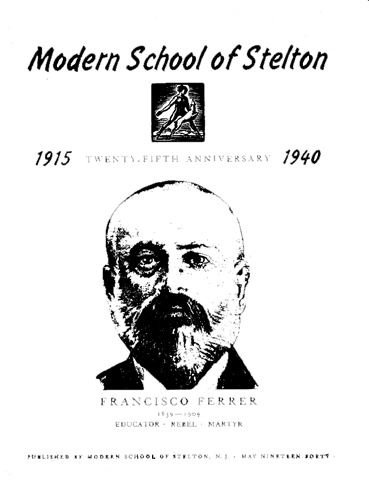
From Modern School of Stelton. 25th Anniversary, New Jersey: Modern School of Stelton, 1940.

MODERN SCHOOL OF STELTON
25th ANNIVERSARY COMMITTEE
Arthur S. Samuels
Chairman
Joseph J. Cohen
Co-Chairman
Harry Kelly
Co-Chairman
Harry Kelly
Treasurer
Abe Grosner
Nicholas Kirtzman
Secretaries
___
Editorial Committee
Leonard D. Abbott
Joseph J. Cohen
Abe Grosner
Harry Kelly |
Executive Committee
Anna Block
Claire Comorau
Simon Farber
Samuel Freedman
Masha Hochman
S. Klonin
Minna Lowensohn
Nat Marer
Elsie Kelly Marer
Dora Pearl
I. Pilat
Sam Rothman |
Henry Alsberg
Sally Axelrod
Roger Baldwin
J. Baskin
Thomas Bell
Dr. S. Berlin
Abe Bluestein
Max Bleustein
Sheindel Bluestein
Yossel Bluestein
Bertha Chasick
Harry and Sonia Clemens
Fannia M. Cohn
Anthony Crivello
Jim and Nellie Dick
Kate and John Edelman
Marc Epstein
Israel Feinberg |
SPONSORS:
Morris Feinstone
Elizabeth and Alexis Ferm
Henry Fruchter
Emma Cohen
Abe Goldman
Mary Hansen
Hutchins Hapgood
Hippolyte Havel
Julius Hochman
D. Isakowitz
Joseph Ishill
M. Jagendorf
Phillip Kapp
Stewart Kerr
Lillian Kisluik
Louis Levy
Eugene Lyons
Ray Forter Miller |
Marc Mratchny
Rose Pesotta
I. Radinowsky
Louis Raymond
M. Ricco
Henry Schnittkind
Anna Schwartz
John Scott
Paul and Polly Scott
Bernard Shane
B. Share
Samuel Shore
Anna Sosnofsky
Sol Vinick
Harry Weinberger
Abe Winokur
Carl Zigrosser |
CONCERT AND REUNION
Ball Room, Hotel Diplomat
108 West 43rd Street, N.Y.C.
FRIDAY, MAY 17, 1940, 8:30 P.M.
* * *
ARTHUR SAMUELS
GREETINGS: ALEXIS FERM, MANUEL KOMROFF RUDOLF ROCKER AND OTHERS
LEONARD D. ABBOTT, CHAIRMAN
* * *
RAY PORTER MILLER, SOPRANO
GDAL SALESKY, CELLIST
GLARA FREEDMAN AND EDITH FRIEDMAN AT THE PIANO
* * *
DANCING AFTER 11:30

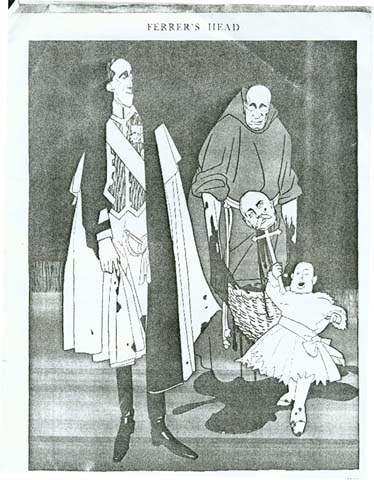
SIRE, THE CROWN PRINCE WILL SOON BECOME A DEVOTED SON OF THE CHURCH: WE MUST TRAIN HIM BEFOREHAND TO PLAY AROUND WITH THE BEST HEADS OF OUR COUNTRY.
Two months almost to the day after the conference in the Rand School, called to discuss and to organize a fitting celebration, we are here with this modest offering to the friends and sympathizers of the Modern School and of the monumental contribution which Ferrer made to progressive, libertarian education.
Possibly our efforts, as embodied in this publication, are not altogether commensurate with the aim we had set for ourselves, nor adequate for such a memorable occasion; but friends will understand-others we will serenely disregard.
Many of us to whom the Ferrer Modern School served as a harbinger of a new day were reluctant, in spite of this epoch of blackouts and carnage, to let the Twenty-Fifth Anniversary of the School in the Ferrer Colony go by unmarked. And although fully aware of the meager means at our disposal and the limited forces in our midst we determined to make an earnest endeavor.
Whatever this is then, in the final result, let it serve as one more token of the indelible impress which Ferrer's life, work and martyrdom made on countless adherents the world over, and which inspired us here to follow, even if but few -if any-ever succeeded in emulating that fountain of energy and idealism which was Ferrer.
If this publication, conceived and born in haste, will serve to reawaken a dormant interest in libertarian education in some, to kindle a spark in others, we shall be gratified in the thought that this attempt was worth making.
Editorial Committee
ABE GROSNER, Secretary
| VERY SAD INDEED IS THE NEWS OF EMMA GOLDMAN'S DEATH, PARTICULARLY AT THIS TIME OF OUR PREPARATIONS FOR FESTIVITIES AND JUST AS WE ARE ABOUT TO GO TO PRESS. UNFORTUNATELY, FOR TECHNICAL REASONS, IT IS IMPOSSIBLE TO DEVOTE PROPER SPACE TO AN ADEQUATE EVALUATION OF THE GREAT PERSONALITY WHO, IN ADDITION TO HER MANY OTHER ACTIVITIES, WAS ONE OF THE FOUNDERS OF THE MODERN SCHOOL. MAY HER SPIRIT AND IN FLUENCE LIVE LONG IN OUR MEMORIES! |
WE ARE GRATEFUL to all our sympathizers and friends who with their contributions have made this publication possible.
May we at the same time urge those who for some reason have not given their contribution, to do so now and thus help us republish this material in a more handy format, in the very near future?
The names of such additional contributors, as well as those contained herein, will appear in the forthcoming edition.
Address communications to Abe Grosner, Secretary, 45 West 17th Street, New York City, N. Y., and make checks payable to Harry Kelly, Treasurer.
The Slain Prophet
By LEONARD D. ABBOTT
FRANCISCO FERRER was the morning star of an aborted Spanish revolution. Everything that has happened in Spain during the last three decades-the long travail toward a juster social order; the expulsion of King Alphonso XIll; the establishment of the Spanish Republic; the counter-Revolution of Francisco Franco-can be related to the fateful October day in 1909 On which Ferrer was slain.
He was born on a farm at the village of Alella, near Barcelona, in 1859. His parents were vine-dressers. Like their neighbors they were orthodox Roman Catholics and believed what their priest (who was probably the only man in Alella able to read) told them. One of the things that he may have told them was that popular education is an evil and that radicals are emissaries of Satan. The boy Francisco at the age of thirteen was without education-a fact which made him sympathetic with others similarly deprived.
He developed into a youth of independent and vigorous character. The Roman Catholic training imposed upon him he rejected. The spirit of religious and political revolt was in his blood.
For a short period he held a position as railroad inspector, but his heart was not in his work. He regarded his occupation simply as a method of providing subsistence while he prepared himself to labor for the realization of an ideal that was dominating his every waking moment. This ideal was the emancipation of Spain from the Roman Catholic and monarchist blight.
In 1879 he proclaimed himself a republican. When Santa-Coloma de Farnès and General Villa Campa made insurrectionary attempts to overthrow the Spanish monarchy and to inaugurate a republic, he allied himself with them. After the failure of these attempts he fled to Paris. There he became secretary to the Spanish republican leader, Ruiz Zorilla.
At this time, under the stress of economic necessity, he discovered his vocation: he decided to be a teacher. His kind heart made him an excellent mentor, a successful educator, an apostle of modern scientific instruction. He soon was a familiar figure in centers of adult education in Paris. In the rooms of the Masonic order, the Grand Orient in the Rue Cadet, he taught every night through 1897. He also gave private lessons in Spanish.
One of Ferrer's pupils was Mlle. Ernestine Meunier, a Frenchwoman who with her mother had inherited three million francs from her father. Mlle. Meunier loved music and the modern languages. She traveled with her mother in Italy and in Spain.
Mlle. Meunier was a Roman Catholic and unsympathetic with radical ideas when she engaged Ferrer as a teacher. But she was a person of independent ideas; she had been strongly influenced by the Dreyfus case: and on the day when she finished Emile Zola's novel, "Truth," she espoused the cause of Dreyfus. Later, as a result of her conversations with Ferrer and of her reading of books, such as Volney's "Ruins of Empires," which Ferrer gave to her, she began to share his enthusiasms. Ferrer was ever a crusader in behalf of ideas that appealed to him. "I cannot conceive of life without propaganda," he said. During this period he met Anatole France, the greatest French writer of his time, and Elisée Reclus, geographer and encyclopedist, and corresponded with Peter Kropotkin and Ernst Haeckel. The instrument by which he hoped to achieve the emancipation of Spain was now education, instead of violent revolution. He had arrived at the conclusion that the employment of violence is useless; that, despite its apparent swiftness, it is the slowest method in the end. He said:
"Time respects only those institutions which time itself has played its part in building up. That which violence wins for us today, another act of violence may wrest from us tomorrow. Those stages of progress are alone durable which have rooted themselves in the mind and conscience of mankind before receiving the final sanction of legislators. The only means of realizing what is good is to teach it by education and propagate it by example." Sixty-eight per cent of the Spanish people were unable to read. Most of the Roman Catholic schools were grossly inadequate both in equipment and in the quality of their teachers. What was needed, Ferrer contended, was a new system of education inspired by faith in the human future rather than in antique religious dogmas. Mlle. Meunier grew into fuller and fuller symypathy with his ideals, and when she died left him a large bequest.
Ferrer went back to Barcelona and founded the Escuela Moderna. In this pioneer educational work he manifested real genius. The first of his schools was opened in 1901. It soon absorbed a number of other schools established in Catalonia and elsewhere; by 1904 forty schools had copied its textbooks. The number of schools finally reached 120. The curriculum of these schools included the following program of subjects and illustrated studies:
The Evolution of Worlds; The Story of the Earth; The Origin of Life; The Evolution of Living Things; The Factors of Organic Evolution: The Origin and Development of Man; Thought; The History of Civilization; Religions; Laws and Morals; Social Organizations; Economic Systems; The Evolution of Technics and Art; The Factors of Social Evolution; Man and the World.
Some of the textbooks used in the Modern Schools were these:
"Man and the Earth," by Elisée Reclus; "Résume of Spanish History," by Nicholas Estévanez; "Compendium of Universal History," by Clemencia Jacquinet; "The Universal Substance," by A. Bloch and Paraf Javal; "Superorganic Evolution," by Enrique Lluria; "Physical Geography," by Odon de Buen; "Mineralogy," by Odon de Buen; "First Stages of Humanity," by Georges Engerrand; "Ethnical Psychology", by Charles Letourneau: "A Free World," by Jean Grave; "Misery, Its Cause and Cure," by Leon Martin; "The Banquet of Life," by Anselmo Lorenzo; "War," by Charles Malato.
From the first the Roman Catholics were bitterly hostile to the Modern Schools. They looked for an opportunity to suppress them and in 1906 their opportunity came. Mateo Morral, who had been connected with the schools, threw a bomb at the King and Queen of Spain on their wedding day. Ferrer was charged with complicity in the act, and held in prison for a year. But nothing could be proved against him.
The second opportunity of the clericals came in July 1909 when the Spanish government was preparing a new raid on the Riff district in Morocco. Mobilization orders called out reservists consisting of working men and poor peasants, many of whom refused to be shipped to Africa. Popular indignation culminated in anticlerical demonstrations and in a general strike in Barcelona and in other cities. The industrial life of Catalonia suddenly came to a standstill.
The authorities after a few days succeeded in quelling the uprising. Thousands of persons-men, women and children-were arrested. Among the prisoners were the most prominent labor leaders and many veterans of the revolutionary movement, including Francisco Ferrer.
It was the Archbishop of Barcelona who, in a statement signed by himself and other prelates of the church, first denounced Ferrer and demanded his life. Ferrer was charged with having been the head and chief of the Barcelona uprising. His trial attracted attention throughout the world by reason of the obvious bias displayed.
Imagine a man trapped in the midst of his enemies; confronted with the testimony of a multitude of soldiers, spies, and weak-kneed radicals who had turned "state's evidence"; undefended except by an army captain (Galceran) whom he had been compelled to choose. This was the plight of Ferrer.
Every influence was hostile to him. The presiding officers who constituted his judge and jury were military men who had themselves taken a leading part in suppressing the people's antimilitarist revolt in July. No less than sixty witnesses had been persuaded or bribed to testify against him. Not a single witness was heard on Ferrer's side.
We now know positively that Ferrer was not the head or the chief of the Barcelona uprising. We know it from his own statements, from the statements of his friends, and-most important of all-from the statements of the men who actually planned and led the July revolt, so far as it had any plan or leading.
The witnesses were not heard in court. Their depositions were read. This in itself was a grave injustice and, it should be added, a grave violation of Spanish law. The Spanish government must have been conscious of irregularity, for it allowed false reports to be sent to the newspapers conveying the idea that the witnesses had actually been heard.
Ferrer was questioned concerning two violent incendiary circulars alleged to have been found during a search of his house. He disclaimed knowledge of these. The circulars were in fact "found" by the police during a search when competent witnesses-witnesses required by law-were not present.
Captain Galceran made a heroic effort to save Ferrer's life. He showed that Ferrer's ruin was sought by the corrupt interests menaced by the Modern Schools. He had encountered, he said, in the preparation of his case so much fraud and "vile passion" in a single week that he was overwhelmed.
Ferrer contented himself, in his final speech before the court, with a quiet protestation of innocence. He said:
"With the consent of the presiding officer, let me ask the court to judge me only upon the facts connected with the events of the last week of July or of the days immediately preceding, during which certain persons incited or prepared the general strike of July 26. If this is done, you must find me innocent, for I had no part whatever in the inciting of that event.
"Let me say also that it would be wholly unjust to condemn me today for my political opinions or utterances during the last twenty years of the nineteenth century, for none of which have I ever been reproached or called to account. Nor should my work during the present century in connection with the Modern School be brought up against me; for the publications of that school are either translations of classic authors, whose names are accepted and glorious, or else the work of modern authors of worldwide reputation, of acknowledged wisdom, of humane sentiments. Let me close by affirming that those who criticize the works published by the Modern School either have not read them or else, as the result of the prejudice which they entertain, are incapable of judging them."
A few hours later the sentence of death was decreed.
So the hideous drama was enacted. So this brave man went to his doom. Francisco Ferrer, the founder of the Modern Schools, was condemned before he was tried.
Madame Soledad Villafranca, Ferrer's companion during his later years, was a beautiful and intelligent woman She appears with him in a group photograph showing the delegates to an International Freethought Congress held in Brussels. After his death she attended an immense demonstration in Brussels at which a memorial slab let into the pavement of the historic Maison du Roi was unveiled, bearing a suitable inscription.
In 1911 a symbolic statue in commemoration of Ferrer, showing a nude male figure upholding a torch, was erected in Brussels. This statue was removed by the Germans at the time of their invasion of Belgium in 1915, but was restored after the war and now stands on its original pedestal in the Place de Saint Catherine.
Ferrer's property, at first confiscated by the Spanish government, was later restored to his heirs. This act was an official acknowledgment of the government's failure to prove its charge that he had been "chief of a military rebellion."
Precursors of Ferrer in Spain
By RUDOLF ROCKER
THE execution of Francisco Ferrer by the Spanish government in October 1909 not only released a storm of public protest all the world over, but also led to numerous experiments in free education in various countries in Europe and South and North America of which the Stelton School is one of the oldest. Ferrer's ideas of a free and rational education of youth and the success of his work in his native country are fairly well known to the liberal world. Not so the fact that attempts in his direction had been made quite frequently in Spain and occupied the minds of many of the best brains in the social movement in that country.
Right from the beginning, when socialist ideas penetrated from France into the Iberian peninsula, the question of a free education became one of the main problems for the Spanish socialists. There were several reasons for that; in a country where every attempt to educate the people had been stifled for centuries by the Church and the reactionary powers, that problem had a greater importance than in any other country in Europe.
But there is still another reason: Among the great pioneers of European socialism there were only two who had a great and lasting influence upon the social movement in Spain-Charles Fourier and P. J. Proudhon. The first socialist paper in Spain, La Atraccion, published in 1846 in Madrid by the well-known socialist writer and historian Fernando Garrido, propagated the ideas of the great French social philosopher Fourier, and it was precisely Fourier who had developed quite a new way of education which is one of the cornerstones of his whole social system.
Among the followers of Garrido in Madrid there was a young and very intelligent enthusiast, Antonio Ignacio Ververa, who was much impressed by the theories of the celebrated French philosopher, and especially by his brilliant views on education. To Fourier education was not a system of training to achieve a certain uniformity of the human mind, but a method to strengthen the natural inclinations of the individual and to facilitate the development of his inborn abilities.
Cervera, who was a great admirer of Pestalozzi, combined the teachings of the great Swiss pedagogue with the socialist conceptions of Fourier, and developed his ideas about free education in his paper El Trabajador and other publications of the time. With money collected among his friends Cervera founded in 1847 the first free school in Madrid. He started with a class for workers in the evening hours hoping that by this he would be able to procure the necessary means for a children's school. But the beginning was not encouraging. Weeks passed by, and the only pupil of Cervera's school was a middle-aged worker, a mason, who seemed to be interested in the work of the young teacher. But Cervera did not become discouraged, and noticing the sincerity of his pupil and his eagerness to acquire some knowledge in the few hours left to him, he treated him with all the courtesy and patience he possessed. After a few months his pupil brought some of his comrades. and by and by the school embraced about fifty pupils.
Under the influence of the revolutionary events in France in February 1848 a new wave of liberal ideas swept over Spain and strengthened the spirit of the progressive elements. Now Cervera's school became a social institution in Madrid. It had more than 500 pupils and was divided into classes for children and adults. The reactionaries became alarmed by Cervera's success, and the clerical press denounced him as an "enemy of the state" and his school as "a conspiracy against the Church and the monarchy,"
By the end of 1849 the government arrested Cervera, confiscated his property and closed his school. When a few liberal deputies in the Cortes protested against the illegal procedure of the government and praised Cervera's educational experiment as an attempt to enlighten the Spanish people, the Prime Minister Bravo Murillo made the cynical reply: "Thinking is not the business of the people. What we need in Spain is beasts of burden."
While in Madrid the nucleus of the first socialist movement consisted mainly of intellectuals, the pioneers in Catalonia found a much larger field for their activities in the labor unions which existed there since 1840. The members of these unions readily accepted the new ideas of socialism and have remained ever since the backbone of the libertarian movement in Spain.
Quite a number of the first socialists in Catalonia occupied themselves with the practical methods of a new education. One of the outstanding militants of the movement in Catalonia, Abdon de Terradas, organized in 1847 the first free school in Barcelona. As in Madrid, the school in Barcelona had special classes for children and evening courses for the workers. After several months it counted over 600 pupils, and new schools were founded in seven other towns in Catalonia. The means to keep up these institutions came mainly from labor organizations. The methods of teaching were on the same line as those of Cervera's school in Madrid. These first free schools in Catalonia existed for a number of years in spite of the continual attacks of the reactionary press. But after the great general strike in 1855 for the right of coalition, and the bloody suppression of the labor unions by General Zapata all these institutions were destroyed.
But every time that the political conditions permitted the workers to build up their organizations again, new attempts for a free education were made. At the time of the First International, which had more followers in Spain than in any other country, 50 to 60 of these institutions were in existence. At the congress of the Spanish Federation of the International in Zaragoza (1872) the scientist Trinidad Soriano developed in a masterly speech the elements of a free education. His plan was unanimously adopted by the delegates, and had very much in common with the methods which Ferrer employed in his Modern School many years later.
As we can see, Ferrer was by no means the initiator of these ideas, but only one of their most successful exponents on Spanish soil, and he had to pay with his life for his aspirations, as so many others before him.
The Great Heritage
By HIPPOLYTE HAVEL
IN joining the great line of martyrs for freedom Francisco Ferrer y Guardia left us a great heritage: the ideal of the Modern School.
The shots before the fortress of Montjuich in Barcelona ended the life of an individual, but gave life to education through self-development. Inspired by the work of the Spanish martyr some comrades to the idea in New York organized the Francisco Ferrer Association: the result was the Modern School in Stelton, celebrating this month the twenty-fifth year of its existence.
Twenty-five years of heartrending struggle to keep the school alive ... and so very few realize the importance of the institution. We hear nowadays many effusions about democracy . . . the only path toward democracy is the education of the child through selfdevelopment as practiced in the Modern School. Many of us are only too eager to criticize some phases in the development of the School, but taking the general situation in consideration we find how picayune our objections and criticisms prove to be.
Observing the children of the Modern School at play and at work we notice only the true path toward freedom: development of free individuals through self-expression.
The great forerunners and pathfinders in libertarian education, a Rousseau, a Tolstoi, a Froebel, a Montessori, a Pestalozzi, great nonconformists like Whitman and Thoreau . . . all would feel themselves at home in the Modern School. They would rejoice in observing the children in activity at play and at work.
And no less a person than the grandson of two presidents of the United States has left us a remarkable testament on education: "The Education of Henry Adams."
Declaring that education has never been stated and cannot be stated in terms of dollars and cents, Adams declares:
"A teacher must either treat education as a catalogue, a record, a romance, or as an evolution; whether he affirms or denies evolution he falls into the burning fagots of the pit. He makes of his scholars either priests or atheists, plutocrats or socialists, judges or anarchists, almost in spite of himself. The chief wonder of education is that it does not ruin everybody concerned in it, teachers and taught."
The Modern School did not fall into such a pit. Free development through self-expression is the goal and no free society is possible without free individuals.
The Modern School is in need of a greater support from individuals and organizations striving for a free society. It is kept alive through sacrifice on the part of the Principal and Teaching Staff and the comrades of the Board of Management. In neglecting to support the school libertarians commit a great error and a great crime against their own ideals.
A Pioneer School
By CARL ZIGROSSER
SOME thirty years ago a group of enlightened people, convinced that perhaps the best way to make the world a better place to live in was to start with children, banded together and founded the Ferrer Modern School. They took their cue from the ideals of the Spanish martyr, Francisco Ferrer, who summarized his principles as follows: "The whole value of education consists in respect for the physical, intellectual, and moral faculties of the child. As in science, the only possible demonstration is demonstration by facts; education is not worthy of the name unless it be stripped of all dogmatism, and unless it leaves to the child the direction of its powers and is content to support them in their manifestations." The Modern School thus was a pioneer in free experimental education in New York along with the Walden School and the City and Country School. The Modern School eventually moved to Stelton, N. J., and in spite of many handicaps has carried on under the able leadership of Alexis and Elizabeth Byrne Ferm. Indeed without the unselfish devotion of these two teachers the school would never be where it is today. Thirty years ago there was need of a Modern School; today the need is infinitely greater. If Modern Schools had sprung up in great quantities in all countries, the world would not be the sorry place it is today.
The Stelton School and Liberty
By HARRY WEINBERGER of the New York Bar
A QUARTER of a century is a long time in the life of nations, institutions or individuals.
The Stelton Modern School has stood for the ideal of liberty during a quarter of a century, and faces the next quarter of a century with courage undimmed and an abiding faith that in liberty there is strength and in freedom mankind can still be happy, contented and find the solution of its economic problems.
A people who are an-hungered cannot stay free. Occasional brave souls may starve and struggle to the end, to maintain liberty and democracy. Large groups may fight while starving and die in the struggle. For an entire nation, unemployment and starvation, however, will lead that nation inevitably to accept dictatorship in preference to hunger; whether that dictatorship is in the form of Fascism, of Nazism or Communism. Life even with all economic questions solved, if without liberty, would be like a rope of sand which perishes in the twisting.
There can be no overproduction; there can only be underconsumption. Today we have wonderful machinery making too much clothing and the other necessities of life so that millions are without jobs and therefore cannot buy. We have agriculture that produces abundant crops of wheat and corn and fruits and vegetables, yet millions who are unemployed go hungry because their purchasing power is gone. We have the capacity to build hundreds of thousands of homes, but the building of these houses would bring additional taxes, so they are not built. We allow land to remain idle; we allow the unearned increment of land created by the community to be taken by individuals instead of the community. Only students trained in freedom will change all that and will break down and pull down national high tariff walls, so that other nations may do likewise. Then trade and goods may flow through the world again and nations will cease to fear that they cannot get raw materials for their people to eat or manufacture. Tariff walls cause nations to prepare for war. This preparation for war entails a burden that is like the Old Man of the Sea whom Sinbad carried almost to the point of his destruction.
Economic liberty or proper distribution of wealth and the proper forms of taxation have nothing to do with the question of liberty. They have only to do with economics. But only a free people with liberty of speech can change economic conditions in order to bring about the welfare of all the people.
The Stelton Modern School stands against regimentation of the people under any guise or pretext. Some men in a hurry to save the world before nightfall would dispense with all liberty.
The School has always stood against the despotism of government or men. Its teachers have never been afraid of paper bullets containing ideas; never afraid of verbal shot containing controversial ammunition.
It is no disgrace nor dishonor to fail in the conflict for justice and liberty. It is only a disgrace and dishonor not to enter the arena and give battle. Democracy with all its faults is the sole hope of a world seeking a possible peaceful solution of economic problems. If despotism conquers, it will mold the world for a long time in unchangeable form; it will build on the masses for the benefit of the few.
So I salute the Stelton Modern School which continues to stand for freedom in education, freedom in life, as a fine beacon light in a dark world.
A Remembrance
By B. LIBER
EARLY in the morning of the day when the Ferrer School opened in New York I was at its door with my five-year- old boy. We were the only ones present. It was too early and we had to wait. After a short while another person, who was impatient to see the school function, arrived. It was the youthful, enthusiastic Leonard Abbott. He was all smiles. He joked with the child until the teacher came. I still remember his first words: "Great, isn't it?"
I had spoken before and after the opening of the School, to the audiences of the Ferrer Association. I wrote for its little magazine when it was multigraphed, and later in its printed form. My articles and courses were all on the relationship between parents and children, between adults in general and children, and about Modern School education. The talks and writings formed later the seeds of my book, "The Child and the Home," which has been published in subsequent years and, after three or four American editions, has been translated into several languages. It is now out of print. I had been a school teacher before I became a physician. But not being engaged as a regular instructor of the Ferrer School, I was asked to speak to its older pupils on anatomy, physiology, health, sex. Although this series of lectures was rather short because of the removal of the School to Stelton, I enjoyed greatly this contact with the children.
These remembrances, stirring up many details, many dreams that I still cherish, ideals and principles to which I have not ceased to be faithful, move me deeply, although I feel that practical activities must now be adjusted to present conditions.
Libertarian Education
By PRYNS HOPKINS, M.A., PH.D.
LIBERTARIAN education I define as a schooling which respects the freedom of a child to do as he likes short of imperiling the equal freedom of others or his own safety. If we love the child, we wish him to be happy, and as the free are happier than the unfree, the burden of proof is on those who oppose libertarian education.
The first line such opponents will take is to claim that free children may be happy for the moment, but their enjoyment is bought at the cost of acquiring those skills, painfully learnt, which they will need in after life to keep well, discover the truth, earn a living, successfully marry and raise families of their own. And insofar as failure does not make the chances of happiness more remote, those are right who insist that these acquirements receive some attention. Unfortunately for the argument, recent experiments on animals and children as to what conditions are most favourable for stamping in habits and memories show that we have hitherto greatly overestimated the benefit of mere repetition when it is not accompanied by pleasant associations.
Many of the opponents of libertarian education are biased, I think, by a point of view which is religious rather than scientific. There is belief in a "law of compensation" in the universe, by which all enjoyment must be paid for by subsequent retribution, so that a happy childhood results in flabby personality and a consequently unsuccessful life; conversely, to be much under the parental rod in childhood developes "character" and opens the road to industrial captaincy or to the White House As theology, I cannot praise this view too highly; but it has little relation to any facts and as pedagogy it is vicious.
Another class of the opponents of free education methods are, however, the opposite of religious. They are the ultra "practical" people whose outlook is cynical of all values except the obviously utilitarian. To see children dabbling in a dozen arts and learning to classify butterflies before they can do simple accounting seems to them to evince a wrong perspective on life, a dangerous "Idealism."
These people argue as though the problem of enabling our children to either enjoy happiness or give it to others would be solved if we could enable them to become rich! To anyone who has known intimately many rich persons and their frustrations, the idea is grotesquely amusing. Yet I find that many socialists and communists have not thought their way through it. It is a reaction against the theological view that "wordly" concerns do not matter; but an extreme cannot be bettered by swinging to such an opposite.
Given we are freed from worry about our human relationships and our bare comforts, much the most important thing we then need is to become so interested in furthering an external purpose that the small annoyances of life don't matter. If we can get our child keen on the game of making actual whatever potentialities for humanistic usefulness can be found in any situation he finds himself in, we shall have provided him with a source of enjoyment. We shall have blessed him also with a means of distraction from the troubles life is sure to bring and with a purpose which can hardly be frustrated by any sort of outside events (as, for example, the desire to achieve a certain political end might be frustrated by the victory of the opposed party) .
But, you will ask, does not this view of the requisites for happiness close whatever case for libertarian education might have been made out, by prescribing an ideal that must be instilled?
On the contrary; every attempt to impose ideals on our children has defeated itself by imposing only a formula and letting the ideal escape. If the view I have expressed is a true one, it will be accepted by a child when he has had the requisite amount of experience and has developed sufficiently in judgment. The greatest enemy of these values is dogmatism. The greatest aid to them is fullness of life. We cannot pour experience into children. Therefore the most- and the least -we can do is to provide a rich environment in which they can experiment and from among the aspects of which their crude energies will find opportunities for sublimation; this, and to interfere very little unless they might injure themselves or others. Thus spontaneously experimenting and acting in the midst of people who are ready with help but do not too much proffer it and who do not push forward their philosophy unless their conduct has provoked an interest in it, a child ripens best.
Some people complain that such a conception of education leaves out the important elements of sacrifice and discipline, which, they point out, are demanded by the adult world. The objection is largely a rationalization of the objector's own indiscipline and unwillingness to sacrifice himself. Ask him whether he will start to-day to submit himself to, say, a course of physical culture which you, not he, shall prescribe as good for him; or whether he will sacrifice a part of his income for a cause he has never been interested in but which you, being wiser than he, know to be more worthy than what he spends his money on now! When the young person conceives an ambition he can be quite Spartan in training towards it. When he admires or loves, he can sacrifice generously. Meantime, instead of preaching to him that cigarettes are bad for him let us stop smoking; instead of homilies on lying, let us be utterly frank with him; instead of worrying over his respect for our property, let us respect his, etc.
The greatest positive advantage of libertarian education remains yet to be mentioned. I will introduce the subject in this way; researches which have been made into the careers of graduates show that while undergraduate success is somewhat promising for a student's subsequent record, it is not the most important factor. More so, considerably, is his personality index. Students with brilliant records or who were regarded by classmates as having an all-around ability that would ensure success, but who were badly integrated, tended to break down under the complex strain of life afterward or at best to do less well than less promising students who were nervously more stable. Now, the analysis of great numbers of neurotic persons in recent years has shown that the trouble always started in in fancy and was generally due to unhappy relationship between the parents or to their excessive disturbance of the natural development of the child.
Against mistakes that go on in the home, a school can with difficulty fight. But it can refrain from further aggravating antagonisms which have been begotten against persons or interests or their symbolic surrogates and may even help pupils to find suitable expression for pent up emotions.
Contrarily to the insinuations in loose talk about children whose school life is delightful being ill prepared to take the hard knocks which the world will give them afterward, they are found to be prepared better than others. Being on the average (when home conditions are the same) less frustrated internally than the pupil from the antiquated type of institution, the one from a modern school can bear external frustrations with less anxiety. Having exercised his mind more freely, he also is nearer to a mature wisdom which will enable him to extract, even from unpleasant situations and via suffering, their potential values. He will therefore be a more valuable citizen and a happier man.
In and Around Stelton
(ODD RECOLLECTIONS)
By JOSEPH J. COHEN
BOOMP-BOOM! The old well-drilling rig kept on pounding for the third consecutive day, burying the heavy drill deeper and deeper in the ground all the time.
I sit near by and watch the operation with interest and apprehension: here we are going to get our supply of pure, wholesome water, so essential for our well-being! but where will we get the money to pay for the work? Every stroke or two means another dollar added to the bill, and the dollars in our treasury are so few that they will never pay for this job if the drilling keeps up much longer.
And suddenly, what a relief! The pending ceased, the water gushed up to near the surface. We have a supply of 26 gallons per minute, all that we will need for a number of years, and the depth is only 84 feet. The bill amounts to $118.00, which we may be able to scrape together somehow.
In the great excitement I offer the man one hundred dollars, if he will call it square; and he, poor devil, accustomed to collect for his work in driblets over a period of years, gets even more excited than I am. We close the deal right then and there, and go home happy, delighted each one of us at the ignorance of the other-a bargain that pleased both makers!
The water, plenty of it, is there in the well. The problem now is to get it to flow into the prospective houses that are going to be built within a radius of half a mile around.
After interviewing and consulting half a dozen salesmen and engineers of various construction companies we decide to tackle the job ourselves.
We order the material, tower, tank, pump, and engine, from a reliable concern and wait for the approval of their Credit department for the shipment of the goods on the mere promise of payment in time to come.
A letter reaches us at the New York address of the Ferrer School asking information about the Ferrer Colony, and on our favorable recommendation of ourselves the credit is granted and the material delivered without any further complications.
The tower and tank were erected by one young man single-handed without ever calling for any assistance from anyone.
How he managed to do it single-handed puzzled all of us a long time, and the lightness of the tower frame called forth considerable criticism from the pessimists in the community.
Wait! they kept on warning us, until you will fill the tank with 5,000 gallons of water. The weight of it will twist the tower out of shape and the first strong wind will topple it to the ground!
There it is now, 25 years later, as erect and as solid as on the first day when it was put up. The pessimists are still shaking their head, but the water plant does not seem to be affected by it the least little bit.
A visitor in one of those early spring days of 1915 came in a decent automobile-not nearly as common then as now. The occupant, a gentleman of past middle age, introduced himself as a neighbor, an agriculturist from Rutgers College. He wanted to know something about our plans and intentions. Why did we select this poor, neglected farm? How did we expect to raise anything on soil that has no humus on it?
There he had me baffled. "Humus", what kind of a thing is that? In the shops where I worked, at the radical meetings which I attended, and in the various literary creations that I have read, I never met this particular term. What can be the meaning of it?
I tried to cover my ignorance by changing the subject, but deep in my heart I felt that all is not well with our new location. We selected a homesite without knowing anything about the requirements of soil, drainage, shade, bathing facilities and all the other things that make life in the country attractive and pleasant.
Of a sudden my interlocutor asked: Tell me, how is it possible for society to get along without a government?
The question was altogether unexpected. The best that I could answer on the spur of the moment was: When you will tell me how to put humus in this soil and raise good crops, I will explain to you how society can get along without government!
He seemed to like the answer and the bargain was tacitly made. Neither of us has been very successful in the first 25 years: the soil at Stelton is still deficient of humus, though I have learned a good deal about it in the interval, and the old Professor of Agriculture, if he is among the living, has still got his doubts about the possibility of mankind getting along without a government.
We are all of slow to learn new tricks and still slower to change abstract concepts that we have inscribed in our youth.
The surveyor who laid out the acre plots on our farm, Mr. Josiah Tice, was a very interesting man. He was far advanced in age when we came to ask for his services and knew every span of ground in a radius of 50 miles around New Brunswick.
Tall, broad shouldered, with a long, well-kept beard and highly intelligent face, he was a real patriarch in appearance and a gentleman in behavior. He did his work in his own way and would not be rushed by anything or anybody.
"What do you care," he used to say to me, "how and when I do my work? It won't cost you anything extra. Whenever you need a definite plot come and tell me. I'll have the boys stake it out for you!"
His advanced age kept him from doing any actual field work. He used to stay behind and discuss all kinds of things with me while his boys would do the measuring and staking out of the plots.
I learned to respect and love the old man, whose views on life and approach to practical questions were so close to my own, although he would most likely have been horrified if anybody had told him that he acted like an Anarchist.
In all his long active life he never sued anyone, had never come in contact with government as such. "If a man can afford to cheat me," he used to say, "I can afford to be cheated! Judges and sheriffs are not the ones to protect me. They are all bought and sold, and I will be the last one to besmirch my hands in dealing with them!"
He never had a shingle on his door, no announcement of any kind about his profession. His work and reputation spoke louder than all artificial displays.
A truly deserving man, honored and loved by all who knew him!
Mr. Brynn, manager of the Freeman Lumber yard at Metuchen, was another interesting person with whom we had dealings in those days. There was hardly a house in and around Metuchen that did not owe the Freeman Lumber yard money for building material or coal. Many of the accounts were years overdue, and poor Mr. Brynn, tall, gaunt and emaciated by consumption, had a job to cross over the street to the other side every time he met one of his bad accounts in order not to embarrass the fellow. His appeals to the debtors in the local press, appearing regularly once or twice every year, would bring some results, but the sailing became harder from year to year and drove the kind-hearted managers, as well as the unusual owner, to despair. But the universal extension of credit was not curtailed. The gates of the Freeman Lumber yard were wide open to any and all who needed material to build a house or fuel to keep it warm in the winter.
The owner, Mr. Freeman, was a physician by training, but he did not practice his profession when we came to know him. He liked his drinks and hated the gossip of his neighbors. In the dingy office of his lumber yard he felt more secure and free than by mingling with people and attending to their ailments.
We used to spend hours together talking about all kinds of things. He seldom complained about his bad debtors-took them for granted, and pointed out houses that changed hands several times since they were built, while the bill for the lumber remained unpaid.
In answer to my question as to what made him adopt this unlimited credit method he told me the following interesting story:
His father, Pete Freeman, came over from Ireland half a century ago. He settled in Metuchen, a very small village at that time, and earned his living as a laborer, helping the neighbors with the work they couldn't or wouldn't do themselves. Then came hard times when people couldn't afford to hire and help. The Freeman family was hard put to keep the wolf away from the door.
One day Pete Freeman was sauntering idly in the street of the village, hoping that somebody would offer him employment. He found himself in front of an oyster saloon which attracted his attention and aroused his desire for the delicacy. Without stopping to consider what he was doing, he walked in and ordered a plate of oysters, reminding himself too late that he had not a cent in his pocket to pay for the extravagant pleasure.
The owner of the place, also an Irishman not too long in this country, brought over the order and sat down to gossip a while. He wanted to know how Pete was getting along, to which Mr. Freeman replied, that if he could only lay his hands on $200 he would be all set in this world.
What would you do with the money, if you had it, the other man asked? And the answer was: I would open a lumber yard.
The owner continued to talk for a while, then he went back of his counter and returned to the astonished Mr. Freeman with $200 cash in his hand.
Here, Pete, he said, is the money. Go and open your lumber yard!
Mr. Freeman paid for the oysters out of the money he borrowed from the owner of the place and did open a lumber yard which put him on his feet and enabled him to send his son to college.
No needy person was ever since refused credit in the Freeman Lumber Yard and not too many have misused the generosity of the owners.
Not all of our neighbors, however, were considerate and humane. Mr. Johnson, the tycoon of New Brunswick, swooped down on our community accompanied by a whole troop of mounted cut-throats armed to the teeth. The red flag on top of the water tank, 60 feet up in the air, displayed on the occasion of the flight of Kaiser Wilhelm from Germany, brought down on us the ire of the super-patriots who were filling their pockets with the unlimited profits of the war business. There was only one man home in the community at the time, the rest being all at work in the city. When that one man refused to take down the red flag, the great heroes surrounded the tower and sent up one of their men to bring down the threatening emblem of revolution and universal brotherhood. Proudly they carried off with them the symbol, leaving the spirit untouched, if not strengthened by their brutal display of power.
Brutality was the order of the day by that time. Mitchell Palmer, the prototype of Fascist dictatorial oppression, let loose an army of spies, provocateurs and secret agents, to break up meetings of radicals, to arrest and deport every alien who did not display a 100% American patriotism. They did not overlook Stelton, naturally.
The first investigating agent was an elderly gentleman, who was quite decent in his questions, but his report, it seemed, did not please his chiefs. Two youngish men were sent a couple of weeks later. They came to the house and spent more than an hour with me discussing all phases of our activity in the school and community.
They pretended to be pleased with my explanations and offered me the shady compliment of saying: "If all Anarchists were like you, we would not have any objection to them. But why do Anarchists throw bombs?"
That stirred me up and I said: "You, representatives of government, have the nerve to object to the very rare occasions when an individual anarchist throws a bomb while your government is using dynamite and nitroglycerine by the trainload, killing and maiming people by the thousands every day!"
No, they could not see the similarity, of course. What the government and its army are doing is legal, has been done at all times by all people, and so on and so forth.
They were getting ready to go. Taking their leave one of them asked me, "What about free love?"
"What about it?" I retorted. "Between ourselves, as man to man, do you secure a license every time you become intimate with a woman?"
They blushed, both of them, and left me in peace without any further ado.
That did not settle the matter either. Mr. Stone, the U. S. District Attorney for the Eastern District, who conducted all the raids on the radicals in New York and vicinity, did me the honor of questioning me in my own house. He was accompanied by two secret service men and spent four hours with me, getting into heated discussion on every point, and reminding me every time arguments failed him that he is questioning me in his official capacity, as one would say, You'd better be careful what you say, I don't have to argue with you unless I want to get you in a corner!
I insisted that the red-busting activities of the U. S. Department of Justice, particularly the deportations, were, from the point of view of American law, illegal and simply criminal actions committed by officers appointed to observe and enforce the law, a new kind of witch hunting which we thought we had done away with a hundred years ago.
I supported my contention by pointing out the incontestable fact that none of those destined to be deported had committed a crime or any overt act against the laws of the country. Could any of them be proven to have committed a crime he would not be deported but tried and sentenced to some punishment. "The fact that you deport them without a trial." I said, "shows that they had not done any wrong. You persecute them on account of the opinions they hold, you punish them for the things they believe in, although they have not done any harm to anyone!"
Mr. Stone got hot under the collar. The only defence he could put up was the sham contention that the deportees are not at all punished. They are merely being sent back to the countries they originally belonged to. "We don't want you, foreigners, to tell us how to run our government!" was his strongest argument.
But when I asked him, who are the "We" that don't want it, and who gave them the right to say that this is their country and their government to the exclusion of those who landed here a few years, or even a few generations for that matter, later, his only answer was, "Now, Mr. Cohen, I am questioning you in my official capacity. Be careful what you say."
To such an argument my answer was: "In your official capacity I realize you can do what you please. You can take me to the Federal Building in New York or to Ellis Island and break up my family as you did with hundreds of others, but that will not make you right, neither will it make your actions legal and defensible."
That would start him off again to try and argue the thing out, make me see his point of view and the righteousness of his actions.
The comrades in New York succeeded in getting a copy of his report on the visit to Stelton that he sent to the Department of Justice. In it he recommended that all the inhabitants of the colony be taken to Ellis Island for examination and deportation. What saved us was the fact that we were all property owners, tied up with all kinds of obligations and entanglements. Even Mitchell Palmer did not have the nerve to uproot a whole community of people against whom there was nothing but their belief that could be objected to.
Some Personal Reminiscences
By PAUL SCOTT
THE thought of working with children had never entered my mind previous to the Modern School Convention of 1920.
That was my first contact with the School in any way, and my first immpression was not of the educational work of the School itself, but of the men and women who were making it possible for the work to be done-a group of voluntary workers seeking new roads to a new freedom in education.
In my memory I can still see that first session of the Convention. The crowded auditorium was vibrant with life, and in all that throng perhaps I was the only one who was impelled by no more than idle curiosity to see what was going on, and anticipating only a boring day to satisfy a whim of Polly's. Yet the atmosphere was so electric, the proceedings so earnest, the spirit of unity so profound, that 1 was soon saying, to myself, "here are workers who know what they want and are determined to get it through their own efforts. Surely this is not just another school. Only something worth while could evoke such enthusiasm." And so I remained andlistened and learned and received inspiration,-at this prelude to five years of activity which I shall always regard as the most important period of my life; important because it meant so much to my own growth and because that growth progressed along with others, children and adults, engaged in the great adventure of living.
I can still see the benign countenance of good Doctor Andrews as he sat listening to Harry Kelly outline a "New Deal" for the Modern School; how Harry had induced two educators to take over the Living House and was sure that the hypnotic influence of Joseph Cohen would soon induce them further to take complete charge of the School. "The Ferms" were just names to me then, and meant no more than any other names of people unknown to me. Then the discussion by others, some with such strange sounding names as Pogrebitsky, Popugilo.. Stechbart, Winokur, and by Mary Krimont, Bernard Shane, Leonard Abbott, Minna Lowensohn, S. Farber, Bella Vinick, Lillian Goldblatt, and many others-all enthusiastic for the "New Deal" and determined to put it over.
Nothing ever inspired me more than to behold working men and women endeavoring to do something for themselves without benefit of clergy, politicians, or any other leaning post; so, when a question arose pertaining to the printing of the school magazine, I suggested, in my innocence, that there were three or four printers in the community and perhaps we could get together and do the work without expense to the school. It seemed that acting chairman Cohen was just waiting for some such naive commitment, and, before I realized what was happening I was appointed a committee of one to get the work under way.
None of the other printers seemed inclined to help with the work, yet the undertaking could not be ignored-the convention having adjourned and the delegates having gone home with expectations of results; so 1 went in search of printing material which I understood was somewhere in the Colony, finding it finally in Wally's chicken house-the most godawful assortment of mixed fonts any, printer was ever confronted with. The type cases had been used as a breeding place by mice, and wasps, spiders, mud-daubers had contributed liberally of their industry, in addition to accumulated dust and dirt from the nearby road. However, this material was carted to the school building and dumped indiscriminately on the porch, type of all sizes from six to 48 point.
Much to my surprise, the children volunteered to straighten the mess if I'd show them how printers would do it. So we got together some printers' sticks and after I had explained a few technical matters, some twenty children, boys and girls, were soon wading enthusiastically through dirt and dust, each in quest of his chosen size and font of type, expressing amazement that a type case contained so many characters other than the letters of the alphabet, such as punctuation marks, logotypes, reference marks, etc. This discovery seemed to add spice to the adventure, for questions were many and comments were pithy as they inquired about the use of diphthongs, semi-colons, etc., many of the youngsters having never been exposed to formal academics.
Comrade Schneider arrived from Detroit about this time and volunteered to build some stands low enough to be reached by the children, and so after an industrious week the mess was straightened out, the type washed and disinfected, and the youngsters were gratified for having resurrected an orderly printshop - minus a press. This had involved a prodigious amount of work, for not only had each size and kind of type been separated from all the rest, but all the a's, b's, c's, etc., had to be assembled separately and placed in their proper compartments in the case.
Having told the children of my difficulty in inducing others to print the magazine, they suggested doing it themselves if I'd show them how; and with many misgivings on my part the job was under way.
Most of the children were unable to read script, and some knew nothing of even printed words. Equipped with neither the printer's technic, nor the knowledge of spelling, capitalization, punctuation, sentence structure-we were certainly starting "from scratch". Everybody was confident except myself.
The youngsters persevered valiantly for three or four days, after which they began to show signs of boredom. I realized something was lacking, but I did not know what to do about it. Children could not be expected to sustain interest in setting up words and sentences they could not understand, in fact they expressed the conviction that such long words had no meaning and made no sense. One of the boys finally suggested that we scrap the idea of a magazine written by adults and proceed to get out a magazine that made sense-stories made up and printed by themselves. This suggestion met with unanimous and vociferous acclaim; so was born the Voice of the Children, perhaps the only magazine ever attempted by children most of whom could not themselves read or write. With the birth of the Voice of the Children, Paul Scott was himself reborn.
I found so much joy in working with these spontaneous, creative youngsters that I could not break away and return to my printing job, and so began an adventure that lasted five short years, which I shall ever regard as the most satisfactory period of my life. These years can not be recalled to memory without a feeling of nostalgia and a recognition of what I owe to all those many friends, children and adults, with whom it was a privilege to engage in creative work, especially with such understanding and sympathetic comrades as Elizabeth and Alexis Ferm. Compared with these five years, all my subsequent activity seems pale and without substance.
Fragmentary Notes
By JOSEPH J. ISHILL
AS a pioneer and co-worker of the Modern School I am glad to avail myself of this opportunity to jot down a few reminiscences of those happy and carefree days of my life.
Colonization at that time was a new experience for me. I had never participated in a colony or similar organization. However, the program to be carried out in the founding, of such a colony called for more than mere enthusiasm and I confess that when I decided to leave New York for Stelton I had no idea of what use 1 could make myself, especially since I am by nature somewhat of a recluse. It may well be that the name of Francisco Ferrer attracted me to this colony, because his libertarian teachings attracted me from the moment I took part in a protest meeting in one of the Balkan states on the eve of the execution of this great martyr and revolutionary educator. The meeting was broken up by the local police together with a band of so-called university students whose role was rather that of ordinary hoodlums. This unforgettable experience preceded my departure for America by but a short time, and from then on I became an adherent of Ferrer's principle.
It was in the Spring of 1915 that I first arrived at the colony. Everything seemed so fantastically strange and yet so pleasantly colorful-the bursting of the buds, new life, new hope-Today also I inhale the fragrance of the countryside, above the Watchung Mountains where I so often dreamed of being and which are so visible from the plain of the Ferrer Colony.
At the colony I built myself a one-room bungalow though I had never before had the slightest experience in any form of carpentry. The tap of my hammer echoing through the wide-open spaces gave me an unforgettable thrill. It was named "Little Nirvana" and in that tiny sanction many of my own dreams and those of my friend, Rose Florence Freeman, were realized. There was serenity there and also fantastic illusions and youth were with us.
After accomplishing my "bit" in building, my thoughts began to spin around the old farmstead then converted into a school and also into living quarters. As I was snooping around examining every available foot of space I spotted a vacant little room, too small perhaps for any regular work of the school, but nevertheless a quiet corner with a sunny exposure. And here is the reason for hovering over this particular spot:
As the atmosphere was permeated with many creative ideas, my own also concentrated towards a cozy little printshop where, from a defunct little Bulletin of the school published in New York, I visualized a permanent monthly magazine.
Thus, without any advance fanfare, The Modern School magazine soon made its regular monthly appearance, and likewise a number of other publications. This is now all history. My allotted space does not permit me to go into further detail. But I wish to conclude these fragmentary notes with a few pleasant memories still vivid after the lapse of a quarter century.
I will always remember the little printshop, I introduced at the Ferrer School and all it meant to me and some of my co-workers, the children. We were like a happy family with the work equitably divided among us according to capability. None asked how I planted myself in their midst! From morning to evening we worked, myself on the magazine or other publications and the children on their own little periodical called The Path of Joy. Here in this little bee-hive was the editorial office combined with the composing and pressroom all in one. How we managed this now seems a miracle. But I distinctly recall that a number of contributors dispensed with the regular "copy" and set up their story or poem either from memory or ex tempore.
Now the only thing left is an endearing memory of a moment in the past caught up and held separate from all the other drab moments in life-imperishable and serene yet somehow most vital of all.
A Greeting from Vienna
By HARRY KELLY
IN the winter of 1921-22 1 spent about four months in Europe and two weeks of that time was in Vienna visiting with Dr. Max Nettlau, an old friend, who was born in that city and has spent most of his life there-now of course in exile. He took me to many places, two of which were schools. The following is a description of one of them taken from an article entitled "Observations of a Traveller" which appeared in the Modern School Magazine, Summer Number, 1922:
"The other school visited was an ordinary public school where we saw a class of thirty girls between the ages of seven and nine years. Most of them were undersized as a result of undernourishment, a child of eight being smaller than a normal child of five. The teacher was an exceedingly intelligent young woman, far more so than the usual run of public school teachers we have met in this country. She asked the children a number of questions and we were struck by the fact that they all seemed to think in terms of food. A little one of eight, when asked what she would like best in the world, answered with a smile that spread over her entire face, 11 a pancake." It was all so pitiful and so tragic that upon our return to the hotel we wrote a letter to our children at Stelton reciting to them the details of our visit and asking them to arrange a little play or entertainment with a small admission fee to raise the price of a" pancake" for the little ones in Vienna. Upon our return home we were surprised and overjoyed to learn that the children had dramatized the story in every detail and the affair was one of the most artistic of the many wonderful things the children here have done. They raised between seventeen and eighteen dollars, which was sent to our good friend Dr. Nettlau, who had accompanied us, and he in turn gave it over to the school. Pathos and joy are ever mingled in life and so it was with the letters received from the teacher and principal of the school in Vienna. One-ninth of the money, or 10,000 Kroner (the Kroner was then 6,000 to the Dollar), was sent to the starving children of Russia; the thirty children will receive bread and milk ever), school morning for six weeks and at the end of the school term they will have a party at which Dr. Nettlau will represent the Stelton School. There are many tragic things to tell of Vienna, but the most tragic of all is that it is the only large city in the world where there are more school buildings than children to occupy them. Some schools are closed for lack of children. . . . The small number of children is explained by the fact that fewer children were born and a larger percentage have died since 1914."
The following are the letters written from Vienna:
"Dear Friends: It was a glad day today for us, and we want to thank you for it. You have so kindly thought of us, although we do not know each other. Twelve girls of our class receive for six weeks milk and bread for their dinner through your help, and when school closes we all shall have a dinner.
Ten thousand Kroner we will send to Russia where the great famine is. We are sending our best wishes to you and thank you and your friends with all our heart.
Many regards from Class a."
"Dear good friends: I wish I could describe to you the joy my little ones had when the letter from Stelton, so full of good will and kindness, arrived! It was a loving thought indeed to provide the little girl with the pancake she so longed for. Warm appreciation to you for your gift to my class, especially our thanks to Mr. Kelly, who told the children of his visit here, and thus brought about the gift. Our thanks also to the teachers of your school and the children who gave their art to so fine a cause.
We will never forget you, dear friends.
With best wishes and kind regards to all, I remain,
Sincerely yours,
Adele Schrammel, Teacher,
Vienna, VI Mariahilfstr"
The Function of a Modern School
By HENRY T. SCHNITTKIND
I FIRST came to Stelton about a quarter of a century ago-a long time in the span of a single life, a mere pin-point of time in the span of human history. During, this quarter of a century, much water has flowed under the bridge. But the bridge is the same. The self-same, rickety, rotting swaying bridge of interracial hatred and international strife. It is amazing how little the face of the world has changed in all these years. In 1915, nations were plunged in war. In 1940, the nations are again plunged in war. The same vocabulary, the same dishonesty, the same selfish hunger for glory the same barbaric disregard of human life and of human dignity the same unnecessary slaughter for the same unimportant ends.
In view of all this, how sadly needed are such guiding, lanterns as the Modern School in this dark and seemingly endless night through which we are passing! When I came to teach at the Modern School in 1916, flushed with the dreams and the enthusiasms of a young man as yet unacquainted with life, I saw in this school a real hope for a better, saner, more civilized system of education. And now, after all these years of disillusionment, I have a confession to make. I still see in this school the self-same hope for such a better, saner, more civilized system, of education. I am an incorrigible optimist. I do believe in progress. I do believe in civilization. 1 do believe in the ability of this stubborn human race of ours to learn. And it is up to such schools as the Modern School to show the way. * * * Show the way? To what? And how? Show the way to peace, through a better understanding of human relationships, political, social, and economic. If the children of today could be taught to understand the political chicanery, the social maladjustments and the economic disintegration that lie at the root of our modern society, the men and the women of tomorrow would find themselves building a better world. Thus to prepare the children of today into the more intelligent builders of tomorrow is, it seems to me, the most important function of the Modern School. The world is sick, but not hopelessly sick. There are definite causes for this sickness, and definite remedies. Let us study the causes, in order that we may be able to apply the remedies. And one of the places where such a study and such an application can begin, is the Modern School at Stelton. This school can, and should, become a testing laboratory for a new world.
Open Letter
By THEODORE SCHROEDER
I CAN scarcely believe that thirty years have passed since the founding of the Ferrer Modern School, and yet I doubt that 1 can add anything to the record of its achievements. In the early days I often. lectured at its open forums conducted in New York City. I liked the intelligent curiosity and criticism which I found there. Besides, I was probably incurable in my interest in educational reform. I saw the shortcomings of the old systems, which sought to standardize the intellects of children, but I was uncertain about the answer. Now I see the answer in building an educational system and pedagogic theory around a concept of evolutionary psychology. About that, I think we were all ignorant at that time.
I still retain a pleasant impression of the devotion of the friends of the School to their dream of a radical education. They seemed so willing to give their all, and yet that was always so inadequate. Always they were hampered by lack of money with which to buy much-needed equipment, and by lack of a larger teaching staff. Under hard conditions there was also the inevitable but unnecessary bickering within the group. And in spite of these many difficulties these devoted souls continued with untiring effort.
With me it was a matter of great regret that the school's meagre resources prevented its managers from putting this experiment on a more scientific basis. Unhappily, those who have money with which to endow such enterprises seldom encourage experiments which prove the existing institutions to be wrong. I suggested that every entrant to the school should submit to all the conventional mental tests. These might be a great help in connection with a later study of the raw material and of the results of the school's effort, in comparison with those of the more conventional methods of education.
Of course we all know of some very useful persons who received their first instruction in this school. However, there are many questions which a scientist might like to ask. For example: Are superior ones what they are because of or in spite of the efforts of this Modern School? Was the raw material of this school inferior or superior to that of the conventional schools." Is the percentage of desirable results higher or lower in this Modern School? etc. etc. Yes, there should also have been much of specific statement of method and aims, in contrast with methods and aims of more conventional schools. Also these contrasts should have gone deeper than a mere statement of obvious differences in pedagogical indoctrination. Unfortunately in our society, those who have enough money to endow such an experimental school cannot find sufficient applause or sufficient interest in social experimentation to give any money to such an enterprise. Perhaps society has lost something by reason of this lack of a scientific record and comparative study of the results of the Modern School's experiment.
Nowhere, in our society, is there so great a need for better theories, methods and goals as there is in our educational system. I congratulate the Ferrer Modern School for having done something in this direction, although 1 must regret the larger social organism will reap so relatively little benefit from this experiment. I console myself with the thought that all beginnings are so hampered.
'20-'21 at Stelton
By SHERWOOD TRASK
TO the quarter-century invoice of the Modern School I gladly contribute. Constructive factors abound for description. As I recall life on our Stelton shale-plain, the natural is outstanding-nature herself, the animated children, and the free-living people. Born in the similarly flat and youthful midwest, and still anticipating a further welter of raw, real life until much universal maladjustment shall be rectified, it is not for me to carp against Stelton, sprawled out in its rather crude attemptings.
Quite the contrary, I treasure much of what I had time to live through at Stelton. For there, as "teacher," I learned first things must come first. I already knew that benightedness is the enemy. But through the Modern School, that manifold laboratory, it came home to me that the enemy of benightedness must be enlightening education. A large order-for to work all this out requires EXPERIMENTAL EDUCATION. Amid the daylong chicken-cackle (one of the most widespread though least influential characteristics) and the joy of such all-round life as then seemed possible, in that cross-sectioned Stelton Of '20-'21 1 came to realize that benightedness can thrive only in a, retrogressive philosophy, which we now call fascism, that is, in a narrow homogeneity. Working, romping, living, group-fashion, upon that reddish, intractable shaly soil. I experienced contrariwise, that it cannot thrive in a progressive philosophy--in that multiplicity of forces, the very opposite of homogeneity, which we call heterogeneity. This last fact I hold of paramount importance on our American stage.
At Stelton, high with life, where in '20-'21 almost every progressive came, or sojourned, or dug in, I learned several first things first. Though not given to a too categorical exactness, I think of six:
(1) The guide should not teach, but learn along with others-fellow students.
(2) This basic conception is bound to lead to experimentation, which is freedom.
(3) But freedom is not license,-quite the contrary. Freedom comes only with inner discipline, so that where there is not freedom, maladjustment is discoverable.
(4) Maladjustment, in its turn, requires an antidote. To find the antidote is the task of the experimental school.
(5) Even in a brave incipient stage at Stelton, one came to focus on the finest thing in nature, man himself.
(6) And the study of man (through man-in-the-making, who is the child) brings one to the paramount concernment: relationships in heterogeneity. What a place was Stelton with that early-period rollcall: Jews, Irish. Byelo-Russians, Biro-Bidjlanians. maritime Chinese, inland Chinese (our 1920 summer swallow students), working artists, liberated women, spade-culture English gardeners (wartime conscientious objectors) . There were also Latins and on the adjoining Fellowship Farm efficient Germans, and the not-to-be-forgotten Scandinavians, or "Americans" who here and there appeared.
Under these same six headings above let me recapitulate constructive factors, to round out this picture of the Modern School and its import.
(1) One must learn along with others. The basic substance was mud in which, sometimes, with nature so fundamentally omnipresent, it seemed that we were but making lowly turtle trails, and slowly. The situation, however, was rawly, really, fundamental, and I learned my first lesson quite naturally: nature doesn't didactically teach. In my earliest report in the Modern School Magazine, April, 1920, 1 find this bit: "...the happiest hours have been those spent in lifting the smallest ones over the marshy spots on the way to the woods..."
(2) On this route experimentation led to a considerable degree of freedom, naturally. For our woodworld Modern School stretched from the sea to the night-notched hills of Watchung. There I wrote my poem, "Camping With Tomorrow's Men." That enlarged schoolroom elicited much, and was and is complementary to the true meaning of the Latin word education: to draw from within, out. When in a searching furtherance of such education Marion and I passed on to a few years in obsolescent Europe, we found ourselves preceeded by "The Children's Magazine" from Stelton. Leading educators of that mores-bound Europe looked even then to this unfolding prospect in the land to the west. Yes, experimentation is freedom; the Modern School then looked exceedingly free. Much too free, argued the critics. I do not say so.
(3) I pass by the fact that freedom does not mean license-leaving that to a more ramified discussion in the realm of paradoxical psychology-to center on the corollary that where there is not freedom, there is maladjustment. The inadequacies at Stelton were glaring; but to charge that they were due to lack of inner discipline, to an overstressing of factionalism, or to the rural isolation, is beside the point. The ice cold fact is, of course, that capitalism is too much for any lone Stelton. Though actually the colony, its ideologies, and all else pertaining thereto, were but adjuncts to its wellspring. that is to say, the Modern School. And personally I have felt that the inadequacies were due not only to the fact of its lonely beginning stage when the general day of progress was not nearly advanced enough, but also because we had to skimp so. Such an impoverished laboratory, in all save daring.
In any case I saw the maladjustment there, and went in search of the antidote. The loss of grace and creative power between youth and maturity brought me to concentration on adolescence. Since then, and because of this fact, I have followed the problems of the adolescent in the, Organic School at Fairhope, Alabama, where Marietta Johnson had a high school, thence to Europe where. amongst others, I encountered the Scotchman, A. S. Neill, at Hellerau in his international school, and finally to Walden in New York City. For most of these past two decades I have been cooperatively developing with others, in schools and out, an educational triangle of activity that takes cognizance of (a) the psychological import of each act, (b) compensatory creativity and (c) the underlying basis on which all this can be sustained, namely the broadest latitude in economic interest. Space permits saying only that the wideopen Stelton experience furnished many a prompting as to which way, fuller education could expand, and that, four years, ago, when many at Stelton found accord with the idea of a progressive front of broadest unity, I did address the annual convention on much of this material under the subject, "Children of Radicals."
(5) And so, by natural degrees, I the "teacher," or guide, or fellow student, came to focus on the finest thing in nature, the human being himself. How to win him, how to draw him out, was the big question. I learned that where I wished to learn something, the child would emulate and learn; that through "transference" (as psychologists term it) the adolescent, or adult-like youth, would progress in his field. It was as easy as falling off a log, or getting down a log, in the wood-world schoolroom. The formula seemed to be: I do, they do, we all do together, and learn in the doing. I well recognize the folly of judging only by the particular, yet it is not just accidental that from tiny, lowly Stelton several students have gone further, into American inland life, than any metropolitan children I have known. Another, Stelton-born and -started, wields outstanding student influence (were the U. S. China, this factor would be of even more telling import). In spite of all those inadequacies a number have transferred themselves out of the frying pan of madadjustment into active, run-of-the-mill life, or on into creativity, with a scholarship in design, a place in some experimental theatre, etc. At the Modern School I learned profoundly this first thing first-the value of man himself-not only in the realm of reality, as shown above, but in the realm of potentiality, or of man over and above himself. On into the subjunctive which is the mood contrary to mundane fact: the mood of the wish, the lift, concession as well as of potentiality. On into something over and above primary yes and no, up into the realm of the elasticity of nuances, of expansion. With lone individuals such knowledge runs into pedantry, priestcraftsmanship, egocentricity. But in the stream of life when it does flow as in a Stelton, abob with activity and bits-of-this-and-that project, with. the give-and-take, the touch-and-go-and-shove of chips on the on-flowing water-there, in modern ongoing education, with one-for-all. and all-for-one you can get somewhere.
(6) The great thing about Stelton was that children were allowed to pass in and out of adults' life as they pleased. They carried on projects with workers in their crafts, or even with their own parents who sometimes might dwell elsewhere in the community. And so I learned this paramount first thing: the vast importance of man in heterogeneity. The every-dayness of education and of life, and the inch-by-inch increase of many men's and many children's progress lays deepest hold on me. Stelton in its innocuous mud, off the fast railroad at a waystation, up a politicians' turnpike to cinder sideroads into unpretentious homesteads sprawled all over the lot-Stelton in its nondescript flatness where its very mud seems to give immunity-Stelton gave forth ingredients of real poetry. And like such poetry, as said Walt Whitman, has been fated to lie with little notice, until those giving attention shall have lived into and loved into the subject as much as it, the poet, making its poetry. For Stelton is life, raw and real. It always has its fundamental mud to delve into and to lift out of-from which to perennially restart. Stelton has been a conglomerate of almost everything, a heterogeneity in miniature. There the Modern School, like any other true center of creativity, retrying, can make a very real contribution to life. At Stelton it often seemed we were but making turtle trails in our mud. But one remembers that turtles lay eggs in that mud which hatch into creatures of greatest longevity and which win, what's more, in the long walk forward.
Drama in the Ferrer School
By M. JAGEND0RF
HISTORY is told in big events and is made up of minute ones easily forgotten, often even by those who took part in them. So the small "Free Theatre" at the Ferrer School, antedating "The Washington Square Players," has been completely lost in the larger and longer lived dramatic achievement of the latter.
Yet the simple little stage built by all who could hammer the end of a nail properly rather than that of a finger made definite history in the drama in New York City, which means in the country. It brought in plays and men who have made strong marks in the big trek of the development of the theatre.
When I proposed the idea of a theatre at the Ferrer Center to Berkman, Abbott and Kelly, all three said with enthusiastic unanimity: Go ahead. Do anything you wish so long as you do it well.
So I turned to writing a play when I was not busy with those who were struggling with the stage, curtains, lights, costumes, and all those other details which make up a performance.
The first production given in the back yard was "Cut From The Dark," a one-act play dealing with those who spend their nights on wooden park benches instead of a warm bed. The theme somehow came to me because of Rubio, a Spanish comrade at the School. Rubio took the leading role and he struggled with the English words more valiantly than Don Quixote with the mills. The performance came off with cheers from the audience and cat calls and occasional tin missiles from the congenial neighbors.
Thereupon it was decided to give plays indoors. The work of building the stage was herculean. As for those who helped dye the muslin for the back drop and curtain, they had an unforgettable experience. We could only afford the cheapest muslin which had to be dyed. There were hundreds of yards of muslin that had to be dipped in one small tin washtub in the back room downstairs, When the work was done, not only the material was blue, but half the members of the Ferrer School were blue as well.
With the simplest facilities plays were given week after week, building up a record of which any Little Theatre would be proud.
There were French. German, and English plays. Audiences packed the long narrow room and the venture was profitable not only culturally but even financially.
The work was not easy, and following the theory that a mental rest is as essential as physical I often asked others who were interested in modern plays to bring in their productions and their actors. Thus Andre Tridon gave a play by Browning and one of the actors was David Ross, whose voice is now known to all the country. Floyd Dell brought up his plays and actors from the Liberal Club.
The "Free Theatre" became better known. and plays for production began to be sent in.. I then heard of Lord Dunsany, and when I wrote to him he sent his plays in manuscript. Many of them had their premiere at the Ferrer School. Samuel Janney, who wrote the first Broadway "hoofer" play, acted in "The Glittering Gate".
Now came requests for performances outside of the school. Groups like the "Women's Professional League" asked for performances at their own theater.
One Saturday afternoon Phillip Moeller, Edward Goodman, Robert Jones, Lawrence Langner, Helen Wesley, the Bonis, and a few others who were talking of forming, another "Little Theatre" came to a dress rehearsal. Two days later I was asked to assume, together with Edward Goodman, the directorship of the "Washington Square Players." I did, only to resign soon and continue my work at the Ferrer School.
Performances were given on a larger scale now as part of the big gatherings of sympathizers with the school. At the hall on Lenox Avenue and 116th Street the audiences ran to hundreds.
Many white pages could be covered with tales of adventures, humorous and pleasant, which followed in the wake of the work. There was Roth, big and burly, who became so frightened and nervous when he had a part that he forgot all his lines. I stood right behind him, prompting, and though I shouted so loud that I could be heard at the end of the hall, he did not hear a single word. Again at one performance even I forgot my lines when Zari Schwartz with solemn blue saucer eves pointed at me and called my name. There was Komroff's famous play which no one understood except in its maze of falling newspaper streamers.
Even more could be said of the unstinted help on the part of the members of the School. Marc Epstein printed beautiful programs and forgot the cost; Tridon helped continuously, and many others.
There were pleasure, happy hard work, and humor -which is the way life should be. And for that reason it was work worthy of the ideals of a Ferrer.
From a "Tough" School to the Modern School
By JO ANN WHEELER
SOMETHING like fifteen years ago I first heard of The Modern School, while I was teaching in a rural school district in New York State, a district notorious for its "toughness." During the Christmas holiday, which was spent with my parents in Reading, Pa., I met a former resident of Stelton, one who had been much interested in The Modern School, and as a result went back to school with a copy of "The Spirit of Freedom in Education" tucked away in my baggage. To make this a real story, I suppose I ought to say that what I learned from that booklet helped me to subdue the tough school, but it didn't. That school never was subdued because it never needed subduing. Mostly by dumb luck I hit upon the notion of throwing much of the responsibility for their behavior back on the children's own shoulders; that with the relaxation of irking and unnecessary restrictions, and the dim perception on the part of both the children and myself that school could be fun, worked remarkably well. It wasn't a paradise by any manner of means, but one could feel that the school was alive with something more than mere irritation and rebellion.
So when I read Auntie Ferm's booklet it was of a revelation. Freedom . . . that was what we were evidently feeling toward. Carried away by enthusiasm, I determined to try it out immediately. We tried it for one day; an experiment I shall never forget.
It was probably the longest and most boring day of any I had ever spent. Freedom to do as we wished, and there wasn't anything we wanted to do . . . unless it was to play "hooky," a consequence of "perfect freedom" I hadn't quite counted on and wasn't quite ready to face. So by the next day we were glad to relax after the apparent failure of our experiment. But it started me thinking. . . . Apparently there was no such thing as allowing a little freedom. Gradually I worked into the concept of Freedom as a condition, not a commodity, something to be achieved . . . grown into . . . not given, the highest of obligations, not a mere birthright. Not all at once of course. . . . Ideas crystalize slowly out of experience. But the idea, stimulated by the mere "hearsay evidence" of such an experience as The Modern School led me away from the compromise of the public school system under which I then taught, and finally landed me here in Stelton five years ago. . .for five rich, stimulating disillusioning but also vital and happy years of growth along with our children. And when tempted to become discouraged I remember that old experience of mine. If my own life could be so enriched and affected by a mere chance mention, how can we gauge the effect we may have upon the lives of the children now with us? And if there are but two or three so affected, shall we still say it was not worth while?
Reflections of a Worker
By MINNA LOWENSOHN
HAVING had the good fortune of being affiliated with the Modern School Association from its inception, years before Stelton, I should have much to write, not only of occurrences, pleasures, and struggles, but also of its many advantages. This, however, is to be an essay of about 500 words, and I shall be glad if I can express but one phase of my own personal impressions and my own point of view. I did not, and do not now, belong to that group of educators who did so much to bring honor to our memorial of Francisco Ferrer, nor did I come into close contact with the children of the school, from whom I might have learned.
However, life is a good school, and life was at its best among the members of the Modern School Association. One would have had to be very stupid not to have derived benefit from the contact and association with the men and women who came to the School and gave freely of the best that was in them.
To go to a school or college is the privilege and good fortune of millions of people, but to meet a group of educators who are big enough to raise plain and simple average men and women to their own level in perfect freedom and equality is a rare treat indeed.
I started by saving that I would speak about myself, but undoubtedly there are many like me.
It takes little imagination to realize the impressions made by the leaders of the Modern School upon a working woman five years in America, who up to the time of the Ferrer Association thought that writers, painters, and lecturers belonged on a separate planet, and who suddenly felt herself one of a group of not only creative artists.. but of great humanitarians and intellectuals who were so free and great as to make those less blessed with knowledge than themselves share their ideals and also their woes and pleasures.
Sometimes when I meet a comrade who tries to remind me of all the work we have done for the Modern School Association, it astonishes me, to be mild, for surely every hour I have given has been compensated many times over by the pleasure and benefit I derived from it.
Even today, after thirty years of troubles and tribulations, after wars and disasters, when many of our friends and comrades have gone into the great beyond, and many others have followed what they undoubtedly thought was the call of our long fought for and expected revolution-even today, with the new rampage of killings and persecutions, those few who remain are still upholding the banner of freedom and idealism and are still working and hoping for a better world.
In spite of poor roads, level flat land, unattractive houses, Stelton's inhabitants are people unlike any group to be found elsewhere, a group of people who were willing to forego the ease and comfort of life, preferring commuting in winter and in summer in all kinds of weather, and who were willing to forego better earnings and all sorts of advantages for the sake of supporting and being near the Modern School, and struggling to maintain the School, which is the pattern of their ideal.
Those comrades I salute!
Long live the Modern School!!!
Attempt at Appraisal
By KATE and JOHN W. EDELMAN
ENGLISH fiction familiarized the world with the idea that the graduate of the "right" schools become the chief strength and glory of the nation, that the graduates inevitably meet in later life when they, have in their separate ways climbed to positions Of leadership and renown.
Even the fondest recollections of Stelton in its heyday can't translate our Modern School into the Eton or Harrow of progressive education. Still, it's darn interesting, after 17 years, to run across, in this small world, a number of people who were once "Stelton kids" and to find that although they are not famous, important, or wealthy, at least they are useful, well-adjusted adults, interested and active, many of them in contemporary progressive movements in various fields.
It would be faint praise to say that the young people who weathered a fairly drastic experiment in nonconformist schooling have proven themselves able to survive in a world where human beings are subjected to terrific pressure to conform to "type." Neither Stelton nor progressive education wherever practised has yet produced (or pretended to) the individual so creative, so rich in the inner resources, that he is entirely insulated from all of the influences toward regimentation in thought and conduct. But Stelton did leave some valuable impress on the make-up of several scores of young people. There is no way of proving it by the newer and probably over-fancy forms of measurement and analysis but those whom we have met during recent years seem to us more interesting than the average run of their contemporaries. They have kept a certain freshness of outlook, a measure of self-confidence, a degree of versatility which are rare enough qualities in these days (although by no means restricted to the product of the Stelton school).
The fact must not be overlooked that "progressive education" in the past twenty-five years swiftly and amazingly ran the whole gamut of intellectual fashion -from being almost a revolutionary idea to the point where it is in danger of being completely appropriated by the official school system of the country. The change which "free education" went through during these years is comparable only to the phenomenon of the daughters of historical revolutionists becoming the principal prophets of present-day reaction.
The ideas which the Ferms and others taught at Stelton have (in diluted form, of course) obtained an incredibly farflung currency.
In the Days Before Stelton
By EMMA
WHEN I first came to the school, the teacher was Cora Bennett Stephenson-well combed and well corseted-with a book of Stanley Hall's under her arm. Somehow I have the impression that it was a volume on adolescence and that she watched us closely for symptoms and that we were rather a disappointment to her. The only instruction I remember receiving from her was concerning adverbs-about which I am hazy to this day. I know I went soberly through a very stuffy textbook on grammar because she seemed to set such store by it. Left to our own devices, as we mostly were, We spent our time reading the "Book of Knowledge" and poring over the microscope looking at everything we could find.
We played "Snow White and the Seven Dwarfs" all over the school, and "Pocahontas" on the rocks of Central Park with unflagging enthusiasm and joy. We also did some less spontaneous "play acting" under adult direction. At that time that meant mostly Jagey [Jagen-dorf] blasting us in the white fire of his creative drive. If it had not been for his wife, Sophie, who fluttered about trying to calm him and soothe us, we would have come to grief far more often than we did. As it was, I remember one performance night, when we were all swathed in tight green or brown draperies so that we could not walk (we were being trees or flowers* or something equally poetic), when we staged the original American sit-down strike. There was much running buck and forth of messengers (we couldn't move), alarums and excursions, and wild outcry. We finally agreed to let ourselves be carried down to go on if it were clearly understood that we were furious with Jagey and were doing it all for Sophie's sake. We'd have done more than that for her. We all adored her and tried to imitate her hair-do; something that started with a part in the middle and a circlet of braided raffia. Jagey was our first intimate experience with the artistic temperament, but we were to meet it often in and around the school.
There were brief exposures to various teachers and subjects-all enthusiasm and no staying power. There were lessons on hygiene by Dr. L. who gave one long and passionate lecture-with a personal demonstration-on teeth washing. As I remember it, you had to start by mixing your own powder and then go on into the elaborate ritual. We looked at the man with amazement. For anyone his age to be so absorbed in a proceeding so elementary seemed to us remarkable. There was a later lesson on the care of the hair with another demonstration. He hung over a chair with his head down to get a flow of blood to it and his face turned a lovely purple, then he put both hands into his thick, long mop of hair and pulled hard with appropriate facial expressions. But we were getting hardened by this time and were not much impressed.
There were drawing lessons by Zorach. Of these I retain nothing, but then I was completely barren ground for such seed. One afternoon visit to his studio, though, opened our eyes to sculpture as something meaningful and significant, far different from the goldfish on the clay slab and similarly recumbent daffodil we had been taught to model by a lady art teacher.
There were lessons in Esperanto. The teacher, as excitable and enthusiastic as the rest, had, however, unusual persistence. He came and came. We learned to read Esperanto, to write it and sing it. We corresponded with children in other countries and got taken to Esperanto conventions.
And always there was Helen Lund in the kindergarten room in the midst of all her Montessori apparatus calm and poised and adult. We would run in often, spend ten or fifteen quiet minutes by her side, then return, strengthened and refreshed, to the hurly burly of our own life.
The Mother Earth office was on 116th Street and every once in a while two or three of us would walk over there. We were sure of a warm booming welcome from Alexander Berkman -"Tia Sasha," as he liked us to call him. He always had time for a bit of boisterous fun. He was very proud of his physical prowess and loved to indulge in all kinds of contests with the younger men. Often we found ourselves caught up and tossed about in those impromptu acrobatics and we loved it. Then Emma (Goldman) would come out and somehow it grew colder. She never said anything, but we knew that she did not care for children and we soon went away.
Back in our own yard we had a frequent visitor in Puck Durant, who no longer attended the school but who still liked to play on the seesaw. Either Puck was very discreet or we were very unsophisticated, because the only impression we got from her constant chatter, every other sentence of which started with "Will says," was of Will as a tiresomely ever-present, over-solicitous father. We were grateful that our own parents had grown-up interests of their own to keep them amused and leave us free to think and grow as we would.
Chief among the grown up friends of the school to whom we looked for applause for our performances, for encouragement for our magazines, for general cheer and sympathy, was Leonard Abbott. No project of ours was quite complete till he beamed his approval. Our frequent visits to his house were gala events. The rugs, pictures, books, music, made a home richer in texture and color than most of us knew. I remember it as full of light and warmth, but it was lit, I think, by the radiance of his personality. Leonard's "Quite so" of approval made things seem really quite so and the world quite right.
Another and quite different personality was that of a man whose name I never knew-he was just called "Back to Nature." He wore his wavy hair long to his shoulders, had a beard, wore only linen and canvas and went about preaching a return to the natural life and vegetarianism. The only truly attractive thing about him was his whistling; most liquid and beautiful whistling, Unlike most of the people who came to the Center, he was completely oblivious to children. Yet we heard his preaching and I, for one, was rather disturbed by it. Then once in Manuel Komroff's studio I saw a little drawing of our preaching friend-nude, turning his back on a little wilted flower in a pot on a fire escape. As I looked at it the whole empty and pretentious nature of his pose became clear, and I felt -"Well I don't have to bother about that any more!"
The last year that the school was in New York we had new teachers: Bobby and Deedee Hutchinson. Bobby was very tall and very thin, all angles and crinkly, but with a gentle smile. Deedee was more solid, brisk and positive. They brought with them stories of far off places they had visited and strange ways of life. To us Deedee's stories of life as a society bud in Boston -teas and dowagers, dances and Harvard football games-were as strange as Bobby's stories of Egypt.
In the School this was a time of learning through doing, I think. At any rate there were stores where we had to buy all our supplies, and toy money and accounts. I found that very dull. To make up for that Bobby read astronomy with me all year and that was terribly exciting. We haunted the Museum of Natural History, visited the Museum of Fine Arts and newspaper plants and factories. The high spot of those visits was the Sunshine Biscuit factory, where they were very hospitable so that most of us returned sick. What a clucking among the mothers when Bobby brought us back that day!
We were always building or planning something, and our school life was very zestful. That was the winter Heloise and I very secretly planned a Christmas celebration with a tree and Santa Claus (Heloise herself) and presents for the little children and the usual "dances and performance" that marked all our efforts of that period. We invited grown up visitors and created a minor scandal. Our observance of a "religious" holiday caused a controversy that went on and on and spilled over into print. It was only on someone's demonstration that Christmas was originally a pagan (for some reason that was acceptable), not a Christian, holiday, that the excitement died down.
This was also the winter when we saw Isadora Duncan dance so often (eight times in all, I think) with tickets provided by Robert Henri. We sat all over the Metropolitan, once even in the orchestra where the strong conflicting smells of the fine ladies distracted us so that we could hardly pay attention to the performance. She opened up a new world of music and light and rhythm to us. We went back to the school and danced and danced.
When we were not dancing we played-no, we were-Robin Hood and his Merry -Men. The quips of Friar Tuck (whatever became of Benny?) were the height of wit and humor to us that year. The triumph of the young over the old, the poor over the rich, the spirit of the wild free life of the woods over the forces of law and order all satisfied and enriched us.
Deedee brought a real baby-sized celluloid doll to school to teach us how to bathe and care for a baby. We were a little too old to enjoy doll play and much too young to care anything about babies, but Deedee seemed to like it and we liked Deedee, so we went through the motions.
Another of her ideas met with a more enthusiastic reception. We used to play hospital, and Deedee (a trained nurse) would coach the patients in their symptoms, the doctor in his diagnosis and prescription, and the nurses in the care of the sick. We all became very glib in describing and diagnosing ailments and learned much about first aid, and it was unusually good fun.
There was one day when someone decided we were ready for sex instruction, and Deedee took the girls off by themselves for a talk. I can't for the life of me remember what she told us, but I do remember very clearly how we went right down into the back yard and told the boys all about it while we put the roof on the shack we were building. No one ever segregated us for any purpose after that.
Toward the end of the winter the adults were all talking colony. Bobby let us divide the big lecture room into plots with chalk lines. We laid out roads and community holdings and built orange crate houses. We built our community and played "colony" till the spring, when we moved out to Stelton to begin to live the game we had played.
*We were flowers again for Temma Committa and her operetta, but that must have been the next year. She was gentle and the music sweet, so we didn't mind much.
My Happiness in Dancing
By ETHEL BUTLER
AFTER long pondering and much deliberation, pro and con, with myself-since I write so badly and am anxious to write something as regards my feeling about "Stelton in relation to my present activities"- I have decided that the only way I can express myself is by writing a letter to you. ***My contention has always been that dancers should dance, move-not speak. Perhaps that is my subconscious excuse for evading a difficult problem. Which means, stated simply, that I find it much more difficult to express myself in words than thru my own medium of expression, which is movement. And now to get to the point of the letter.
Firstly, I wish you to understand fully that I speak only from personal reaction and experience. All people are essentially individuals, and individuals are confronted with different problems and different reactions to environment and life in general.
Since all of my life before the time when I went to Stelton is a void in my mind, and since I feel that the period of my life in the Modern School has had the most influence on my later years, I will confine this bit solely to that reaction.
Naturally, the first few weeks were difficult, as, no doubt, all new adjustments are, particularly for sensitive beings, as children usually are. At first the school and Its innumerable advantages were analogous to each individual's day-dream of a land of the most wondrous beauty and joy, with the fear that when one extended that dream into realism, it would all disappear into thin air. I was such a little dreamer, at first, in Stelton, and not being the type of person, even as a child, who takes things for granted, I feared to reach forth with my hand lest all of the school and its wonder should be whisked away before my startled eyes! It was some little time before my naturally unbelieving soul realized that it was all true, solid, actual reality; mine to be used, mine to create, mine to take part in! What a wondrous moment that consciousness was! It instilled new faith in me, and infinitely more courage.
The moments of the days that I longed for with breathlessness were always those of "theatre" -assemblies (singing and dancing), the plays that Lovey wrote and produced with us, the hours we spent in our "fairyland," the days on end that I was Princess Irene of "Irene and the Goblins" (a form of realistic theatre), the days that I was "Edin" of the Mohammedan sect and the pine tree at the Living House was our ship (more realistic theatre) , the joyous day when Lovey found the map of "the buried treasure" and we sought and found the treasure, I believed in the reality of that (Woolworth) box of jewels until long after I left Stelton; it was one of the great disappointing shocks of my life when I was informed of the actual value of those jewels.
It was in Stelton that I first recognized my love for the theatre, and it was thru the school and principally the Ferms and Lovey that I found the courage to admit my great desire, and, as a consequence, to pursue that desire to the point of actuality.
Being still in a very animalistic stage of development, it was natural that that part of the theatre which was closest to movement, as a means of expression, was most exciting or attractive to me. I believe that the decisive moment of my life was that in which I overcame my shyness and joined the other children in dancing at assembly. When dancing the first day, I was in a high state of ecstatic joy and more sure of myself as an integral part of humanity than ever before. Then afterwards when Alexis, Lovey, Auntie and Bill complimented me on my work, my life was complete, my mind was made up; I would be a dancer regardless of all obstacles that might arise!
Due to encouragement received at the school and complete freedom in the development of desires, I have become a dancer. And I am a supremely happy person in my work. I have experienced many hardships; have known mental and emotional anguish and insecurity-as yet a creative dancer's life is a difficult one-particularly from a financial standpoint; but the excitement and joy of the work far surpass the difficulties involved.
I am today associated with the greatest amongst our contemporary dancers, Martha Graham, and I am also her assistant in teaching and demonstrating. I have done my own creative work and have performed my own dances many times very successfully. As a member of Martha Graham's group I have traveled and danced all over the country. I have experienced the excitement of innumerable audiences of great variety.
I believe sincerely that much of my success and happiness of today is due to the Modern School of Stelton and I shall be ever thankful that I had the opportunity to be there during the formative period of my life.
LOOKING BACK WITH JOY
By Anna Koch-Riedel
Twenty years ago . . . it seems a long time in retrospect; they have become the past now for all of us who were called by the Ferms to help to work out a free educational idea at the Modern School in Stelton. In the serious concern with a human problem such as that we faced together, the realization came to us that we, adults, in turn gained; in trying to help the children to a more rounded development, our own growth was effected by our work.
For personal reasons my years in Stelton were not happy years, and yet I am unwilling to dislodge them from my memory; for was not that period one of the most significant building stones in the development of my own personality? It was at the Modern School where I began to understand the basic value of WORK for all human beings. I soon became convinced that life without the creative expression through hand and mind is doomed to frustration.
Twenty years ago this old Froebel message, carried and so ably interpreted by the Ferms, was even less understood by society in general than it is today, from kindergarten through college. The "cramming" of subject matter as practiced yesterday and today is surely not education inasmuch as it cramps the mind and often entirely prevents further spiritual development.
Having learned such a truth with its tremendous influence in my life, should I not be grateful to the Modern School-- I am, with all my heart. Those four or five years at the School were certainly worth my while; I am happy to look back to them. I believe that many of us, if not all of us, feel in accord with this expression of my appreciation.
If we have shown to most of the children of the School a glimpse of a good way to live, we have succeeded.
THE MODERN SCHOOL IS EVER HANDY
By Marucci Rappaport
I have been asked, as an old pupil, to write what I think about the School. I won't do that, but I will give an example of what the School did to me, or for me. You take your choice.
I am going to move in a week. I have known about it for two months. I have the universal problem of curtains, bedspreads, rugs, arrangements, etc. All homemakers have the same problem, but I don't go out to buy what I need . . . no indeed, This ordinary problem becomes a challenge to the creativeness that was instilled in me by the School. I cannot go to buy what I need. The things couldn't be bought. They're my ideas. And even if I had the money to go to a decorator with my first nebulous feeling of how the house should look, I would never be satisfied. Because only in the working out of the problem, has my "feeling" taken shape and become a solid and definite pattern to work by. With no false modesty I think that it's a good pattern. Beautiful. And clear as crystal . . . to me. No one else can see it, it's not tangible yet. When I'm finished I'm sure everyone will like it.
There's the rub . . . that word finished. The job will be done . . . but I won't be finished. I won't be able to leave it and go on to something else. There will always be that creative dissatisfaction riding me. It would be much easier to go out and buy the curtains . . . but I'm more satisfied and dissatisfied this way, and it's all right with me.
NOT JUST A SCHOOL
By Zachary Schwartz
The Modern School has meant a great deal to me. It has been an important part of my life; to be exact, since early 1914, when I entered the School at 107th Street. That makes it a good long time. I was just seven then.
The happiest and most important period of my childhood was spent at the School, and later on when I had the good fortune to return to the School to teach for six years, I was indeed a lucky man.
The School made no robot of me. I had my own problems, troubles, interests, talents, and no one else had them quite the same way. I was a unit unto myself.. and so were the other children, and we were given the opportunity to work things out in a way best suited to each of us. We learned that each one had a responsibility to the others in the School, children and teachers alike. We got to know the meaning of discipline, although it came from within rather than from without, and we learned that cause and effect went hand in hand and one could not be separated from the other. The three bugaboo "R's" came along in their own good time, and no one fretted or fussed about them.
Ours was no ordinary School. The doors were open all year round and there were no holidays or vacations. The cry "no more teachers, no more books" was never heard at our School, and with good reason. It wasn't just a school for book-learning or for the wholesale manufacture by a whole class of a teacher-designed combination inkwell and bookend. It was, and still is, the living center of its children. It is life itself.
AN APPRECIATION
By Pauline Bridge Henderson
I remember the day I arrived at Stelton. It was cloudy, cold and I had never seen so much mud anywhere. I was thin and sickly and had an awful cough. The children stared at me and thought me a fascinating example of all a child should not be. I wore fancy pointed-toed shoes and for the first weeks my only name was "Pointy-Toes." Stelton was going to cure me or kill me. It cured me by turning a puny, affected child into a fairly presentable human being.
When I say Stelton, I mean two people who were the moving spirits of the Modern School, Auntie and Uncle Ferm. Their ideas and the way they lived influenced me, as a child, in every way. Auntie hated any form of human weakness. To this day I see Auntie's face rise before me when I want to take a hot water bottle to bed. Uncle always had a twinkle in his eye which was very welcome when things became desperate with Auntie. They were a perfect balance for each other and we loved them both.
From the Modern School I learned to rely on myself and to develop the capacities I had in me. I learned simplicity of living, self discipline, and most of all I learned the joy of living a creative life. These are the kind of lessons that one never forgets.
After some four decades of pioneering in education such as the Ferms have done, they must look back and wonder if they have really succeeded. One can't measure this particular kind of success in quantitative terms, but if one measures it by the lives they have influenced and changed, they have succeeded over and over again. I personally will be indebted to Auntie and Uncle Ferm, for their ideas and their influence on me for the rest of my life. Good luck to the Modern School for the next twenty-five years!
THE FERRER MODERN SCHOOL
(What It Means to a Mother)
By Lilly Sarnoff
An oasis in the field of education. A place where the doors are wide open for the children to come and go as they please.
What is it to the child if the world is plunged in the throes of anguish, of rebirth or death (who knows). What is it to him if the adults are on one side of the fence or another? Their bitter struggles, their hatreds, wars, conquests, do not, should not, enter into child life.
Children hunger for hours of play and freedom to do the things they wish to do: to dream; to play house; store; clown or pony express or what you will; to create; draw; or weave or fashion things out of wood or metal or clay. To play outdoors when the woods or fields call to them: or play indoors when they so desire. Can anything be more ideal for the little child? Here his senses can be awakened, here he will find himself, among his playmates, learn life's laws in their simplest forms, and the little dreamers of today will be the creators of the morrow; the little busy workers of to-day become the builders of the future.
Childhood! Period of fantasy, poetry, simplicity, eagerness, joy, light-heartedness, impulsiveness, spontaneity, faith, courage, daring. Freedom to play and develop, unhampered by rules, regulations, regimentation, musts, don'ts, marks-that should be the precious heritage of childhood. Fortunate indeed he who possessed it. What more precious treasure to store in one's memory's chest than a childhood fully lived? That is what our children receive in this school, that is what all children everywhere should receive. Small wonder that we mothers strive to keep the school in existence.
- "Childhood's years are quick to pass"
Give him love, understanding, shelter, food,
Build his body, strong and good,
But give him most of all the freedom to grow.
A MODERN "GRADUATE" SPEAKS
By Victor Sacharoff
Dear Uncle,
Try and try as I would to enclose a literary piece of "profound" thought without feeling embarrassed, (due to the fact that I would be talking about myself) I just don't seem able to write anything at all. Consequently I have penned the enclosed short item which does in some respects reflect how I feel towards the School.
Sincerely,
Victor Sacharoff
What are my impressions of the Modern School and what did it mean to me?
Of the various theories on which the Modern School is supposedly based, I haven't as yet decided with which one I agree, or which one I understand . . . nor do I believe that I'll be making any such decisions for a long time. . . .
To some the success of the Modern School would be shown by the number of misfits you have given to this decadent society; to others the School's success would be gauged by the number of artists or super-intellects it has produced. Some will gauge the success of the School by the number of true revolutionists it has given to the movement. while others have yet different conceptions of what the School stands for.
A mixture of modesty and pride prevents me from actually revealing to you whether I consider myself a social misfit or not; or whether I'm an artist or superintellect or not; or whether I'm a true revolutionist or not . . . or whether I might be regarded as a successful "graduate" of the Modern School by still some other concept.
However, I will say that I did have an enjoyable childhood, what with not having been obliged to sit silent and motionless behind a school desk each day. (And I believe that whoever it was who invented children meant to enclose written instructions that they be permitted to live a life of joy.)
Now if I finally confide that I don't consider myself worse off than the other mortals who inhabit this earth, I believe you may rightfully read the decision that the score stands in favor of the Modern School.
MY TEACHERS AT STELTON
By Ray Porter Miller
I always marvel at people who can write intimate and detailed accounts of what happened to them in their childhood. It seems to me that without a diary, one can have only a jumbled mass of fragmentary and disconnected recollections. And diaries were something we had no time for at Stelton-we were too busy living. Although I spent several years in the company of Henry Schnittkind, William Brown, Fred Dunn, James Dick and others; I can give no coherent account of any purely academic relationship I had with any of them.
School at Stelton in those days was not something that started at 9 A.M. and ended at 3. It began when we got up in the morning and finished when we went to bed. Now that I think back, it must have been a terrific strain on our teachers, but I can only remember that they always seemed eager and enthusiastic to spend time with us. Perhaps that is how any child enjoying her teachers would feel.
When I first came to Stelton, Bob and Delia Hutchinson were in charge of the school. They stayed a short time and I recall only Deedee's pregnancy which was a most public affair among the children and involved my first intensive study of human physiology. I believe it was during the Hutchinson regime that we all took to living in trees for several weeks in order to sense the full flavor of life as lived by our very ancient ancestors. Many a hurry call for the first-aid kit resulted from this experiment as the children insisted on doing the thing right-namely, minus clothes.
After the Hutchinsons came Henry, who introduced me to writing and literature, his chief enthusiasms. The Fall had set in by then, and with little facility for heating school rooms, we preferred to "walk through school." A five-mile hike was just time enough in which to discuss Egypt, the pyramids and slave labor; or to sing French folk-songs by way of learning the language. Henry was the first teacher I ever had who impressed me as having a genuine talent for teaching. I still feel that it is a profession to which many are called but for which very few should be chosen. As was usual those first years in Stelton, the spirit was willing but the flesh finally succumbed to lack of plumbing, and Henry and his bride departed for more civilized surroundings.
Uncle Will arrived then and we began to feel that our school was taking on some dignity and importance with this genial and beloved ex-minister at the head. Uncle Will wasn't quite so revolutionary about his educational theories as previous teachers had been, and I recall using paper and pencil much more frequently under his tutelage. I only wish every child could become acquainted with Mark Twain and Dickens as we did. On cold winter nights after supper, we would troop down to Uncle Will's cottage and make fudge and popcorn while he read aloud. When he tired, we would all take turns reading. I think I got a greater kick out of watching Uncle Will's enjoyment of a book than from the book itself. He would laugh until he cried at Mark Twain's antics. At times life took on the aspect of a traveling stock company during those days. When funds were low, we trooped the neighboring towns while Uncle Will harangued the public and we children tried to charm them with our singing and dancing into parting with a few coins to keep our school alive.
I did not have so much direct contact with Jimmy Dick and Fred Dunn as teachers. They were mostly busy with younger children, but I was just as closely tied to them and they all seemed part of my immediate family. I talked with them, danced with them, sang with them, embroidered Mexican designs with them and generally lived with them in closest harmony. I should say that any child who has missed that experience has never been truly happy.
I LIKE TO REMEMBER STELTON
By Gerda Koch Riedel
The walk to school in the morning and the feeling of being intensly alive with the trees, the brook and the yellow cow illies that floated on it in the spring.
There was something inevitable about working and learning in Stelton, as when the location and environment of a tree are ideal it is inevitable that it should grow. I remember clearly our assemblies, our dances and songs. Somehow they rang true and came from somewhere else besides our throats. To this day when I hear "Daffodils. daffodils, say do you hear? Summer is Coming and Spring-time is here!"-be it January, it would feel like spring! There was something about our songs which made them real. And there was that also about our work and play. Living and learning in Stelton included not only the school and the hours we spent there but the colony and the people in it. Teachers and pupils were consistently busy on all fronts.
No high and mighty authority cut out time up into forty-five minute periods and told us what to do and when to do it. We were released and encouraged to be ourselves. We worked under our power.
It is precisely this which other progressive schools are trying to accomplish. But they have no "Auntie" and "Uncle" and lack power and conviction. There was a time when educators tried to make children over completely to fit their standards. But we have progressed. We now merely try to graft onto the child what we think is best for him to be.
Perhaps. some day, we will learn to help the individual be what he is.
MY LIFE BEGAN IN STELTON
By Elizabeth ("Billie") Vasilio
On the day that I arrived at Stelton, Auntie Ferm in a funny white cap, was painting the entrance of the Living House. With the natural conservativeness of a child I considered that as rather strange. The whole new way of living was strange. There was a period for me of feeling out the situation, of going along with things with judgement reserved.
I ate the cooked carrots at supper the first night with hardly a murmur. Learned the Living House routine quickly under the wing of Rose.
Watching the assemblies, I knew my "dancing school" dancing wouldn't do at all. I didn't step out into the circle until I was ready to dance, not just do "Steps" as I had learned before.
I was appalled at first by the long words used by the adults and children. Responsibility, solidarity, consideration. When two children came to complain to a member of the staff about the "confiscation" of a bathrobe, I wondered what in the world that meant, and felt that I would never learn. But eventually I learned the meanings of those words, More than just their definitions. One can live words.
Things had happened to me before I went to the School, but my life really began then. I was nine years old at the time and was only there about four or five years, and yet it seems as though most of my childhood was spent at the School. It was a happy childhood lived to the limit. And not all play by any means, responsibility and work were an important part of it. I was very proud the day I learned the meaning of the word "conscientious" as applied to the way I had performed a duty.
I believe that my failings and virtues were all in me when I came to the School. And I know that all the qualities in me that were encouraged and given a chance to develop while I was there are the very qualities that I value most.
Thanks to Spanish Reaction
By ARTHUR S. SAMUELS
PARADOXICAL as it may sound, the volley of shots fired into the body of Francisco Ferrer on October 13, 1909, at Montjuich prison in Barcelona did more to stir up interest in modern education than all the strivings of the founder of Escuela Moderna and his followers. Those shots resounded in nearly every capital of the civilized world where monster meetings were held in protest against murder perpetrated by the Spanish government.
As nearly as I can ascertain, no one took the experimentations and death of the Spanish educator more seriously than the liberals in New York.
Shortly after the Church-and-State conspiracy of Spain drew the curtain upon the last act of their tragicomedy, an organization was formed 3000 miles away in New York City, under the name of Francisco Ferrer Association. That organization set for itself the task of continuing the experiments and the teachings of Ferrer; of building schools to bring up children along lines and principles for which the Spanish martyr paid with his life.
From a modest beginning with inadequate equipment, the Ferrer School in New York managed to bring rays of hope for progressive, libertarian education to all parts of the United States. Soon after the association opened its doors at No. 6 St. Marks Place, New York City, liberals of every shade of thought began to frequent the "center." Lectures, debates and discussions were held in those small quarters almost nightly. The place became a rendezvous for intellectuals in New York. Out-of-towners did not consider their visits in New York complete unless they visited the Ferrer School and the center.
Thousands of people, who before that time had never given a thought to the problem of modern education and methods of teaching employed in our public schools and colleges, became deeply interested in that subject. Parents who had previously accepted the educational system of the country as the last word now began to scrutinize that system critically and craved and clamored for improvements and liberalization of the methods of teaching and of teachers in our schools. In short, where the question of the mental development of the child had seemed a matter of minor concern, it now became a topic of prime importance.
The influence of the Ferrer School in New York did not end with the education of the child. It spread to adults, to parents who began gradually to discard old concepts, prejudices and dogmas as antiquated and obsolete.
The Ferrer School in New York became the center for liberal discussion on the drama; every new work of literary value-and also old ones for that matter-was discussed at the center. Music, painting, sculpture-indeed, every phase of art was accorded critical but at the same time liberal treatment.
The labor movement in all its phases occupied a most prominent place at the center. Not a labor problem in which we were not intensely interested, not a labor struggle but we were actively aiding the strikers to win it. A new departure in the labor movement, a new school of thought, though not always fully acceptable to the overwhelming majority of the association, found a platform for the free and generous discussion of their validity.
One feature in particular distinguished the Ferrer Association from any other organization: Despite the many valid philosophies and shades of thought represented, there were no cliques, no politics. One applauded generously and supported the things one agreed with and assailed vehemently those that did not appeal. No speaker or lecturer, however prominent, was spared if his topic of discussion or any part of it did not appeal to his audience; the discussions were frequently more illuminating than the lecture itself.
Very rarely did anyone at the Ferrer Center indulge in personal attacks; we discussed the topic, the lecture, but not the speaker.
As already noted, the Ferrer Center attracted people of various opinions, of various philosophies. There were Socialists, Anarchists, Single-Taxers, Trade-Unionists, I.W.W.'s, Syndicalists. There were Theologians and Atheists. There were Non-resistants and Direct Actionists. All found a free platform and all blended harmoniously at the center. There was a complete absence of groupings and plottings by one group against another.
* * *
Not all who came to the Ferrer School were by any means Idealists. One of the shortcomings, one of the weak spots of the liberal movement, (or of a free society,) is that it also attracts irresponsibles; those who come to take advantage of everything you have to offer but will not and cannot contribute anything in return. We had a few disturbers, a few who sought to destroy, a few who sought personal gain, but these undesirable, unsocial elements soon discovered that our movement did not relish them and our atmosphere was most unconducive to their presence and they withdrew.
The Ferrer Association was instrumental in developing young men and women whose desire was to give to the community and to the world in which they live, not merely to take. Thus we find that a number of them-thanks to the spirit of idealism they have gained in the Ferrer School-are now among the most prominent writers, artists, teachers, labor leaders. It may be said without fear of contradiction that though all of these might have pursued the same occupations even if they had never seen the inside of the Ferrer School, their mingling for a time in the atmosphere of the school has greatly augmented their perspective and their usefulness in their professions and in the community as a whole.
The transfer of the School to Stelton would not have been possible if a small idealistic group, led and inspired by such able and devoted souls as Emma Goldman, Alexander Berkman, Harry Kelly, Leonard Abbott and a few others, had not laid the groundwork and paved the way. It certainly cannot be argued that the inestimable contributions in awakening the interest in liberal thought and education in the masses in America would have been possible if the Spanish government had not conceived the diabolic plan of extinguishing the life of one of its dreamers, Francisco Ferrer y Guardia.
The Spanish government, in its stupidity, quite unwittingly rendered a great service to libertarian education and to the liberal movement in America.
No Accomplishment Without Sacrifice
By ALEXIS C. FERM
WHEN Elizabeth Ferm and I gave up our work in New York because of my health, to go to farming in Connecticut, we said to ourselves that we would never again go into educational work unless we could have complete charge of the children for twenty-four hours of the day.
After seven years of farming we were induced to consider the taking over of the Boarding House in Stelton, New Jersey, because we would be given entire charge of the children and would not be interfered with by the Board and could select our children from parents who would have confidence in us.
After a trip to the School by Elizabeth Ferm she reported to the writer that there were children there who needed some care, but it was difficult to get any other information about the conditions of the place. For instance, was there room for a horse? Yes, Harry Kelly said there was a barn and they could use a horse, for the children would like to have one. So we drove down in a two-seated buggy with some of our luggage in place of the back seat. It took a week to drive down. We suffered for the horse as did the horse, because it was difficult to find livery stables on the way down, they having been turned into garages. On the last day, April 20, 1920, we must have driven over forty miles, from Baychester, New York, to the colony, because we could find no hotel for the horse.
After some difficulty in finding the Ferrer Colony we arrived after dark and found the place dark as well. There seemed to be no one to receive us, but before long a figure appeared which proved to be Gray Wu, a student who was acting as cook. The children were asleep, but some were away in the city with John Edelman, where they had given a play. We were ushered into a bare room containing two cots, no mattresses. Luckily, we had some blankets with us. As for the horse, poor Fred, he was glad to get something to eat and a place to rest, even though the half of him had to stand outside of the barn, which was intended for one cow; but Harry did not know that. Anyhow, his head was inside, so probably the horse felt that he was all there.
In the morning we heard children's voices. Looking out we saw a redhead and some others looking over the contraption in which we had come to the colony.
After having worked for five and one half years to establish the idea of the creative spirit, initiative, self-activity, and the idea, as Ferrer put it, "that the faculties of the children shall develop freely without subjection to any dogmatic patron," we resigned to leave the work to be further developed by those who could do it better.
The school had its ups and downs while we were sawing wood and chopping out in the country far away; and then after ten years we were induced to return, not because we were the most competent to carry on the work but because there was no one else to do the job. It requires too much sacrifice. On our part we felt that as we were more or less responsible for implanting the creative idea it was up to us to see that it should not die in spite of much opposition from fault-finders.
Work of this kind cannot be carried on without some sacrifice on the part of those doing the work and of the parents whose children attend the school, because there are not many parents who want their children to rely upon their own initiative or creative ability. Mostly they would like to have them beg for a job, compete for titles, follow a leader, or have the government take care of them.
To be successful the staff and Board of Management must work with the utmost co-operation and each member must not be subjected to fault-finding and adverse criticism but needs to be helped by kindly suggestions and understanding, in order that the children may get the spirit of co-operation and freedom without too much preaching. Children are psychic and soon feel any discord that may be in the air.
We hope our children will understand that human parasites are not only those who live on the interest of unearned inheritances. There are many others. And they are not all in the money class.
Some Memories and Passing Thoughts
By JIM DICK
OUR experience with the Ferrer Modern School has been long and varied. It was in 1901 that Francisco Ferrer inaugurated the Escuela Moderna in Barcelona, Spain.
In 1909 Ferrer, after being in gaol for twelve months on a trumped-up charge, visited England and France. During this time he organized the International League for the Rational Education of Childhood. The English section (in which we were actively engaged) had for its president W. Heaford. Ernst Haeckel, celebrated scientist, was the president of the German section. This league had on its roll such men as Peter Kropotkin, M. Materlinck, Maxim Gorky, Edward Carpenter, Havelock Ellis, Elisee Reclus, Jack London, Joseph McCabe, R. Rocker, Lorenzo Portet, who subsequendy became Ferrer's successor, and many other prominent Europeans.
In England efforts were made to establish clubs for children and adults, with varying success.
During 1909 there was a great agitation in Barcelona against the war in Morocco. Ferrer returned there from England only to be arrested on the charge of "instigating a riot." He was tried and shot before anything could be done about it. This summary murder had repercussions all over the civilized world. Educators, literateurs, scientists and forward-looking people from all over the world sent indignant protests. Clubs were organized, monuments raised, schools formed. The event which arrested our attention in the English section was the formation of the Ferrer Association of New York in 1910. Well written publications came from that source. Here, we thought, was action! It was indeed an inspiration to us in England, but we had not the audacity to start a real day school as had been done in New York. Subsequently news came from New York that a Ferrer Colony and boarding school had been formed in Stelton, New Jersey. We began to look forward to literature coming from that direction. The magazine, The Modern School, among other publications, was an achievement. The war broke up many of our activities in England, disturbed the lives of many of us. Nellie and I decided to go to America and our first thought was to see this school, about which we had read so much.
We arrived in Stelton in March 1917. With Fred Dunn, who was then teaching at the school, we tramped up from the station in a terrific blizzard. We trudged for one and a half miles and eventually arrived at the living house. The dormitory and house looked as if they had been thru the wars. The children, about four of them, were using the kitchen as a skating rink. They were having a swell time, but the school itself had an aspect of neglect. It was just a period when activity was at a low ebb. However, here was a job to face, and there was nothing to do but get things into shape.
We were rewarded for our efforts, for the house became actually livable. The teachers cooperated in the work of the house. The dormitory took on color and was filled with children. Harry Kelly's shack was used as a school room in cold weather; the green lawn or the trees-when the sun began to shine. The old red barn was used as a play house for children and adults. The spirit that began to assert itself is something to be remembered.
Subsequently Nellie and I resigned and returned to England; but the call of the activities in Stelton was always in our minds. So we returned to Stelton only to find the ambitious and courageous school committee embarked on a new scheme-building a real school house! What nerve! What enterprise! There is something to be said for these colonists. We found the building in the making. Everybody helping-parents, teachers, children, colonists. It was an object lesson in cooperation.
In the spring of 1920 Alexis and Elizabeth Ferm came to take full charge. The Ferms shouldered the dual responsibility of the school and the living house. Both places made great strides. There were increased activities by both young and old. Many groups were formed which stimulated arts and crafts. Adults and children became more interested in music, drama, education, and even sports. The Ferrer Colony became alive once more, but as time rolled on, politics became a disrupting influence. The school could not be free from the entangling arguments. When Alexis and Elizabeth resigned after a stay of about four or five years, the school and living house suffered once again. Both school and living house were practically closed in 1928. The living house was being used as a school for two or three pupils. After our own absence for four years we were commissioned to come back and reorganize the School. Once more there was pioneering to be done; once more we had the School on the upgrade. Activities revived. The living house became populated, and the school house buzzed with work. In 1933 we resigned to carry on other work, and an urgent call upon Alexis and Elizabeth Ferm to renew their work at the School was accepted by them, and it is still in their capable hands in May 1940.
I know that the vast majority of children who have passed through the portals of the School have enjoyed the experience, and many of them, now grown up, are happy in their school memories, despite the ups and downs.
From its inception there have been teachers with all sorts of ideas about morality, ethics-puritanical and otherwise-diets, politics. The School has been a happy hunting ground for teachers with pet isms to indoctrinate, with slogans. It has usually been difficult for the pioneers to keep the School free from ideas which were diametrically opposed to the original principles.
In the Modern School the children can learn to live cooperatively, free from racial and religious prejudices. They are free to express their ideas and solve their problems in their own particular way. They find that learning is a quest- not subject matter divided into water-tight compartments. Surely this is enough to form a basis for an intelligent all-round human being. But uppermost in all discussion of the Stelton Modern School is the matter of indoctrination of opinions. Probably the controversy over this question has been more damaging to the welfare of the School than any other single factor.
Today we can look at the present situation in Europe and see how propaganda in "education" works. Everything that one holds sacred in education is doomed to extinction. We find now that smart uniforms, military music, orders, and distinctions are the basis of life. Teachers vie with one another in exhorting children to follow the glorious traditions of their own particular nationalism, breeding hate, religious intolerance, and social animosity, destroying all that a true educator reveres, such as dignity, tolerance, intelligence, cooperation.
I believe that the School has always tried to furnish an environment in which the child will not look for gods or heroes to save him, but will be self-reliant and have the capacity for appreciation of the finer things of life. If we members and teachers of the Modern School have in some measure accomplished this, then we may feel that our twenty-five years of effort have not been in vain. We may assume that we have contributed something toward shaping a better social order and to the culture of the future.
Let us hope that the wonderful pioneer spirit of the Modern School founders, that prevailed over a quarter of a century, will manifest itself in the youngsters who should be ready to take over the reins as it were and make the school the Mecca of all lovers of freedom in education.
*
A DEDICATION
By Goldie Markovitz
I remember--I was there,
Shouts of freedom in the air;
Childrens' laughter in the hall
Answering the silent call
Of a man who yesteryear,
Swore--that freedom would reign here!
*
|