|
|
IN THE
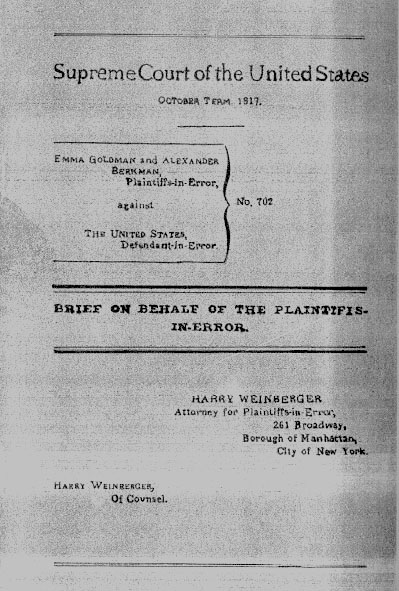
Supreme Court of the United States
OCTOBER TERM, 1917.
-------------------------------------------------
EMMA GOLDMAN and ALEXANDER
BERKMAN,
Plaintiffs-in-Error,
No. 702.
THE UNITED STATES,
Defendant-in-Error.
-------------------------------------------------
BRIEF ON BEHALF OF
THE PLAINTIFFS-IN-ERROR.
------
|
|
Statement.
The indictment charges the defendants with conspiracy as accessories before the fact for violation of the Draft Act as follows:
- "THE GRAND JURORS OF THE UNITED STATES of AMERICA, within and for the District aforesaid, on their oath present that on the eighteenth day of May in the year of our Lord one thousand nine hundred and seventeen, the President of the United States of America duly issued his Proclamation as provided by the Act of Congress approved May 18, 1917, entitled, 'An Act to authorize the President to increase temporarily the Military Establishment of the United States,' in which said Proclamation the President of the United States duly proclaimed and gave notice to all persons subject to registration in the several States and in the District of Columbia, in accordance with the said Act of Congress approved May 18, 1917, that the time and place of such registration shall be between 7 A. M. and 9 P. M. on the fifth day of June in the year of our Lord one thousand nine hundred and seventeen, at the registration place in the precinct wherein they may have their permanent homes; that those who shall have attained their twenty-first birthday and who shall not have attained their thirty-first birthday on or before the day therein named are required to register, excepting only officers and enlisted men of the regular army, the navy, the Marine Corps, and the National Guard and Naval Militia, while in the service of the United States, and officers in the Officers' Reserve Corps, enlisted men in the Enlisted Reserve Corps, while in active service:
And the Grand Jurors aforesaid, on their oath aforesaid, do further present that Emma Goldman and Alexander Berkman (hereinafter referred to as the defendants), both late of the City and County of New York, in the District aforesaid, heretofore, to wit, on the eighteenth day of May in the year of our Lord one thousand nine hundred and seventeen, and On each and every day thereafter up to and including the date of the filing of this indictment, at the Southern District of New York and within the jurisdiction of this Court, unlawfully, wilfully, knowingly and feloniously did conspire together and agree between themselves, and with divers other persons whose names are to, the Grand Jurors unknown, to commit an offense against the United States, that is to say : The said defendants unlawfully, wilfully, knowingly and feloniously did conspire together and agree between themselves, and with the said divers persons whose names are to the Grand Jurors unknown, that divers persons whose names are to the Grand Jurors unknown, the same being male persons between the ages of twenty-one and thirty, both inclusive, being subject to registration in accordance with regulations to be prescribed by the President, and upon proclamation by the President and other public notice given by him and by his direction stating the time and place of such registration, being under the duty as persons of the designated ages, except officers and enlisted men of the Regular Army, the Navy, and the National Guard and Naval Militia while in the service of the United States, to present themselves for and submit to registration under the provisions of the Act of Congress, approved May 18, 1917, entitled, 'An Act to authorize the President to increase temporarily the Military Establishment of the United States,' should unlawfully and wilfully fail and refuse to present themselves for registration and to submit thereto, as provided by the aforementioned Act of Congress, approved May 18, 1917;
And the Grand Jurors aforesaid, on their oath aforesaid, do further present that the said defendants, Emma Goldman and Alexander Berkman, unlawfully, wilfully, knowingly and feloniously did conspire together and agree between themselves, and with the said divers persons whose names are to the Grand Jurors unknown, to aid, abet, counsel, command, induce and procure divers persons whose names are to the Grand Jurors unknown, the same being male persons between the ages of twenty-one and thirty, both inclusive, being subject to registration in accordance with regulations to be prescribed by the President, and upon proclamation by the President and other public notice given by him and by his direction stating the time and place of such registration, being under the duty as persons of the designated ages, except officers and enlisted men of the Regular Army, the Navy, and the National Guard and Naval Militia while in the service of the United States, to present themselves for and submit to registration under the provisions of the Act of Congress approved May 18, 1917, entitled, 'An Act to authorize the President to increase temporarily the Military Establishment of the United States,' unlawfully and wilfully to fail and refuse to present themselves for registration and to submit thereto, as provided by the aforementioned Act of Congress approved May 18, 1917;
And to effect the object of the said conspiracy the defendant Emma Goldman, on the eighteenth day of May in the year of our Lord one thousand nine hundred and seventeen did deliver an address beginning with the words, 'We don't believe in conscription!' and ending with the words 'we can support the point of real freedom and liberty and brotherhood' at a public meeting held in the Harlem River Park and Casino, situate at Second Avenue, 126th to 127th Streets, in the City and County of New York, in the Southern District of New York;
And further to effect the object of the said conspiracy, the defendant Alexander Berkman on the first day of June in the year of our Lord one thousand nine hundred and seventeen, did publish and cause to be published in the City and County of New York, in the Southern District of New York a periodical and publication entitled 'The Blast, Vol. II. New York, June 1, 1917. No. 5';-
And further to effect the object of the said conspiracy, the defendant Emma Goldman, on the second day of June in the year of our Lord one thousand nine hundred and seven- teen, did give to one, James A. Hagerty, at the office of the No-Conscription League, situate 20 East 125th St., in the City and County of New York, in the Southern District of New York, a copy of a peiodical and publication entitled 'Mother Earth, Vol. XII. June, 1917. No. 4';
And further to effect the object of the said conspiracy, the defendant Alexander Berkman, on the fourth day of June in the year of our Lord one thousand nine hundred and seventeen, did deliver an address beginning with the words 'Comrades, friends and enemies,' and ending with the words 'You know that after all, the cause of the soldiers and the workers is the common cause,' at a public meeting held at the Hunts Point Palace, situate at 953 Southern Boulevard, in the City of New York and County of Bronx, in the Southern District of New York;
And further to effect the object of the said conspiracy, the defendant Emma Goldman, on the fourth day of June in the year of our Lord one thousand nine hundred and seventeen, did deliver an address beginning with the words 'Men, don't you know that the soldiers came here to disturb the meeting?' and ending with the words 'and you will all raise one mighty voice just going to drown militarism,' at a public meeting held at the Hunts Point Palace, situate at 953 Southern Boulevard, in the City of New York and County of Bronx, in the Southern District of New York;
Against the peace of the United States and their dignity, and contrary to the form of the statute of the United States in such case made and provided. (§§37 and 332 U. S. C. C., and §5 of the Act of May 18, 1917.) 11
Nowhere is there any allegation of an actual violation of the Draft Act or of any principal who may have violated the act.
Assignments of Error.
These will be found in extenso on pages 534-539 of the transcript of record.
POINT I.
No crime charged in the indictment.
The indictment did not charge the defendants with any offense against the United States. It is not a violation of any law for defendants to have conspired and agreed among themselves and other persons to aid, abet, counsel, command, induce and procure divers persons subject to registration to fail and refuse to present themselves for registration unless alleged someone did fail to register because of defendants' acts. The lower court, so stated to the jury after the conviction (p. 448), as follows:
-
"The Government has thus far enacted no special statute to deal with those who counsel disobedience, and who advise insurrection who seek to reach and control the humbler people, some of whom do not understand things, by methods such as were disclosed in this case."
If that was the Court's opinion, it should have dismissed the indictment the opening of the trial.
However, we find that the defendants are really indicted as accessories under Section 332, U. S. C. C., which reads:
-
"Whoever directly commits any act constituting an offense defined in any law of the United States, or aid, abets, counsels, commands, induces or procures its commission, is a principal."
The indictment does not allege that any young man who was urged or solicited to refuse to register failed, as a result of said alleged conspiracy, to comply with the Registration Act, approved May 18th, 1.91.7, or the Proclamation of the President of the United States under date of the 5th of June, 1917. The indictment therefore does not state a crime, as there can be no accessory before the fact, unless there is a principal who has actually committed a crime.
In Bishop New Criminal Law, Vol. 1, See. 670, it is said:
-
"Under a statute making it a felony to 'counsel procure, or command any other person to commit any felony,' one becomes a felon only when the felony persuaded to is committed."
Sec. 671:
-
"Moreover, statutes like these do not supercede the necessity of proving the guilt of the principal; for in the nature of things, one cannot procure what is not done, or receive the doer of what was never performed."
Citing:
-
Simmon v. State, 4 Ga., 465.
Ogden v. State, 12 Wis., 532.
In U. S. v. Hartwell (U. S. Circuit Ct., D. Mass.), a well-considered case, 26 Fed. Cas., No. 15,318 the Court said:
-
" * * * the charge against the accessory is in a certain sense ancillary to the offense, committed by the principal. Take a case, for example, where it appears that the felony charged had never been committed; it could not be said within the meaning of the criminal law that one charged as an accessory before the fact procured, counseled, or commanded another to commit that felony,* * * .
-
Whenever the accessory is indicted before the principal has been convicted, it is necessary that the indictment against him, whether they are indicted separately, or jointly, should allege the guilt of the principal, as the offense of the accessory, even when charged as such before the fact, depends upon the principal's guilt, and is never to be regarded as complete unless the principal offense was actually committed."
POINT II.
No evidence of defendants' guilt.
In Chappel V. United States, 160 U. S., 499, 509, the Court said:
-
"This Court * * * has appellate jurisdiction of this case as one in which the constitutionally of a law of the United States was drawn in question; and, having acquired jurisdiction under this clause, has the power to dispose, not merely of the constitutional question, but of the entire case, including all questions, whether of jurisdiction or of merits" (citing cases).
Direct appeals will be entertained where the construction or application of the Constitution of the United States is involved and the evidence is contained in a bill of exceptions.
-
Union & P. B. of M. N. Memphis, 189 U. S., 71.
Elkin v. U. S., 142 U. S., 651.
Horner v. U. S., 143 U. S., 570.
Williamson v. U. S., 207 U. S., 425.
Spreckles Sugar Ref. Co. V. McClair, 192 U. S., 397.
The provision "involves the construction or application of the constitution" does not make any distinction between civil and criminal cases, and this Court will review judgment on writ of error, in criminal case.
-
Motes v. U. S., 178 U. S., 458.
Defendants are charged with a conspiracy to have young men of draft age refuse to register, violation Section 37 and Section 332, U. S. 0. C., and Section 5 of the Act of May 8th, 1917. To find a person guilty of conspiracy there must be an agreement and an overt act.
-
Pettibone v. U. S., 148 U. S., 197.
Under Section 332 it must be shown that someone did not register by reason of defendants' acts in order to make defendants principals, as accessories before the fact.
See:
-
U. S. v. Hartwell, supra.
In Buck v. Commonwealth, 107 Pa. St., 486, the Court said:
-
"Since the act of 1860 it is no longer necessary to convict the principal before the accessory can be tried, yet it is still requisite in some way to prove that the principals are guilty before the accessory can be convicted. No man can be accessory to a crime which has never been committed."
In Ogden v. State, 12 Wis., 592, the Court mid:
-
"For however clearly it may have appeared that Ogden counseled and advised Wright to commit the offense, yet if Wright never did so in point of fact, and the barn was set on fire by someone else, or by other means, then Ogden was innocent of the crime, with the
In Stabler v. Com., 95 Pa. St., 318, the Court said:
-
"Merely soliciting one to do an act is not an attempt to do that act: Rex v. Butler, 6 C. & P., 368; Smith, v. Com., 4 P.F. Smith, 209. In this last case it was said, 'In a high, moral sense it may be true that solicitation is attempt; but in a legal sense it is not.'"
The following is a concise statement of all the facts as shown in the evidence:
Defendant Berkman was released from jail Monday night at 5 P. M., and the trial of the defendants proceeded Wednesday morning, June 27th (p. 9). Defendant Berkman had sustained a severe injury to his leg, and it was necessary for him to have proper medical treatment, and he was suffering great pain at the time (see p. 11, Dr. Max Strunsky's letter).
A motion was made to dismiss the indictment on the ground that the indictment does not charge a crime and that the Conscription Law is unconstitutional (p. 15).
The offices of Mother Earth magazine and The Blast magazine were at 20 East 125th Street, on two different floors, and the work for the No-Conscription League was done mostly in the office of The Blast (p. 17). The No-Conscription League was a voluntary association (p. 18), of which Mr. Berkman and Miss Goldman were members (p. 19). The Blast and Mother Earth were two separate, independent magazines; Mr. Berkman was editor of The Blast and Miss Goldman was editor of Mother Earth (pp. 22 and 49). Mr. Berkman was, however, editor of Mother Earth up to November, 1915, and later started The Blast in California (p. 50). The Blast was published in San Francisco up to March, 1917, when it came to New York City (p. 22). The No-Conscription League was formed May 9th (p. 23), before the Draft Law was passed, to protest against its passage (p. 24). The League got out a manifesto (Government's Exhibit 1, see p. 25, and Exhibit C, 451). A protest meeting was held May 18th, 1917, at the Harlem River Casino before the Draft Act was passed (pp. 27 and 58), and both defendants spoke (p. 28). The meeting started at about 8 P. M. and continued until about 10.30 (p. 69). Neither of the defendants had seen a newspaper or announcement that the Draft Bill was passed while the meeting was being held (p. 70).
No one at the meeting of May 18th knew that the Draft Law was passed (pp. 58 and 59), and they did not learn of it until after the meeting. The meeting was called the "no-conscription meeting," and the Government admitted that it was not a "noregistration meeting" (p. 60) .
There was a committee meeting of the League held on May 23rd, at which Miss Goldman was not present, she being at Springfield, Massachusetts, lecturing (p. 63). Miss Goldman wrote a letter from Springfield.
There was a meeting held at Hunt's Point Palace on June 4th (p. 71).
Copies of the June Mother Earth and the June Blast were given out at the office of Mother Earth and The Blast office to a reporter (pp. 76 and 1-32.).
Defendants were arrested June 15, 1917.
William H. Randolph, a patrolman of the New York City Police Department, who was also by training a shorthand reporter, attended the meeting at the Harlem River Casino on May 18th and took down the speech of Miss Goldman (p. 137) ; took down the speech and transcribed it. He testified that he could take from 125 to 150 words a minute (p. 140), but that his average was about 100 to 125 words a minute (p. 154). His notebook showed that Miss Goldman finished speaking at 10.15 P. M. (p. 143). He took his notes standing on a table without support for his book (p. 145). Mr. Randolph states that she said at that meeting of the 18th of May: "We are going to support all the men who will refuse to register." (p. 161). He also testified that, Miss Goldman said at that meeting: "We believe in violence and we will use violence" (p. 162). Police, detectives and secret service men were there, but did not interfere with Miss Goldman's speech (p. 162).
Mr. Charles Pickler, for the defense, a member of the bar of the State of New York and the Federal Bar, and an expert shorthand reporter for twenty-five years (pp. 163 and 165), capable of taking 225 words a minute (p. 220), reported and transcribed the speeches of Emma Goldman and Berkman at Hunt's Point Palace at the request of the No- Conscription League. Mr. Pickler testified that under the circumstances testified to by Mr. Randolph he could not take her speech down as she talks 200 words a minute (pp. 166 and 167; see also p. 220). When Mr. Randolph was put to a stenographer's test he failed woefully (pp. 183 to 187).
M r. John C. Dillon, a stenographer in the employ of the New York Police Department, a Government witness, testified Emma Goldman speaks about 125 words a minute (p. 199). A large part of the trial was taken up with the contentions in reference to the meeting of May 18th, in reference to violence, and supporting men who will refuse to register, but all of that was taken away by the Judge, incidentally, in his charge as not to be considered by them (p. 437), but the effect of the evidence was left there, the grilling of the witnesses and the attitude of the Court in reference to the meeting of May 18th, left the impression of the Court's desire for defendants' conviction.
At the end of Government's case a motion was made to dismiss on the ground no evidence that Emma Goldman and Berkman advised people not to register or that their writings advised people not to register (p. 204), which motion was denied and exception taken.
The Court should have dismissed at the end of the Government's case, the Court being of the opinion that telling people not to register is not a crime (see Point I). The defendants could not have committed an offense against the Draft Act, or conspired to do an act against the law, because neither was subject to the draft. They might have conspired to ask someone to do an act, by not registering, but that would not be an overt act on the part of the defendants.
In 8 Cyc., 628, it is stated that:
-
"By a Federal statute (U. S. Rev. St., See. 5440) " (now See. 37, U. S. C. C.) "it is made a punishable offense for two or more persons to conspire to commit any offense against the United States. Conspiracy as used in this statute means an unlawful agree ment to do some act which by some law of the United States has been made a crime, and three elements are necessary to constitute it: (1) For two or more persons to conspire together; (2) to commit an offense against the United States; (3) an overt act of one or more parties to effect the object of the conspiracy. In re Wolf, 27 Fed.., 606; U. S. v. Cassidy, 67 Fed., 698."
See:
U. S. v. Barrett, 65 Fed., 62.
If the meeting of May 18th is eliminated from the case, as the Court did at the end of the trial, the motion to dismiss at the end of the Government's case should have been granted, because then there was no evidence before the Court at all.
Lincoln Steffens, reporter, correspondent and magazine writer, for the defendants, testified that lie had reported the first speech Emma Goldman ever Made and had heard her talk often and had private discussions with her and had never heard her say she would use violence (p. 216). Nor that she would tell others to use violence, but that as a matter of fact, lie had heard her say that site was opposed to violence, and that, as to war and militarism she had always been opposed to it (p. 217).
Paul Munter, public stenographer and official stenographer for Ron. Peter B. Olney, referee in bankruptcy, stenographer for twenty years (passed No. I as court stenographer for Supreme Court, Westchester Comity, with rating 94 per cent.), has reported Emma Goldman's lectures and speeches often since 1914. He was of opinion she spoke at not less than 150 words a minute and often went over 200 words a minute (pp. 223 and 224).
Helen Boardman a psychological research worker for the Bureau of Educational Experiments, a witness for defendants (whose forefathers came to this country 1640), testified that she did not hear Emma Goldman, at the May 18th meeting, say, "We believe ill violence and we will use it" (p. 2271). That site heard Emma Goldman say she would not advise people not to register, and the reasons for not advising them was that site, Emma Goldman, was not subject to registration herself and that it was a matter for each individual's conscience (p. 228; see also p. 229).
Mary Eleanor Fitzgerald testified (p. 211) that a letter sent front Springfield Mass., by Miss Goldman, was read at an informal meeting of No.-Conscription League on May 23rd (Defendant's Exhibit L, p. 531), against advising people not to register, and giving the reasons. This letter specifically states, "But what I do with myself in behalf of my ideal is quite another matter front what I would suggest to you to do; I cannot and will not take the responsibility for your lives, your liberty." This exhibit was a typewritten copy of the original letter, and was taken by the Government in its sudden raid of defendants' offices oil June 15th (p. 233).
That was the stand of defendants and the No-Conscription League, "not to tell people not to register" (pp. 252 and 253.).
Anna Sloan (wife of John Sloan, the painter), testifying for defendants, testified that she did not hear Emma Goldman say: "I believe in violence and we will use violence, and that she had told her, ill previous conversations, site did not believe in violence (p. 273).
Rebecca Shelley (a former school teacher, and college graduate) testified for defendant that she heard the statement. contained in Defendants' Exhibit L front Miss Goldman at the May 23rd meeting (p. 281).
Minna Lederman (a graduate of Barnard College) testified for defendants that at the May 18th meeting she did not hear Emma Goldman advise or urge the people not to register, nor did she say that "We believe in violence and we will use violence" (p. 291). Many other witnesses of unimpeachable position testified to the same effect.
Bolton Hall, lawyer and writer, testifying for defendants, stated he knew Emma Goldman for more than twenty years, and never heard her urge violence (p. 306). The Court, in its charge to the jury (p. 437), said question of "violence" not germane, but the effect on the jury could not be eradicated after they had heard that question pounded at for days. It would be humanly impossible for them to leave it out of their deliberations, and it helps explain the verdict of "guilty" brought in by them. The Court knew that "We believe in violence" was no part of Government's case, but lie left it in. He knew the whole meeting of May 18th was 'Inadmissible, as the Draft Act had not been signed; yet the Court only casually says it is not to be considered by jury. As a matter of fact, it was impossible for any jury to eliminate "We believe in violence" and the rest of the May 18th meeting from their minds or verdict.
Motion made to dismiss at end of case (p. 426), and should have been granted (see Point 1).
Court charged (p. 429) that:
-
"Before act passed May 18, 1917, any person could discuss in the -fullest manner possible the provisions of pending legislation and * * * use the most vehement, language, etc."
Judge charged (p. 437) the jury must find that Draft Act was not signed until after Emma Goldman was through talking at meeting on May 18th, so that everything that was said by Emma Goldman (Berkman spoke before Emma Goldman) at that meeting cannot be considered part of the overt act and the Court so charged, and therefore the whole case of the prosecution falls. What was said at the Hunt's Point Palace is not disputed, as we had our stenographer there, and the people were not advised or urged not to register (Government's Exhibit 3:1, see p. 495).
When the jury brought in the verdict of guilty, at 6 P. M. (p. 444), Miss Goldman asked that sentence be deferred for a few days, and that bail be continued (bail was $25,000 cash each), because defendants wished to arrange their affairs, which they had not been able to do during the trial. The Court denied this, and proceeded to the sentence (p. 445), but did inform defendants, who were in custody, that they could make application for bail to the Circuit Court (p. 445). The Circuit Court was in recess, and defendants could not walk out of the court room, being in custody, to look for a judge of the Circuit Court at 6 P. M.
The Court then expressed to the jury "the appreciation of the Court and of the community * * * for your fearless and prompt manner in which you have discharged your duty."
And then the Court in air equally fearless and prompt manner imposed the full penalty of the law, "two years and $10,000 fine," on each defendant, and ended by saying, "The responsibility for the custody of the defendants is with the Marshal for the Southern District of New York. He may exercise such discretion in that regard as he deems best" (p. 449). Defendant Goldman informed, the Court they intended to appeal the case, and the Court told them they could have ninety clays to sue out a writ of error. He also told them they would have the fullest opportunity within the ninety days to consult counsel and prepare their assignments of error and writs of error; but when Miss Goldman asked whether within the next hour or two they could consult with counsel regarding the appeal the Court replied: "The custody of the defendants is with the Marshal, and the Marshal will deal with the matter referred to. The court is now adjourned" (p. 450).
Straight from the court room, after 7 P. M., the defendants were taken to the Marshal's office, to await the leaving of the train for Atlanta and Jefferson prisons later that night.
When before in the history of any court was a defendant forced to trial when suffering great pain due to injuries received? When before was a reasonable adjournment refused in the United States courts when one of the defendants was only one day out of jail on tremendous bail; and when before has any judge sitting on the criminal side of the United States Court refused a writ of error to a defendant who informs him that an appeal will be taken? The only question has always been the amount of bail. And in this case each defendant had deposited as bail $25,000 cash. Never before in the history of any court were defendants taken from the court straight to jail by the Marshal, when the defendants asked time to consult counsel in reference to an appeal or a stay. The defendants asked a few days to arrange their affairs, which was refused. Both were publishers of magazines and books and had large affairs that had to be taken care of while they were serving the limit of the law. These defendants were, in the eyes of the law, like all other defendants charged with crime, and entitled to all the rights and privileges accorded to all defendants, for the sake of the law and a people's belief in its unvarying action.
All this, and the refusing of an adjournment at the commencement of the trial, though defendant Berkman, just, one day out jail on $25,000 bail, and suffering great pain, though it may not be strictly legal error, gives a better picture of the bitterness and attitude of the Court and its desire for a conviction of the defendants, which, with the war hysteria at, the time, meant that no jury could weigh the testimony fairly, and were bound to convict, even without evidence. Perhaps the defendants, as far as the record is concerned, appear to have gotten the letter of the law, but they did not get the spirit-which means justice and a fair trial.
The charge is defendants conspired to advise and to urge men of conscriptable age not to register. The overt act charged is speeches and articles.
The Government failed to prove conspiracy.
The Government failed to prove that, defendants or either of them told young men of conscription age not to register. No evidence of young men of draft age, who failed to register.
All kinds of evidence was allowed in, happenings of years ago, the defendants' theories and beliefs, but no evidence of the overt acts charged, no evidence of the guilt of any principal. The May 18th meeting and "violence" were paraded before the jury for days. Evidence that the defendants were anarchists, and therefore opposed to all governments, including the United States Government, is admitted, and was proved by the United States District Attorney, and made the most of. That defendants are internationalists, and therefore opposed to all national wars, including this one, is admitted, and was proved by the District Attorney, but those are not the crimes charged against the defendants, that is not how the indictment reads', though that is what they were convicted of, because Me attitude of the Court and of the District Attorney, as shown in the record, called for a, conviction on "patriotic grounds."
The no-conscription manifesto (Government's Exhibit 1, p. 451) does not tell people not to register, it does oppose conscription. It says, "The No-conscription League is to be the voice of protest against the coercion of conscientious objectors to participate in the war." That was the purpose of the league, formed before the Draft Law was passed (p. 23).
There was no proof of a conspiracy, because there was none. That the defendants had similar ideas which they expressed on a public question, which they bad for the past twenty years, is no proof that they conspired to tell young men between the ages of twenty and thirty years, inclusive, not to register. See U.S. v. Donan, 11 Blatchf. (U. S.), 168, and U. S. v. Goldberg, 7 Bissell's (U. S.), 175. As a matter of fact, there was no legal evidence submitted to the jury that the defendants' speeches or writings reached young men subject to the draft, even if they had told anyone not to register. If defendants had conspired and told an audience of women, "Don't register," could it be contended there was a violation of law? It was incumbent on the Government to submit proof that young men of draft age had been reached by defendants' speeches and articles. I
That defendants expressed opinions about conscription and war is admitted, but there was no evidence that they advised people to disobey Cite law. They strongly disapprove of the law, just as many people disapprove of the income tax, or a hundred different laws and express their opinion of those laws, bring test cases to break those laws, but no one Was ever convicted before of the crime of disapproving of laws. What of the men and corporations who strongly disapproved of the first income tax law, and that they brought before this Court, and this Court declared unconstitutional? What of the Eight-hour Law on the railroads, that this Court declared constitutional and of which many editors and railroad men disapproved and voiced their disapproval. The expression of disapproval is necessary before any law can be changed, before Congress can know what the people want, but that does not mean that those who express that disapproval are urging people to break or resist the law. Many people today are strongly pro-war, and yet disapprove of conscription.
The letter written in Springfield, Mass., by Emma Goldman to the meeting of May 23rd of the league, disposes of the conspiracy charge, disposes of alleged overt acts to tell people not to register, more than pages of testimony. She says she will not advise young men not to register. Does that not dispose of the whole case? At the Hunt's Point meeting Emma Goldman expressly stated that she cannot and would not tell people not to register.
These defendants are not the kind of defendants who, when brought before the Bar, deny their beliefs merely because they may go to jail. Their letter to Assistant District Attorney Content (Government's Exhibit 35, p. 499) protesting against the arrest and imprisoning of Kramer and Becker shows that they do not shirk responsibility, they do not deny their position on public questions. The reputation of the defendants, whether the Court believes it enviable or unenviable, is too well known to believe they would deny their principles and preachings for a minute. But even anarchists can consistently fight the charge of an imaginary crime, with imaginary evidence, and they should not seek justice in vain.
One must know the ideals of these people. Frankly they will not obey a law if it interferes with their ideals or their conscience. Frankly they have advocated their principles for years, as shown, for instance, Exhibits B-C, published 1909-1910 (p. 524), entitled "A New Declaration of Independence." But that very principle of ideals and conscience above law explains why defendants would not tell others not to register because, defendants not being of registration age, the ones who followed their advice, if given, would have to suffer the penalty of the law.
To understand how this conviction of these defendants were had, with no evidence of an agreement to conspire, with no evidence of an overt act to tell anyone not to register on June 5th, and absolutely no legal proof of the defendant's speeches or their articles having reached young men between the ages of twenty-one to thirty inclusive, or that any young man subject to draft did refuse to register on account of defendants, one must picture the scene of the trial. A Judge presiding at the trial who had already held the defendants in the astounding sum of Twenty-five thousand ($25,000) dollars bail each for trial, which had to be put up in cash, every surety company refusing to go bail; who when the case was called for trial refused even a reasonable adjournment, though defendant Berkman was only one day out of jail, and suffering great pain at the time because of his leg (p. 11), and defendant, Goldman had been out less than a week, during all of which time she had tried to raise cash bail for Berkman (pp. 7 and 8). Then, as this record of the trial is read, the questions asked by the Judge of witness after witness, when he believes the prosecutor has been weak in his examination and cross-examination, the remarks and the objections of the District Attorney continually echoed by the Court, the feeling in the court room that a conviction must be obtained is realized. As illuminating as is the refusal of the Court to give the defendants a reasonable adjournment at the beginning of the trial, more illuminating of the attitude of the Court throughout the trial was the refusal of a few (lays, stay before the sending of the defendants out of the State to commence the service of their sentence, which was the full extent of the law. All of this may not be judicial error (see Goldsby v. U. S., 160 U. S., 70; Isaacs v. U. S., 159 U. S., 487), but it makes file examining closely of the facts absolutely necessary, to see if an injustice has been done in the conviction. The non-acceptance by the Court of the philosophy of the defendants makes the necessity of doing them justice all the more necessary. Because, if there was no prejudice against defendants, if there was no war hysteria at the time of the trial, there would probably have been no conviction to appeal to this Court.
The crime charged against the defendants is that they conspired to advise and did advise young men, who were subject to draft, not to register, and that said young men did not register.
It has been uniformly held that defendants can only be convicted of the crime charged.
In United States v. Cruikshank, 92 U. S.1 5427 this Court said:
-
"In criminal cases, prosecuted under the laws of the United States, the accused has the constitutional right 'to be informed of the nature and cause of the accusation.' Amend. VI. In United States v. Mills, 7 Pet., 142, this was construed to mean, that the indictment must set forth the offense 'with clearness and all necessary certainty, to apprise the accused of the crime with which he stands charged' * * *.
The object of the indictment is first, to furnish the accused with such a description of the charge against him as will enable him to make his defense, * * *; and, second, to inform the court of the facts alleged, so that it may decide whether they are sufficient in law to support a conviction, if one should be had. For this, facts are to be stated, not conclusions of law alone. A crime is made up of acts and intents; and these must be set forth in the indictment, with reasonable particularity of time, place, and circumstances."
The facts charged were not proved. There is no legal evidence in the whole record that young men of draft age heard defendants or received their literature. This Court cannot speculate that there were young men, no more than the jury had the right to. Suppose defendants had actually said "Don't register" and had said it to an audience of women; would that be a violation of law, even if they had conspired to, say it? They would not. See United States v. Cruikshank, supra. The prosecution had the duty under the indictment and the law to show that people who were advised, aided or abetted were subject to draft, and it had to show it by legal evidence. It had in addition, as defendants were charged as principals, to show some young man of draft age who actually did not register because of defendants' speeches or articles, and no proof was offered, and not even charged in the indictment, that any did fail to actually register.
The law of conspiracy is elementary and needs no citations to this Court. I submit that under the law of conspiracy, two defendants who expressed the same ideas at a meeting or wrote for two different magazines would not be guilty of conspiracy, no more than two Republican or two Democratic speakers or two editors expressing the same ideas would be guilty of conspiracy.
The more wrong the defendants may be considered in their beliefs and in their philosophy or life by the courts, the more sure the courts should be that they had a fair trial and that their conviction now before this Court was not obtained without evidence and merely by prejudice created inside and outside the court room.
Even the least among us are entitled to justice.
POINT III.
The Draft Act is unconstitutional.
A. It violates Section XIII, Subdivision I of the Amendments of the United States Constitution:
-
"Neither slavery nor involuntary servitude, except as a punishment for crime whereof the party shall have been duly convicted, shall exist within the United States, or any place subject to their jurisdiction."
By registering, according to a proclamation of General Crowder, all men between the ages of twenty-one to thirty inclusive become immediately soldiers of the United States--not by enlistment, not by being mustered in, but by the mere act of signing their name, subject to be court-martialed and shot if they should fail afterwards to appear for physical examination and enrollment. They must then obey military orders to serve at home or abroad. They may, according to proclamations of the President and the new rules of the War Department, become liable to be assigned to duty at manual labor in mines, factories and fields (see also Section 4 of Draft Act).
Appreciating the importance of this question, its relation to the fundamental principles of American liberty, and the necessities of the National Government, it is not my contention nor belief that a soldier is a slave. A volunteer soldier is a free man fighting for what he believes. But where he does not volunteer for service in the United States army, the conscripting him is involuntary servitude, if the English language means anything. If the conscript is forced into military, agricultural, industrial or mining work--as the Government proclaims it intends to do--that is clearly involuntary servitude.
Millions of young men have complied with the rigid conscription law; many have done so unwillingly some only after protest, some have obeyed only under threat of arms others have altogether refused, many have claimed exemption. Only those that have offered Home sort or protest have expressed themselves as to the value and validity of military service. The others have, merely obeyed the law as written. Their action in registering can hardly indicate an opinion with regard to conscription. The attempt to make it appear an endorsement of any national military policy is either due to lack of logic or a desire to misrepresent the attitude of those called upon to comply with it.
Conscripted, many unwilling, but we are a law-abiding people, and obey the law, until this Court, if it shall so decide, shall declare it unconstitutional.
To prevent usurpation and despotism by the executive power has always been the task of liberty-loving people, and that is why we have checks and balances in our Constitution.
Public interests and private rights, the liberty of the citizens and the Power of government is all entwined in this case.
The words of Section XIII of the amendments are plain and determinate, clear and the sense distinct and Perfect, and they require no interpretation or construction. The words are to be taken in the sense which they naturally bear on their face.
-
United States v. Fisher, 2 Cranch., 386.
Lake v. Rollins, 130 U. S., 662.
Doggett v. Florida, R. Co., 99 U. S., 72.
In the Slaughter House cases, 16 Wallace, at Page 69, the Court said: -
"Its two short sections (13th Amendment) seem hardly to admit of construction) so vigorous is their expression and so appropriate to the Purpose we have indicated:
1. * * * this grand yet simple declaration of the Personal freedom of all the human race within the jurisdiction of this government declaration designed to establish the freedom of four millions of slaves * * *. That a personal servitude was meant, is proved by the use of the word 'involuntary,' which can only apply to human beings. The exception of servitude as a punishment for crime gives an idea, of the class of servitude that is meant,. The word 'servitude' is of larger meaning than slavery, as the latter is popularly understood in this country, and the obvious purpose was to forbid all shades and conditions of African slavery. * * *
We do not say that no one else but the negro can share in this protection. Both the language and spirit of these articles are to have their fair and just weight in any question of construction; undoubtedly, while negro slavery alone was in the mind of the Congress which proposed the thirteenth article, it forbids any other kind of slavery, now or hereafter. If Mexican peonage or the Chinese coolie labor system shall develop slavery of the Mexican or Chinese race within our territory, this amendment may safely he trusted to make it void. And so, if other rights are assailed by the States which properly and necessarily fall within the protection of these articles, that Protection will apply though the party interested may not be of African descent."
In Barley v. Alabama, 219 U. S., 219, 240, Mr. Justice Hughes said:
-
"The language of the Thirteenth Amendment was not new. It reproduced the historic words of the ordinance of 1787 for the government of the Northwest Territory and gave them unrestricted application within the United States and all places subject to their jurisdiction. While the immediate concern was with African slavery, the Amendment was not limited to that. It was a charter of universal civil freedom for all persons, of whatever race, color or estate, under the flag.
The words 'involuntary servitude' have a 'larger meaning than slavery.' 'It wag very well understood that in the form of apprenticeship for long terms, as it had been practised in file West Indies Islands, oil the abolition of slavery by the English government, or by reducing the slaves to tile condition of serfs attached to the plantation, the purpose of the article might have been evaded, if only tile word slavery had been used.' Slaughter House Cases, 16 Wall., p. 69. The plain intention was to abolish slavery of whatever name and form and all its badges and incidents; to render impossible any state of bondage; to make labor free, by prohibiting that control by which the personal service of one man is disposed of or coerced for another's benefit, which is the essence of involuntary servitude."
It forbids not, merely the slavery heretofore known to our laws, but all kinds of involuntary servitude not imposed in punishment for public offenses.
-
Matter of Turner, 1 Abb. U. S. R., 84.
In Robertson v. Baldwin, 165 U. S., at page 281, the Court said:
-
"Not that all such contracts (or servitude of a sailor or soldier) would be lawful, but that a servitude which. was knowingly and willingly entered into could not be termed involuntary. * * * From the earliest historical period the contract of the sailor has been treated as an exceptional one, and involving, to a certain extent, the surrender of his personal liberty during the life of the contract."
But if it had been shown that the contract of servitude had not been voluntarily entered into (whether of soldier or sailor) according to the reasoning of the Court, the sailor or soldier would have been entitled to release on writ of habeas corpus.
Justice Harlan wrote a strong dissenting opinion, and with all due respect to this Court, in my opinion the majority were wrong in not construing that seamen were protected by the Thirteenth Amendment, though they did have ancient law and custom to sustain their decision. Justice Harlan well said:
-
"Those (ancient) laws, whatever they may have been, were enacted at a time when no account was taken of mail as man, when human life and human liberty were regarded as of little value, and when the powers of government were employed to gratify the ambition and the pleasures of despotic rulers rather than promote the welfare of the people."
But even the majority opinion refers to "a servitude which %vas knowingly and willingly entered into could not be termed involuntary." But there can be no claim that the drafted men voluntarily enter the army. Therefore, it would be involuntary servitude even according to the majority decision of this Court in this case. Congress has since passed the Seamen's Act, which has removed the injustice of this decision.
The word "servitude" was not an unknown word in 1865. Reeves History of English Law, Pt. 1, C. 1:
-
"These are the persons who are described by Sir William Temple as 'a sort of people who were in a condition of downright servitude, used and employed in the most servile works; and belonging, they and their children and effects, to the lord of the soil, like the rest of the stock or cattle upon it.' "
In 1514 Henry VIII manumitted two of his villeins in the following words:
-
"Whereas God created all men free, but afterwards the laws and customs of nations subjected some under the yoke of servitude, etc." (Barrington on Statutes, 3rd Ed., 275).
The word "servitude" as used in the Constitution of the United States, Amendment Thirteen, means a condition of enforced compulsory service of one to another; "servitude" being defined by Webster as "the state of voluntary or compulsory subjection to a master."
-
Hodges v. United States, 203 U. S., 1, 17; 51 L. Ed., 65.
Bouvier's Law Dictionary defines "Involuntary":
-
"An involuntary act is that which is performed with constraint or with repugnance, or without the will to do it. An action is involuntary which is performed under duress. Wolffins Inst., Section 5."
Black's Law Dictionary defines
-
"Involuntary servitude. The condition of one who, is compelled by force, coercion or imprisonment, and against his will, to labor for another, whether he is paid or not" (citing cases).
Blackstone, 1 Bl. Com., 1:14, said:
-
"Personal liberty consists in the power of locomotion, of changing situation, or moving one's person to whatsoever place one's own Inclination may direct, without imprisonment or restraint, unless by due course of law."
The meaning of the word servitude as contended for here is not new.
The Century Dictionary defines
-
"Servitude: Service rendered or duty performed in the army or navy. A state of spiritual, moral, or mental bondage or subjection; compulsion; subordination.
Involuntary. Not voluntary or willing; contrary or opposed to will or desire; unwilling."
Funk & Wagnall's Standard Dictionary also defines servitude as "service in the army or navy."
The New English Dictionary, edited by Sir James A. H. Murray, Oxford, 1914, defines servitude:
"The absence of personal freedom. A person's (period of) service (in the Navy)."
1471 Caxton Recuyell (Sommer) 11. 611 or that we shall be ledde in seruytude & bondage in to strange contreyes.
1776 Gibbon Decl. & F: XIII. 1. 270. The greatest part of the nation was gradually reduced into a state of servitude.
1845 Sarah Austin Ranke's Hist. Ref. IV., IV. If. 457. It enabled them to reduce the peasantry to a still harder state of servitude.
1862 Buckle Cliviliz. III. IV. (1869) 192. The religious servitude into which the Scotch fell was a willing servitude.
1818 Tuckey's Narr. Exped. R. Zaire Introd. p. XIIX. Though wanting eighteen months for the completion of his servitude to qualify him for a lieutenant's Commission.
1836 Marryat Three Cutters ii, "During my servitude as first lieutenant."
Australia had her people vote on conscription and it was rejected. Canada, after more than three years of war, voted for conscription, but did not let the people vote upon the question, and it is now being debated before the people. England raised four million volunteers before conscription was passed, and her Parliament is not limited by a constitution. Even despotic Germany when she sent soldiers to, suppress the Boxer Rebellion in 1900 sent volunteers (Reichstag, Report., Vol. 1, pp. 225-228), and her colonial troops can only be enlisted for overseas service upon their voluntary application (See. 2, Law of July 5, 1896, R. G. P. 1, p. 653; also Act of July 25, 1898, amended August, 1908, and ill force at the outbreak of the European War). But we in the first days of the war, without thought of the spirit of our institutions or the specific prohibition contained in the Thirteenth Amendment to the Constitution, institute conscription for oversea service at once.
The story of despotism is always quite the same. The absence of understanding, or appreciation, of liberty on the part of the masses and the natural lust for power, which makes every human a potential tyrant, makes him indifferent to all, tyranny which does not directly affect him. The initial exercise of tyrannical power always has to do with subjects as to which there is great public indifference, or a quite general approval, at least, of a sentimental sort. The populace thus accustomed to the exercise of tyrannous authority doze on with the delusion of liberty secure, while the lust for power induces officials to extend their authoritarian might from one subject to another, until in the end the masses awake to find they posses all their liberties only as tenants at will of masters whom they thought Servants of their own creation.
-
"Every man has freedom to do all that he wills, provided he infringes not, the equal freedom of any other man."
B. It violates Article I of the Amendments of the United States Constitution, which reads as follows:
-
"Congress shall make no law respecting an establishment of religion, or prohibiting the free exercise thereof; * * *."
And if this law is constitutional, the Court will add: "Except when the Government desires to conscript."
The Draft Act, Section 7, Subdivision 4, exempts
-
"regular or duly ordained ministers of religion, students * * * preparing for the ministry in recognized theological or divinity schools, * * * and nothing in this Act contained shall be construed to require or compel any person to serve in any of the forces herein provided for who is found to be a member of any well-recognized religious sect or organization at present organized and existing and whose existing creed or principles forbid its members to participate in war in any form and whose religious convictions are against war or participation therein in accordance with the creed or principles of said religious organizations."
We contend that this clause establishes a religion or prohibits the free exercise thereof and is a new combination of church and state.
Story on the Const., Section 454, says:
-
Idquo;* * * Congress shall make no law respecting an establishment of religion which seems to prohibit any laws which shall recognize, found, confirm, or patronize any particular religion, or form of religion, whether permanent or temporary, whether already existing or to arise in future. In this clause establishment, seems equivalent in meaning to settlement, recognition or support."
Sixth article, Subd. 3rd of the Constitution:
-
"But no religious test shall ever be required as a qualification to any office or public trust under the United States."
This clause respecting the elimination of a religious test was unanimously adopted (Journal of Convention, p. 313). Story on the Constitution, Book 11, p. 615, See. 1847, says:
-
"This clause is not introduced merely for the Purpose of satisfying the scruples of many respectable persons who feel an invincible repugnance to any religious test or affirmation. It had a higher object--to cut off forever every pretence of any alliance between Church and State in the national government. The framers of the Constitution were fully sensible of the dangers from this source marked out in the history of other ages and countries, and not wholly unknown to our own. They knew that, bigotry was unceasingly vigilant in its stratagems to secure to itself an exclusive ascendancy over the human, and that intolerance was ever ready to arm itself with all the terrors of the civil power to exterminate those who doubted its dogmas or resisted its infallibility."
The history of England and all European countries and the early days of our own country showed to the makers of our Constitution the importance of this clause. It was to exclude all rivalry for the control of the Government by any church.
For the first time in our national history the nation holds an inquisition into a man's faith or his mode of worship or the church he attends, and imposes duties or grants exemptions accordingly.
Cooley Const. Lim., p. 659:
-
"A careful examination of the American constitution will disclose the fact that nothing is more fully set forth or more plainly expressed than the determination of their authors to preserve and perpetuate religious liberty, and to guard against the slightest approach towards the establishment of an inequality in the civil and political rights of citizens, which shall have for its basis only their differences of religious belief. The American people came to the work of framing their fundamental laws, after centuries of religious suppression and persecution, sometimes by one party or sect and sometimes by another, had taught them the utter futility of all attempts to propagate religious opinions by rewards, penalties or terrors of human laws."
And at page 663:
-
"Whatever establishes a distinction against one class or sect is, to the extent to which the distinction operates unfavorably, a persecution; and if based on religious grounds a religious persecution. The extent of the discrimination is not material to the principle; it is enough that it creates an, inequality of right or privilege."
In Reynolds v. United States, 98 U. S., 145, 162. Chief Justice Waite said:
-
"Religious freedom is guaranteed everywhere throughout the United States, so far as congressional interference is concerned. The word 'religion' is not defined in the constitution. We must go elsewhere, therefore, to ascertain its meanings, and nowhere more appropriately, we think, than to the history of the times in the midst of which the provision was adopted. The precise point of the inquiry is, what is the religious freedom which has been guaranteed.
Before the adoption of the Constitution, attempts were made in some of the colonies and states to legislate not only in respect to the establishment of religion, but in respect to its doctrines and precepts as well. The people were taxed, against their will, for the support of religion, and sometimes for the support of particular sects to whose tenets they could not and did not subscribe. Punishments were prescribed for a failure to attend upon public worship, and sometimes for entertaining heretical opinions. The controversy upon this general subject was animated in many of the states, but seemed at last to culminate in Virginia."
The opinion then gives a history of the struggle in Virginia in 1784 for religious liberty and the passing of a bill drafted by Thomas Jefferson "for establishing religious freedom." The Court then quotes from an address by Mr. Jefferson "Believing with you that religion is a matter which lies solely between man and his God; that he owes account to none other for his faith or his worship."
In Davis v. Beason, 133 U. S., at p. 342, the Court said:
-
"The first amendment to the Constitution, in declaring that congress shall make no law respecting the establishment of religion, or forbidding the free exercise thereof, was in tended to allow everyone under the jurisdiction of the United States to entertain such motions respecting his relations to his Maker and the duties they impose as may be approved by his judgment and conscience, find to exhibit his sentiments in such form of worship as lie may think proper, not injurious to the equal rights of others, and to prohibit legislation for the support of any religious tenets, or the modes of worship of any sect."
The old combination of church and state was not only an official state church, but the granting of special privileges to churches or to ministers. The case of Morman Church v. United States, 136 U. S., 1, reviews the history of many different forms of-combination of church and state.
In England the "right of clergy" exempted clergymen or those who could read and write from prosecution for crime by the civil authorities. At other times in the history of the combination of church and state, the churches were entitled to a percentage of the produce of the people. Its manifestations were many and various, in this country in the early days, as well as in Europe.
See:
-
Jefferson Works, 1, 38.
Life of Madison, by Reeves, I, 42.
Terreti v. Taylor, 9 Cranch., 43.
Different religions, as far as this Government is concerned, does not or should not exist. Congress has no power to foster and aid well-recognized churches or sects.
2 American Museum, 552 (1787), from the address and reasons of dissent of the minority of the Convention of the State of Pennsylvania, to the adopting of the Constitution, to their constituents, offer the following propositions to the convention:
2 American Museum, 552 (1787), from the address and reasons of dissent of the minority of the Convention of the State of Pennsylvania, to the adopting of the Constitution, to their constituents, offer the following propositions to the convention: -
"Secondly: The rights of conscience may be violate: as there is no exemption of those persons, who are conscientiously scrupulous of bearing arms. These compose a respectable proportion or the community in the State. This is the more remarkable, because, even when the distress of the late war, and the evident disaffection of many citizens of that description, inflamed our passions--and when every person who was obliged to risk his own life must have been exasperated against, such as on any account kept hack from the common danger-yet even then, when outrage and violence might have been expected, the rights of conscience were held sacred.
At this momentous crisis the framers of our State Constitution made the most express and decided declaration and stipulation in favor of the rights of conscience; but now, when 110 necessity exists, those dearest rights of men are left insecure."
Story on Const., Section 53, said:
-
"Each sect, as it attained power, exhibited the same unrelenting firmness in putting (town its adversaries. * * * There are not wanting oil tile records of the history of these times abundant proofs, how easily sects, which had borne every human calamity with unshrinking fortitude for conscience' sake, could turn upon their inoffensive, but, in their judgment, erring neighbors with a like infliction of suffering."
In 4 Elliot's Debates, page 194, Iredell says:
-
"Happily, no sect here is supreme to another. As long as this is the case, we shall be free from those persecutions and distractions with which other countries have been turned. If in future Congress, shall pass an act concerning religion of the country, it would be all let which they are not authorized to pass by the Constitution, and which the people would not obey."
It is not the religious distinction itself, but the authority that compels it, the danger of this precedent, and the possibility of further religious encroachment that is dangerous. Not when we have a State Church, but now is the time to object.
As Dr. Priestly said:
-
"A tax of a penny is a trifle, but a power imposing that tax is never considered as a trifle, because it may imply absolute servitude in all who submit to it."
Opposition to war or to combatant service need not be a tenet of the minister of religion or of the students preparing for the ministry for them to get exemption. They may believe in wading in the blood of their enemies, but they are exempted from military service.
You may have two persons of exactly the same religious conviction of -opposition to participating in war in any form. They may believe firmly, "Thou shalt not kill." Both of them may be equally honest; both may he equally moral; both derive their convictions from the same source, their conscience; but one of them belongs to a certain particular sect and the other does not. The one who belongs to the well-recognized religious sect is exempted from the duty of engaging in the combatant service of the war if those are its principles, and the other, for his honest conviction, because he refused to serve, is made a felon and subjected to severe penalties. If this is not making a law "respecting an establishment of religion" and "prohibiting the free exercise thereof," "establishing inequality" and "making religious distinctions," no such law can be devised.
The Court cannot strike out the exemptions and itself remodel the act so as to make it uniform. It is not within the judicial province to make a new law. If these exemptions had not been made, the law might never have been passed. The Court will not strike out these exceptions and exemptions so as to give the act an operation which Congress confessedly never meant. If you annul the exemptions, what warrant of law would exist for drafting those exempted? As Mr. Justice Matthews said hi the case of Spraigue v. Thompson, 118 U. S., 90, 95, delivering the opinion of the whole Court, this would confer
-
"upon the statute a positive operation beyond the legislative intent, and beyond what anyone can say it would have enacted in view of the illegality of the exceptions."
Would Congress have passed a law drafting ministers?
Where unconstitutional purposes are completely mingled with what alone would be proper, the whole must be rejected.
-
Allen v. Louisiana, 103 U. S., 80.
C. The Draft Act violates Article I of the United States Constitution, Section 8, Subdivisions 15 and 16:
-
"The Congress shall have power--
15. To provide for calling forth the Militia, to execute the laws of the Union, suppress Insurrections and repel Invasions;
16. To provide for organizing, arming, and disciplining the Militia, and for governing such part of them as may be employed in the service of the United States, reserving to the States respectively the appointment of the officers and the authority of training the Militia according to the discipline prescribed by Congress."
As Story, Section 1897, says:
-
"The militia is the natural defense of a free country against sudden foreign invasions, domestic insurrections, and domestic usurpations of powers by rulers."
In Houston v. Moore, 5 Wheat., 1, 48 (1820), Mr. Justice Story said:
-
"Nor ought any power to be sought, much less to be adjudged, in favor of the United States, unless it be clearly within the reach Of its constitutional charter. Sitting here, we are not at liberty to add one jot of power to the national government beyond what the people have granted by the Constitution. * * *
It is almost too plain for argument that the power here given to Congress over the militia, is of a limited nature, and confined to the objects specified in these classes; and that in all other respects, and for all other purposes, the militia are subject to the control and government of the State authorities. Nor can the reservation to the States of the appointment of the officers and authority of the training the militia according to the discipline prescribed by Congress, be justly considered as weakening this conclusion. That reservation constitutes an exception, merely from the power given to Congress 'to provide for organizing, arming and disciplining the militia'; and is a limitation upon the authority, which would otherwise have devolved upon it, as to the appointment of officers. But the exception from a given power cannot, upon any fair reasoning, be considered as an enumeration of all the powers which belong to the States, over the militia. What those powers are must depend upon their own constitutions; and what is not taken away by the Constitution of the United States must be considered as retained by the States or the people. The exception, then) ascertains only that Congress have not, and that the States have, the power to appoint the officers of the militia, and to train them according to the discipline prescribed by Congress. * * *
The States in virtue of their sovereignty, possessed general authority over their own militia; and the Constitution carved out Of that a specific power in certain enumerated cases."
Judge Washington, at page 15, said:
-
" * * * What are the powers granted to the general government by the Constitution of the United States over the militia? * * *
The Constitution declares that Congress shall have power to provide for calling forth the militia in three specified eases: for organizing, arming, and disciplining them; and for governing such part of them as may be employed in the service Of the United States; reserving to the States, respectively the appointment of the officers, and the authority of training the militia according to the discipline prescribed by Congress. It is further provided, that the President of the United States shall be commander of the militia, when called into the actual service of the United States."
Judge Johnson, page 38:
-
"Whenever bodies of militia have been called forth for the purpose of general defense, it is believed that in no instance has it been done -otherwise than by requisition, the only mode practised towards the States from the commencement of the Revolution to the present day. * * *." (At p. 46) "1 will make one further observation in order to prevent myself from being misunderstood. I have observed that the governors of the States, as military commanders, must be considered as subordinate to the President. I do not mean to intimate, nor have I the least idea, that the Act of 1795 gives authority to the President to issue an order to the governor in that capacity. I hold the opinion to be absurd; for lie comes not within the idea of a militia officer in the language of that act. If lie is so, what is his grade? He will not be included under any title of rank, known to the laws of the United States, from the highest to the lowest. And how is he to be tried? What is his pay? What his punishment? An act which authorizes an order for militia, obviously authorizes a requisition. * * * But the power of ordering out the militia is an alternative given to the President when the other is too circuitous or likely to fail. In that case, the President, may address himself to the executive; and having obtained, through him, the necessary information relative to the distribution and organization of the militia, may proceed, under his own immediate orders, to draft and detach the members wanted."
The Second Amendment to the Constitution,
-
"A well regulated Militia, being necessary to the security of a free State, the right of the people to keep and bear arms shall not be infringed,"
is a limitation only upon the power of Congress and the National Government, and not upon that of the states. It was so held by this Court in the case of United States v. Cruikshank, 92 U. S., 542, 553, in which the Chief Justice, in delivering the judgment of the Court, said that the right of the people to keep and bear arms
-
"is not a, right granted by the Constitution. Neither is it in any manner dependent upon that instrument for its existence. The Second Amendment declares that it shall not be infringed; but this, as has been seen, means no more than that it shall not be infringed by Congress. * * *
In 2 American Museum, 1787, p. 428, it is said:
-
"Where objections were being made to the Constitution, in answer to the objection 'that the militia is to be under the immediate command of Congress; and men conscientiously scrupulous of bearing arms may be compelled to perform military duty,' the answer was made: 'Congress may "provide for calling forth the militia," and "may provide for organizing, arming and disciplining it." But the States respectively can only raise it, and they expressly reserve the right of "appointment of officers and of training it." Now we know that men conscientiously scrupulous, by sect or profession, are not forced to bear arms in any of the States, a pecuniary compensation being accepted in lieu of it. Whatever may be my sentiments on the present state of the matter, is foreign to the point; but it is certain that whatever redress may be wished for or expected can only come from the State Legislature, where, and where only, the dispensing power or enforcing power is in the first, instance placed' " (Article 1, Section 8).
In Pollock v. Farmers' Loan & Trust Co., 157 U.S. 429, 554, Chief Justice Fuller said:
-
"Since the opinion in Marbury v. Madison, 1 Cranch., 137, 177, was delivered, it has not been doubted that it is within judicial competency, by express provisions of the Constitution or by necessary inference and implication, to determine whether a given law of the United States is or is not made in pursuance of the Constitution, and to hold it valid or void accordingly. 'If,' said Chief Justice Marshall, 'both the law and the Constitution apply to a, particular case, so that the court must, either decide that case conformably to the law, disregarding the Constitution; or conformably to the Constitution, disregarding the law; the court must determine which of these conflicting rules governs the case. This is of the very essence of judicial duty.' And the Chief Justice added that the doctrine 'that courts must close their eyes on the Constitution, and see only the law,' 'would subvert the very foundation of all written constitutions.' Necessarily the power to declare a law, unconstitutional is always exercised with reluctance; but the duty to do, so, in a, proper case, cannot be declined, and must be discharged in accordance with the deliberate judgment of the tribunal in which the validity of the enactment is directly drawn in question."
In Slaughter House cases, 164 Wallace, at p. 82, the Court said:
-
"Under the pressure of all the excited feeling growing out of the War, our statesmen have still believed that the existence of the States with powers for domestic and local government, including the regulation of civil rights--the rights of persons and property--was essential to the perfect working of our complex form of government, and though they have, thought proper to impose additional limitations on the States, and to confer additional power on that of the nation.
But whatever fluctuations may be seen in the history of public opinion on this subject during the period of our national existence, we think it will be found that this court, so far as its functions required, has always held with a steady and an, even hand the balance between State and Federal power, and we trust that such may continue to be the history of its relation to, that subject so long as it shall have duties to perform which demand of it a construction of the constitution, or any of its parts."
Chief Justice Bronson, in Oakley v. Aspinwall, 3 Comst. (N. Y.), 568, said:
-
"Believing, as I do, that the success of free institutions depends on a rigid adherence to the fundamental law, I have never yielded to consideration of expediency in expounding it. There is always some plausible reason for the latitudinarian constructions which are resorted to for the purpose of acquiring power, some evil to be avoided, some good to be obtained by pushing the powers of the Government beyond their legitimate boundary. It is by yielding to such influences that Constitutions are gradually undermined, and finally overthrown. My rule has ever been to follow the fundamental law as it is written, regardless of consequences. If the law does not work well, the people can amend it; and inconvenience can be borne long enough to await that process'. But if the legislature or the Courts undertake to cure defects, by forced or unnatural construction, they inflict a wound upon the Constitution which nothing can heal. One step taken by the Legislature or the judiciary in enlarging the powers of Government opens the door for another, Which will be sure to follow; and so the process goes on until all respect for the fundamental law is lost, and the powers of the Government are just what those in authority please to call them."
The plea, therefore, of necessity or expediency cannot be taken into consideration in determinating the validity of the statute under examination. The Constitution has created a judicial power in the United States independent in itself, and standing upon the Constitution-whose duty it is to protect the citizen against unlawful and tyrannical invasions of his private rights.
Story on Const., See. 1908:
-
"What is to become of constitutions of governments if they are to rest, not upon the plain import of their words, but upon conjectural enlargements and restrictions to suit the temporary passions and interests of the day? Let us never forget that our constitutions of government are solemn instruments, addressed to, the common sense of the people, and designed to fix and perpetuate their rights and their liberties. They are not to be frittered away to please the demagogues of the day. They are not to be violated to gratify the ambition of political leaders. They are to speak in the same voice now, and forever. They are of no man's private interpretation. They are ordained by the will of the people; and can be changed only by the sovereign command of the people."
In re ex parte Milligan, 4 Wall, page 125, the Court said:
-
"This nation, as experience bas proved, cannot always remain at peace, and has no right, to expect that it will always have wise and humane rulers, sincerely attached to the principles of the Constitution. Wicked men, ambitious of power, with hatred of liberty and contempt of law, may fill the place once occupied by Washington and Lincoln; and if this right is conceded, and the calamities of war again befall us, the dangers to human liberty are frightful to contemplate. If our fathers had failed to provide for just such a contingency, they would have been false to the trust reposed in them. They knew--the history of the world told them--the nation they were founding, be its existence short or long, would be involved in war; how often or how long continued, human foresight could not tell; and that unlimited power, wherever lodged at such time, was especially hazardous to freemen. For this, and other equally weighty reasons, they secured the inheritance they had fought to maintain, by incorporating in a written constitution the safeguards which time had proved were essential to its preservation. Not one of these safeguards can the President, or Congress, or the Judiciary disturb, except the one concerning the Writ of Habeas Corpus. * * *
It is insisted that the safety of the country in time of war demands that this broad claim for martial law (in this case before this Court conscription) shall be sustained. If this were true, it could be well said that a country, preserved at the sacrifice of all the cardinal principles of liberty, is not worth the cost of preservation. Happily, it is not so."
We can also say, happily, conscription is not necessary in this country. This Court can get the official figures, if necessary, of the number of men in the United States Army and Navy, all volunteers, ready to go anywhere. Happily, we have well organized militia for the repelling of any invasion that may happen. We do not question the high motive of President Wilson and Congress in conscripting, Nit we do question their power.
In McCulloch v. Maryland, 4 Wheat., 316, Chief Justice Marshall said:
-
"Should congress, under the pretext of executing its powers, pass laws for the accomplishment of objects not, entrusted to the government, it would become the painful duty of this tribunal * * * to say that such act, was not the law of the land."
Can it be conceived that the people delegated to the Federal Government a right to conscript men, when never before in the history of England did the government even claim that right or assume that right?
Amendments Article X specifically says:
-
"The powers not delegated to the United States by the Constitution, nor prohibited by it to the States, are reserved to the States respectively, or to the people."
How can it be said the United States, can take men of a State, when the Constitution only gives it the right to govern, etc., the militia, and call it into service under certain conditions? An affirmative grant of special powers would lie absurd, as well as useless, if a general authority were intended and actually given.
Jefferson in 4 Jefferson Correspondence, 373, said:
-
"On every question we should carry ourselves back to the time when the Constitution was adopted; recollect the spirit manifested in the debates and instead of trying what means may lie squeezed out of the context or invented against it conform to the probable one in which it was passed."
The people gave what rights they thought necessary to the common defense, and kept what rights they thought necessary as citizens, from "the rights to keep arms" to the right to have a state militia, which shall be called by the National Government only under certain circumstances, and reserving the right to appoint the officers. No right was ever expressly given to force an individual directly to join the army or navy. The militia could be had only when the necessity mentioned in the Constitution happened, viz.: execute the laws of the Union, suppress insurrections and repel invasions.
The Federalist XXIX by Hamilton:
-
"Concerning the militia.
It is therefore with the most evident propriety (on account of uniformity), that the plan of the convention proposes to empower the union 'to provide for organizing, arming, and disciplining the militia, and for governing such part of them as may be employed in the service of the United States, reserving to the states respectively the appointment of the officers, and the authority of training the militia according to the discipline prescribed by Congress. * * * what reasonable cause of apprehension can be inferred from a power in the union to prescribe regulations for the militia, and to command its services when necessary; while the particular states are to have the sole and exclusive appointment of the officers? It were possible seriously to indulge a jealousy of the militia, upon any conceivable establishment under the Federal government, the circumstances of the officers being in the appointment of the states, ought at once to extinguish it. There can be no doubt that this circumstance will always secure to them a preponderating influence over the militia." (The emphasis is Hamilton's.)
The Federalist XLVl, Madison:
-
"Let a regular army, fully equipped to the resources of the country, be formed; and let it be entirely at the devotion of the federal government * * *. To these would be opposed a militia amounting to near half a million of citizens with arms in their hands, officered by men chosen from among themselves, etc. * * * "
Always that distinction. Let the Federal army and the State militia apparently be kept distinct, and the officers of the militia to be chosen not by the Federal Government.
Fleming v. Page, 9 How., p. 615, Chief Justice Taney said:
-
"The genius and character of our institutions are peaceful, and the power to declare war was not conferred upon Congress for the purposes of aggression or aggrandizement, but to enable the general government to vindicate by arms, if it should become necessary, its own rights and the rights of its citizens. * * * "
And that is why military limitations were placed on Congress, not to allow aggression.
In Martin v. Mott, 12 Wheat., 29 (1822), Judge Story said:
-
"The power thus confided by Congress (to call the militia) to the President, is, doubtless of a very high and delicate nature. A free people are naturally jealous of the exercise of military power; and the power to call the militia in to actual service is certainly felt to be one of no ordinary magnitude. But it is not a power which can be executed without a correspondent responsibility. It is, in its terms, a limited power, confined to cases of actual invasion, or of imminent danger of invasion."
John Marshall, 3 Elliot's Debates, 419, said:
-
"The State Governments did not derive their powers from the General Government; but each Government derived its powers from the people and each was to act according to the powers given it. Would any gentleman deny this? He demanded if powers not given were retained by implication. Could any wan say so? Could any man say that this power was not retained by the States, as they had not given it away? For, says he, does not a power remain till it is given away? The State Legislatures had power to command and govern their militia before, and have it still, undeniable, unless there be something in this Constitution that takes it away. For continental purposes Congress may call forth the militia--as to suppress insurrections and repel invasions. But the power given to the States by the people is not taken away; for the Constitution does not say so. In the Confederation Congress had this power; but the State Legislatures had it also. * * * The truth is, that when power is given to the General Legislature, if it was in the State Legislature before, both exercise it; unless there be an incompatibility in the exercise by one to that by the other, or negative words precluding the State Governments from it. But there are no negative words here. It rests, therefore, with the States. To me it appears, then, unquestionably that, the State Governments can call forth the militia, in case the Constitution should be adopted in the same manner, as they could have done before its adoption. * * * I will show that there could not be a combination, between those who formed the Constitution, to take away this power. All the restraints intended to he laid on the State Governments (besides where an exclusive power is expressly given to Congress) are contained in the tenth section of the First-Article. This power is not included in the restrictions in that section. But what excludes every possibility of doubt is the last part of it--that 'no State shall engage in war, unless actually invaded, or in such imminent danger as will not admit of delay. When invaded, they can engage in war, as also when in imminent danger.' This clearly proves that the States can use the militia when they find it necessary. * * * He then concluded by observing that the power of governing the militia was not vested in the States by implication, because, being possessed of it antecedent to the adoption of the Government, and not being divested of it by any grant or restriction in the Constitution, they must necessarily be -is fully possessed of it as ever they had been. And it could not be said that the States derived any powers from that system, but retained them, though not acknowledged in any part of it."
Governor Randolph of Virginia, 3 Elliot's Debates, page 400, says:
-
"They (the militia) are only to be called out in three cases, and only to be governed by the authority of Congress when in the actual service of the United States; so that their articles of war can no longer operate upon them than when in the actual service of the Union."
Cannot imply powers where specific powers granted.
The Federalist, XXXII, Hamilton:
-
"* * * the state governments would clearly retain all the rights of sovereignty which they before had, and which were Dot, by that act, exclusively delegated to the United States. This exclusive delegation, or rather this alienation of State sovereignty would only exist in three cases: where the constitution in express terms granted an exclusive authority to the union; where it granted, in one instance, an authority to the union; and in another, prohibited the States from exercising the like authority; and where it granted an authority to the union, to which a similar authority in the states would be absolutely and totally contradictory and repugnant."
Nowhere in the Constitutional Convention was conscription ever suggested, mentioned or debated, and Hamilton in all his dreams of a monarchy never thought of that method to establish the next best thing, a strongly centralized government supported by conscripted soldiers, and Hamilton is considered one of the chief authoritative expounders of the Constitution.
Armies were raised under the articles of Confederation merely by requisitions upon the States for quotas of men, and the States raised them by paying bounties to volunteers (Federalist, XXII, Hamilton; see also Memoirs R. H. Lee, Vol. 1, P. 195). Surely Hamilton and Jefferson and the other men who wrote the Constitution, and immediately acted under it, could say what powers over the militia and the army and the States were given to the Federal Government, for they could well use the words quoted in Steinfeld v. Zeckendorf, 239 U. S., 26: "We know it better than you, for we made it."
In Ex parte Milligan, 4 Wall., at page 119, the Court said :
-
"Precedents inform us of the extent of the struggle to preserve liberty and to relieve those in civil life from military trials. The founders of our government were familiar with the history of that struggle; and secured in a written constitution every right which the people had wrested from power during a contest of ages. By that constitution and the laws authorized by it this question must be determined."
So say we. The men who made the Constitution were familiar with Blackstone. They understood the English language. The style and clearness of the language of the Constitution is remarkable. There are fewer phrases in it, probably, that are capable of different construction and equivocal interpretations than any other legal document that has come before this Court. It therefore does not do to say that they put words into the Constitution without consideration, and without intellectual and industrious selection of the terms which they intended to use, and without intending the clear and definite meaning that the universal practice of mankind at that time imputed to them.
In 4 Elliot's Debates, page 459, in a discussion had in the House of Representatives January 12th, 1812, between Mr. Poindexter, Mr. Grundy and Mr. Clay, as to whether the President had the power to employ volunteer militia without the jurisdiction of the United States, Mr. Grundy said he had always understood that in framing the Constitution of this Government there was great jealousy exhibited lest the general government should swallow up the powers of the State governments; and when the power of making war and raising armies Was given to congress, the militia was retained by the States except in cases mentioned by the Constitution.
In a discussion, House of Representatives, December 22nd, 1790, reported in 4 Elliot's Debates, 424, in a debate on the militia bill before Congress, Mr. Jackson (a gentleman of superior talents, who had been an active member of the Federal Convention in framing the general Constitution and later one of the Judges of tile Supreme Court of the United States; who was likewise a member of the late convention of Pennsylvania; and it is in evidence that he gave his assent to the present Constitution of that State, one article of which declared that persons conscientiously scrupulous of bearing arms shall be exempt from performing militia duty, upon the condition of their paying an equivalent):
-
"Is not this a declaration of the sense of the people of Pennsylvania, that they, and they only, had the right to determine exemptions so far as relates to their own citizens? And it is observable that this Constitution has been framed whilst the Federal Government, was in full operation. If this privilege belongs to the State, as they have declared it does, why shall Congress attempt to wrest it from them? * * * certainly such conduct must excite alarm and occasion no inconsiderable degree of jealousy. These circumstances and considerations are forcible argument with me to desist."
Mr. Rutherford, House of Representatives, December, 1796, 4 Elliot's Debates, 438, said:
-
"He believed the Government of the United States had nothing to do with the militia of the several sovereign States. This was his opinion, and it was the opinion of the people at large * * * however, of nine-tenths of them. The Constitution is express upon this subject. It says, when the militia is called into actual service, it shall be under the direction of the general Government, but not until that takes place; the several States shall have command over their own children--their own families. If the United States take it up, they will defeat the end in view--they grasp too much."
Story on the Constitution, Section 462:
-
"The preamble never can be resorted to to enlarge the powers confided to the general government or any of its departments. It cannot confer any power per se; it can never amount by implication, to an enlargement of any power expressly given. It can never be the legitimate source of any implied power, when otherwise withdrawn from the Constitution. It s true office is to expound the nature and extent and application of the powers actually conferred by the Constitution and not substantially to create them. For example, the preamble declares one object to be, 'to provide for the common defense.' No one can doubt that this does not enlarge the powers of Congress to pass any measure which they may deem useful for the common defense." (Yet, strangely enough, this objection was urged very strenuously against the adoption of the Constitution, 1 Elliot's Debates, 293.) "But suppose the terms of a given power admit of two constructions, the one more restrictive, the other move liberal, and each of them is consistent with the words, but is and ought to be, governed by the intent of the power; if one would promote and the other defeat the common defense, ought not the former, upon the soundest principles of interpretation to be adopted?"
In 2 Elliot's Debates, page 97, Mr. Sedgwick says:
-
"Is it possible to ask that an army can be raised for the purpose of enslaving themselves and their brethren? Or, if raised whether they could subdue a nation of free men, who know how to prize liberty and who have arms in their hands?"
A former Justice of this court called our Constitution "A Fighting Constitution," Yes it is, but a Constitution which says specifically how the fighting shall be done under it and how the forces shall be raised to fight.
Statesmen say that conscription is necessary to show that we are an efficient democracy. But if there are two ways of being efficient, one pointed out by the Constitution and another unauthorized and autocratic, why must the unauthorized and autocratic be selected? It is also said that it might happen that an army could not be raised by voluntary enlistment, in which case the power to raise an army would be granted in vain, unless they might be raised by compulsion. If this reasoning could prove anything it would equally show that whenever the legitimate powers of the Constitution should be so badly administered as to cease to answer the great ends intended by them, such new powers may be assumed or usurped, as any existing administration may deem expedient. If it is to be assumed that all powers were granted which might by possibility become necessary, and that Government itself is the judge of this possible necessity, then the powers of the Government are precisely what it chooses they should be.
Debates in the Federal Convention, 5 Elliot's Debates, 480, Mr. Sherman moved to amend the clause, giving the Executive the command of the militia, so as to read:
-
"And of the militia of the several States, when called into the actual service of the United States."
Six States voted aye, two voted no and three absents.
Debates in the Federal Convention, 5 Elliot's Debates, 443, Mr. Ellsworth:
-
"It must be vain to ask the States to give the militia out of their hands."
Others expressed the fear of giving full power to the general Government over the militia (5 Elliot's Debates, pp. 444, 445, 451-464 ; also 465, 466; see especially p. 461).
The Constitution was a matter of compromise in many respects. Some wanted a strong centralized government; others a weak centralized government. The States were jealous of their powers.
Jefferson is alleged to have drafted a conscription law for Virginia. How does that prove that he was of the opinion that the United States had the right to conscript men directly? Jefferson considered among instruments dangerous to the national government a standing army. What would Jefferson have said of the power of the United States to raise a standing army by conscription? To raise an army, if necessary, in war time as well as peace time, of all able bodied men in the United States, wiping out the State militia by taking all the men capable of bearing arms into the United States army and keeping that as a standing army.
Von Holst's Constitutional History of the United States, 1750-1832, pp. 243, 244, 245, gives the history of the denial by the New England Slates of the power to call forth the militia or to send it outside the border, which question as to who had the authority was finally decided by the Supreme Court in Martin v. Mott, 12 Wheat., p. 30.
As stated recently by Chief Justice White, in H. Snowden Marshall v. Robert B. Gordan., U. S. Supreme Court, April 23, 1917:
-
"Undoubtedly what went before the adoption of the constitution may be resorted to for the purpose of throwing light on its provisions."
The Supreme Court of the United States in the case of Martin v. Hunter, 1 Wheat., R., 304, 325, said:
-
"The constitution of the United States was ordained and established, not, by the States in their sovereign capacities, but emphatically as the preamble of the Constitution declares, by 'the people of the United States! There can be no doubt that it was competent for the people to invest the general Government with all the powers which they might deem proper and necessary; to extend or restrain those powers according to their own good pleasure, and to give them a paramount and supreme authority."
The IX amendments to the Constitution declares that:
-
"The powers not delegated to the United States by the Constitution, nor prohibited by it to the States, are reserved to the States respectively or to the people."
Another rule of importance is not to enlarge the construction of a given power beyond the fair scope of its terms merely because the restriction is inconvenient or impolitic (United States v. Fisher, 2 Cranch., 358, S. C. Peters Cond. R., 421), because it should never be lost sight of that the Government of the United States is one of limited and enumerated powers; and that a departure from the true import and sense of its, powers is, pro tanto, the establishment of a new Constitution. It was doing for the people what they have not chosen to do for themselves.
In Sturges v. Crowninshield, 4 Wheat., 193, the Chief Justice of the United States observed that, the powers of the States remain after the adoption of the Constitution of what they were before except so far as they had been abridged by that instrument. The mere grant of a power to Congress did not imply a prohibition on the States to exercise the same power.
Under the clause granting Congress the power "to provide for, organizing, arming and disciplining the militia and for governing such part of them as may be employed in the service of the United States reserving to the States respectively the appointment of the officers, and the authority of training the militia according to the discipline prescribed by Congress," it has been held that where Congress does not exercise this power by acting under it the power is concurrent in the States; and that under such circumstances they might act to the utmost extent of sovereignity.
-
Houston v. Moore, 5 Wheat., 1.
-
Story on the Constitution, Section 1209, and cases cited.
Has Congress the express power or a clear incidental power to resort to conscription for the purpose of replenishing or increasing the regular army? Congress cannot do, everything that it may believe for the best interest of the Union. It cannot, for instance, conscript soldiers and quarter them in private houses in times of peace, as well as war. Congress is not the ultimate judge of the extent of its own power. The glory of our institutions is that its acts are subject to review and may be declared void by this Court.
The important reservation of the appointment of all officers and the training of the militia to the States in express terms and the care with which the exigencies were defined in which the militia could be called (out shows the jealousy of the framers of the Government of the United States or Federal Power. The Governor is Commander-in- Chief of the militia, and the President is under certain specified circumstances made Commander-in-Chief by the following provision: "The President shall be Commander-in-Chief of the army and navy of the United States and of the militia of the several States when called into the actual service of the United States." The Constitution with the precision which generally characterizes that instrument speaks of the "army and navy of the United States and the militia of the several States." No other militia is known to the Constitution. This clause also draws a wide distinction between the army (regular army) of the United States that is raised by voluntary enlistment and the militia of the several States when called into the actual service of the United. States. The President of the United States shall only be Commander-in -Chief of the militia after it is mustered into the actual service of the United States. The militia can only be called out as such.
The militia cannot be called forth as a regular army at all. They may be called as a militia. They cannot be trained and officered in any case except under the authority of the States, nor commanded even by the President except when called forth in the exigencies specified.
The militia, therefore, are not constitutionally subjected to the general and exclusive control of Congress.
The power granted to Congress to raise and support armies does not apply to the militia. This is a distinct, and independent power, and has always been so considered.
The States were always insistent as to their rights over the militia, but in the cage of Martin v. Mott, 12 Wheaton, 19, this Court finally determined that the President Was Judge as to when the exigency had arisen to call out the militia.
This Draft Act does not purport to be passed for the Purpose of calling forth the militia of the States, it denies the right of the States to appoint officers and ignores all State authority (Section Second of Draft Act), It gives to the President full and arbitrary power to assign for, provide, present to military duty men in any corps, regiment or company he may see fit. It is manifest, therefore, that it is not founded upon and cannot be defended as being authorized by any clause in the Constitution relating to the militia.
Conscription is not intended to re-enforce the militia of the States but the army of the United States. By this law the President is authorized to conscript every male person between twenty-one and thirty years, inclusive (with few exceptions), and consolidate them into one immense United States army to be commanded by Federal officers.
If this law is constitutional, if every able-bodied man in the United States may be conscripted directly into the regular army of the United States for the purpose of fighting on soil outside of the United States and without the consent of the State authorities ill what we call a war to make the world safe for democracy, they can also be compelled to do military duty in an aggressive war against a foreign nation. They can be compelled to go to any part of the world to fight. It places the lives and liberties of all at the disposal of Congress. Every soldier may be then compelled to become a soldier for life, or during a, war, or during a period of peace, whenever Congress should deem fit to enact such a law. This extraordinary power, it is said, is given to Congress by the grant: "Congress shall have power to raise and support armies."
The power conferred on Congress was the power to raise armies by the ordinary English mode of voluntary enlistments.
The people were justly jealous of standing armies. Hence they took away most of the war power from the executive, where, under monarchical forms, it generally resides, and vested it in the legislative department, in one branch of which the states have equal representation and the other branch of which the people of the States are directly represented according to their numbers. To these representatives of the States and the people this power of originating war was committed, but even in their hands it was restrained by the limitation of biennial appropriations for the support of the armies they might raise. Of course no army could be raised or supported which did not command popular approbation; and it was rightly considered that voluntary enlistments would never be wanting to recruit the ranks of such an army. The war power, existing only for the protection of the people, and left, as far as it was possible to leave it, in their own hands, was incapable of being used without their consent, and therefore could never languish for enlistments. They would be ready enough to recruit the ranks of any army they deemed necessary to their safety. Thus the theory of the Constitution placed this great power, like all their governmental powers, directly upon the consent of the governed. Equally unjust to their intelligence is it to suppose that they meant to confer on their servants the power to impress them into a war they could not approve.
There is nothing in the history of the Constitution nor in the debates upon it in the conventions, Federal and State, nor in those excellent contemporaneous papers known as the Federalist, to justify the suspicion that this vast and dangerous power lies wrapped up in the few plain words of the twelfth clause, but on the Contrary, the most indubitable evidence is derivable front all those sources that the thought of subjecting State militia to Federal draft had no existence in the winds of that day. If such a construction had been anticipated, the, objections which the Constitution encountered in the State conventions would doubtless have been found insurmountable.
But is this the only check?
Has Congress absolutely unlimited power to raise a regular Federal army by conscription at any time and for any period of time in any manner and for any purpose?
If so, Congress would have the power at any time to impress into military service in the regular army the entire male population capable of bearing arms. It could compel at any time a man to become a soldier in the regular army for life during a war, or for any other period. It could distribute the burden in the most unequal, oppressive, arbitrary and despotic manner, and still its acts would not be liable to the objection that they were not constitutional. Taxation was restricted, the ending of liberty for individuals or states was not. Is that even believable? Congress could raise an army in times of peace, as well as use it in a war of conquest waged against a foreign nation in a distant part of the globe. It could at any time take every man out of a State, no matter for what purpose and against the will of the State authorities, and employ the men so taken for the overthrow of their own State government legally and constitutionally elected. Did the people give that power?
What was the reason for the passage of this grant of power "to raise and support armies"? Congress has exclusive power to declare war and the States are prohibited from engaging in it unless in case of actual invasion or imminent danger thereof. The power to raise armies is an indispensable incident to the power to declare war.
The intention of the, framers of the Constitution to be collected by the history and debates of the times seems to have been that the general Government should have power to raise and support a regular standing army which should be officered and trained exclusively by the United States and kept ready for use at all times and be sufficient for ordinary emergencies which might suddenly arise. Outside of the Civil War, its regular army has never been raised or re-enforced otherwise than by voluntary enlistments. Its organization was based upon a contract between the party enlisting and the United States, to serve as a professional soldier or officer for a certain period of time in consideration of a certain stipulated sum or wages.
But the far-sighted framers of the Constitution did not stop here. They clearly saw that cases might arise in which the regular standing army, raised by contract, might be insufficient. They therefore further enacted that Congress should also have power to provide for calling out the militia in three exigencies, and to provide for organizing, arming and disciplining the militia and for governing such part of them as may be employed in the service of the United States under certain restrictions as I have before shown, and to pass all necessary laws to carry this power into effect.
It is a rule of law that the law will judge an instrument which consists of divers parts or clauses by looking at the whole and will give to each its proper office so as to ascertain. and carry out the intention of the parties. In construing a part or clause of the Constitution, a whole act and all its parts are to be considered for the purpose of ascertaining and carrying into effect the intention of the framers thereof. The whole context must be considered in endeavoring to collect the intentions of the parties, although the immediate object of the inquiry be the meaning of an isolated clause.
-
Broom's Legal Maxims, pp. 253, 254, 6 Cranch, 307.
One of the reasons assigned for this rifle is that the Constitution is the best expositor of itself, and hence every part is to be taken into view for the purpose of discovering the mind of the framers, and that the details of one part may contain regulations restricting the extent of general expression in another part of the same instrument.
Let us now compare the clause "To raise and support armies" with the clauses relating to the militia and see whether from the words or obvious intent of the latter we cannot find out the sense of the framers. The Constitution carefully distinguishes between the army of the United States and militia of the several States; that the President is only Commander-in- Chief over the militia when called into the actual service of the United States; that the militia can only be called out as such; but that Congress, has full and unlimited power to call out the militia whenever three, specific exigencies exist; to pass all necessary laws to make its call effectual, and to provide even for coercive measures, to effect this purpose, with the exception that the States should at all times retain the right to appoint officers and that the President was the sole judge whether any exigencies exist.
Why give this power of calling the militia, with the restrictions attached to it but unfettered by any money limitation while the raising of an army is limited by money appropriations to two years, if the entire authority without any restrictions, not over the militia alone, but over every able-bodied man in The United States, already been directly delegated to Congress? If this was so, the provisions relating to the militia are worse than useless. They would be mere surplusage and as such would only tend to perplex and bewilder. Men the, debates ill the Federal Conventions upon this very subject are considered and which portray the extreme jealousy on the part of the people about delegating to the general Government more military power than was strictly necessary, the framers of the Constitution should have been so extremely reluctant in granting a part of the power which a few moments before they hail already granted in full and without limitation. These practical and far-sighted men did not insert two clauses into the Constitution With the intention that they should be mere surplusage, of no force whatever, and which might be disregarded at any time if in construing another clause of the Constitution conferring similar and more ample powers, they should become inconvenient. The framers of the Constitution intended that the Federal Government should have the power to raise and keep a regular standing army to be officered and trained exclusively by the United States and of sufficient size to be adequate for ordinary emergencies, which army should be raised and reinforced from time to time by voluntary enlistments, and that if extraordinary emergencies should arise which they specified, and the regular army should be insufficient for the exigencies, and it should be impossible to strengthen it sufficiently by the ordinary means, that then Congress shall have the power to call out the militia of, the States liable to do military duty as an auxiliary force, and pass all necessary laws to make its call effectual, always, however, with the reservation that the State should have the Tight to appoint the officers. This is as far as I think those who made the Constitution intended to go, and the powers so conferred seem ample enough for any emergency which may arise.
Congress has power to provide and maintain a navy. This power appears to he as unlimited and as general in its terms asp the power to raise and support armies, and is even -more so because there is no money limitation attached to it. But has it ever been claimed, even in the Civil War, that the general Government possesses the power to impress me" into the naval service? Never.' Yet the Constitution does not limit the navy with funds because the navy has never been a danger to the liberty of the people, Willie large standing armies always have been. Mr. Monroe, who is cited as in favor of conscription for the army, in his, instructions to the commissioners at Ghent, proclaimed that: "Impressment is not an American practice, but is utterly repugnant to our Constitution and laws."
One of the amendments to the Constitution which was added for the purpose of further restricting the Powers granted in the Constitution provides: "A well regulated militia being necessary to the security of a free State, the right of the people to keep and bear arms shall not be infringed." The right of the sovereign State to maintain "a well regulated militia" was universally understood by the framers of the Constitution clear and indisputable
The Conscription Act places every able-bodied man at the disposition of the Federal Government and compels him to go out of the State of New York without the grant and assent of the people of the State of New York, and to serve in the regular army, thus instantly abolishing the entire State Militia, and annulling its organization and the State of New York is even denied the right to appoint the officers for the drafted men. The actual militia has practically been dissolved by being included in the regular army, and losing its identity. It is no argument to say the Federal Government will never be driven to the necessity to take all the able-bodied men out of the, State, That therefore enough will be left to enable the State to exercise its sovereign right to maintain a well-regulated militia. The question is, has Congress the power to pass a law compelling any man to leave a State at any time and for any length of time and for any purpose without the consent of the State authorities? If it has, the Federal Government has the power under such law to take all the able-bodied men of a State and make soldiers of them for life to be used for any purpose, thus abolishing the entire State Militia and wiping it out of existence. What other resources for maintaining a well regulated militia besides its able-bodied citizens can a State have? None. Can it be contended that Congress has power to nullify a sovereign right of a State by rendering the exercise of it impossible, thus doing indirectly what it cannot do directly? Why could it not take all the men in the State and leave only the women? Or why could it not take both and force them all to leave the State? If they have the power to take men between the ages of twenty-one to thirty inclusive, they have the power to take all. It would be the most despotic power ever possessed by any despot in history.
Washington is cited as being in favor of conscription. In the War of 1812 Judge Gaston of North Carolina, a strong Federalist, arose in Congress (1814) and denied that Washington favored conscription, and called that power unconstitutional. General Knox, then Secretary of War under Washington, presented a plan, as did other secretaries for his department, in reference to the militia, among other things, advanced the idea of conscription. This was transmitted to Congress by President Washington without any recommendation whatever. It also did not appear that this feature in that report had ever been brought to the notice of the President. Judge Gaston closed his argument with the remark that: "Congress had no more power to raise armies by conscription than it had to provide and maintain a navy by force."
Mr. Monroe did, however, advocate the constitutionality of conscription in 1814. He was Secretary of War at the time. We were engaged in a war with England. The Government had had hard work to raise money for the purpose of carrying on the war, and, because of it, harder work at times to raise the men, and therefore the urgent necessities of the country had a great deal of influence over the mind of Mr. Monroe in forming this opinion. At any rate, the idea advanced by Mr. Monroe did not meet with favor and did not receive legislative sanction and was dropped.
Chief Justice Daggett of Connecticut, a jurist of rare ability, arose in the Senate of the United States in November, 1814, and denounced Mr. Monroe's idea of conscription as unconstitutional A similar speech was delivered in the Senate of the United States in November, 1814, by Jeremiah Mason of New Hampshire, also, known as an eminent jurist.
Daniel Webster argued against the proposed conscription during the war of 1812. He delivered his argument on the 8th day of December, 1814. The greatest constitutional lawyer that ever sat in the United States Senate, his arguments are skilled, and carries as much weight and convinces the mind against the Draft Law to-day as it did at that time against a proposed Draft Law. He said:
-
"The services of the men to be raised under this act are not limited to those cases in which alone this government is entitled to the aid or the militia of the States. These cases are particularly stated in the Constitution--'to repel invasion, suppress insurrection, or execute the laws.' But this bill has no limitation in this respect.
-
This, then, Sir is a bill for calling out the militia not according to its existing organization, but by draft from new created classes--not merely for the purpose of repelling invasion, suppressing insurrection, or executing the laws, but for the general objects of war.
-
What is this, Sir, but raising a standing army out of the militia by draft, and to be recruited by draft, in like manner, as often as occasions require? * * * Persons thus taken by force and put into an army may be compelled to serve there, during the war, or for life. They may be put on any service, at home or abroad, for defense or for invasion, according to the win and pleasure of the government.
-
Is this, Sir, consistent with the character of a free government? Is this civil liberty? Is this the real character of our Constitution? No, Sir, indeed it is not. The Constitution is libelled, foully libelled. The people of this country have not established for themselves such a fabric of despotism. They have not purchased at a vast expense of their own treasures and their own blood a Magna Charta to be slaves.
-
Where is it written in the Constitution, in what article or section is it contained that you may take children from their parents and parents from their children and compel them to fight the battles of any war which the folly or the wickedness of government may engage in? Under what Concealment has this power lain hidden which now for the first time comes forth, with a tremendous and baleful aspect, to trample down and destroy the dearest rights of personal liberty? Who win show me any constitutional injunction which makes it the duty of the American people to surrender everything valuable in life, and even life itself, not when the safety of their country and its liberties may demand the sacrifice, but whenever the purposes of an ambitious and mischievous government may require it?
-
Sir, I almost disdain to go to quotations and references to prove that such an abominable doctrine has no foundation in the Constitution of the country. It is enough to know that that instrument was intended as the basis of a free government, and that the power contended for is incompatible with any notion of personal liberty. An attempt to maintain this doctrine upon the provisions of the Constitution is an. exercise of perverse ingenuity to extract slavery from the substance of a free government. It is an attempt to show, by proof and argument, that we ourselves are subjects of despotism and that we have a right to chains and bondage, firmly secured to us and our children by the provisions of our government. * * * A free Constitution or government is to be construed upon free principles, and every branch of its provisions is to receive such an interpretation as is full of its general spirit. No means are to be taken by implication, which would strike us absurdly if expressed. And what would have been more absurd, than for this Constitution to have said, that to secure the great blessings of liberty it gave to government an uncontrolled power of military conscription? Yet such is the absurdity which it is made to exhibit under the commentary or the Secretary of War.
-
A compulsory loan is not to be compared, in point of enormity, with a compulsory military service.
-
If the Secretary of War has proved the right of Congress to enact a law enforcing a draft of men out of the militia into the regular army, he will at any time be able to prove quite as clearly that Congress has power to create a Dictator. The arguments which have helped him in one case, will equally help him in the other. The same reason of a supposed or possible state necessity which is urged now, may be repeated then with equal pertinency and effect.
-
Sir, in granting Congress the power to raise armies, the people have granted all the means which are ordinary and usual, and which are consistent with the liberties and security of the people themselves, and they have granted no others. To talk about the unlimited power of the government over the means to execute its authority, is to hold a language which is true only in regard to despotisms. * * * A free government, with arbitrary means to administer it, is a contradiction; a free government, without adequate provisions for personal security, is an absurdity; a free government with an uncontrolled power of military conscription is a solecism, at once the most ridiculous and abominable that ever entered into the head of man.
It is true press-gangs existed in England as long ago as 1756, but no conscription for a regular standing army existed in England at the time of the Revolutionary War. England hired the Hessians to fight when she wanted more soldiers; she did not conscript her people to cross the ocean. Conscription was not debated in the Constitutional Convention nor by the people at the time of the adopting of the Constitution. Conscription in modern times commenced in 1793, when the first conscription act was passed by the French Chamber.
See Blackstone Commentaries on Military Service, and it will be seen that up to 1780, the time of his death, there was no military conscription in England. The only method known at that time to raise a regular army was by voluntary enlistment, and in the United States by requisitions upon the States.
The Constitutional Convention did all in its power to incorporate into our Federal Constitution the English military system, which in 1787 consisted, first, of a regular or "non—constitutional force" made up of a standing army and navy; second, of an emergency or "constitutional force" called the militia, a force for national defense that had existed for a thousand years. In the word's of the Ency. Brit. (9th Ed.):
-
"The militia of the United Kingdom consists of a number of officers and men maintained for the purpose of augmenting the military strength of the country in case of imminent national danger or great emergency. In such a contingency the whole or any part of the militia is liable, by proclamation of the sovereign, to be embodied, that is to say, placed in active service within the confines of the United Kingdom."
The county military system, known as the militia, survived the Norman Conquest unimpaired. Stubbs, Select Charters, pp. 153-154. By the Great Statute of 1 Edw., Edw. III, c. 5, it was provided that the militia should only be used at home for national defense, "as has been used in times past for the defense of the realm." In 1786, the year before the Federal Convention met, was passed the statute of 26 Geo. III, c. 107, Sec. 95, concerning the militia, in which it was specially provided that "neither the whole nor any part shall be ordered out of Great Britain." Mr. Dicey, one of the most eminent, of' modern English commentators, says:
-
"The militia is the constitutional force existing, under the law or the land for the defense of the country. * * * Embodiment indeed converts the militia for the time being into a regular army, though an army which cannot be required to serve abroad" (The Law of the Constitution, pp. 287-288).
England never had a military force that could be sent abroad until William the Conqueror brought such a force with him in the feudal host of professional soldiers who accompanied him. It
was the duty of that host, which simply supplemented the ancient constitutional force known as the militia, "to attend the King in war, within and without the realm, mounted and armed, during the regular term of service." But as that regular term of service only lasted for forty days, it led to the device of shield-money, which produced a fund with which the Crown could employ mercenary and professional soldiers who could be kept abroad so long as needed. Out of that purely voluntary system of paid military service was evolved the standing army of England as it, existed at the date of the American Revolution; and upon the same general basis rested the standing and professional naval force of England at that time. In order to enable this republic to maintain a standing army and navy like that of England, the Convention of 1787, after giving to Congress the power "to declare war, " provided that
-
"The Congress shall have power * * * to raise and support armies, but no appropriation of money to that use shall be for it longer term than two years; To provide and maintain a navy; To make rules for the government and regulation of the land and naval forces."
Those three provisions, grouped together as a connected whole, relate solely and exclusively to one subject-matter--the creation, maintenance and government of the regular army and navy of the United States, which has always been maintained "by voluntary enlistment."
It is simply impossible to confuse "the regular army" of the United States with that force called by the Supreme Court "the reserved military force or reserved militia of the United States."
-
Presser v. Illinois, 116 U. S., 252.
The militia is a force for national defense that can "ever be "taken Out of the realm" for service in a foreign country. fit that sense the term "militia," four times repeated, was embodied in our Federal Constitution.
Ex parte Wells, 18 How., at page 311, stating the rule for deciding the meaning of a word, said:
-
"We must then give the word the same meaning as prevailed here and in England at the time it found a place in the constitution. This is in conformity with the principles laid down by this court in Cathcart v. Robinson, 5 Pet., 264, 280; and in Flavel's case, 8 Watts & Sargent, 197."
And in order to put it forever beyond the power of Congress to impair the ancient constitutional exemption from service abroad, the Convention, employing the masterful pen of Gouverneur Morris, provided that the new government, with strictly limited powers, could only organize the national militia for three purposes: "to execute the laws of the Union, suppress insurrections and repel invasions," By those limitations all other uses were expressly excluded with all the force the language can impart. The moment the exemption of the militia front service abroad was thus embodied in the Constitution, Congress was forever deprived of all power over the subject. All military laws up to the present time, except the acts in question, always made the distinction between the regular army and the militia, and this long-continued action of the executive and legislature is some proof as to the proper distinction to be made, and that the services, to be rendered by the militia can be required only upon the soil of the United States or of its territories, nor can they be used to enforce public rights abroad.
See also opinion of Attorney-General Wickersham, Opinion A. G., Vol. 29, p. 322, Feb. 17,1917, and the opinion of Judge Advocate General Crowder rendered to the Secretary of War Dec. 29, 1911.
There is nothing in the Constitution to prevent us from waging the war successfully; the Constitution provides how it is to be done the regular army and the volunteers to go abroad, the militia to "execute the laws of the Union, suppress insurrections and repel invasions." And the reason it specifically provides with its check and balance how it is to be done is so that no army shall ever be used as an instrument for the establishment of a despotism, the end of every republic in history. The method provided for is sufficient for the common defense.
C-1. The Draft Act Destroys State Governments.
Subdivision Seventh, Section 6, of the Draft Act reads as follows:
-
"That the President is hereby authorized to utilize the service of any or all departments and any or all officer's or agents of the United States and of the several States, Territories, and the District of Columbia, -11141 subdivisions thereof, in the execution of this Act, and all officers and agents of the United States and of the several States, Territories, and subdivisions thereof, and of the District of Columbia, and all persons designated or appointed finder regulations prescribed by the President whether such appointments are made by the President himself or by the governor or other officer of any State or Territory to perform any duty in the execution of this Act, and hereby required to perform such duty mg the President shall order or direct, and all such officers and agents and persons so designated or appointed shall hereby have full authority for all acts done by them in the execution of this Act by the direction of the President. Correspondence in the execution of this Act may be carried in Penalty envelopes bearing the frank of the War Department. Any person charged as herein provided with the duty of carrying into effect any of the Provisions of this Act or the regulations made of directions given thereunder who shall fail or neglect to perform such duty; * * * shall, if not subject to military law, be guilty of a misdemeanor, and upon conviction in the district Court of the United States having jurisdiction thereof, be punished by imprisonment for not more than one year * * * ."
This section conscripts state officials, and places them under the military command of the President. It destroys state sovereignties. It makes Governors and state officials direct subordinates of the President, with criminal punishment for disobedience, and in some instances subject to court- martial.
In Texas v. White, 7 Wall., at, page 725, this Court said:
-
"The perpetuity and indissolubility of the Union, by no means implies the loss of distinct and individual existence, or of the right of self-government by the States. Under the Constitution, though the powers of the States were much restricted, still, all powers not delegated to the United States, nor prohibited to the States, are reserved to the States respectively, or to the people. * * *. The preservation of the States, and the maintenance of their governments, are as much within the design and care of the Constitution as the preservation of the Union and the maintenance of the National Government. The Constitution, in all its provisions, looks to an indestructible Union, composed of indestructible States."
The fear of the destruction of the State Governments was ever present in the Constitutional Convention, and the framers of the Constitution believed that they had provided sufficient safeguards to prevent the destruction of the State Governments.
In Texas v. White, supra, this Court, further said:
-
"The Court is bound to know and notice the public history of the nation."
War does not change the status of the State.
In Ex parte Milligan, 4 Wall., 118, this Court said:
-
"The Constitution of the United States is a law for rulers and people, equally in war and in peace, and covers with the shield of its protection all classes of men, at all times and under all circumstances."
The alarms as to the end of liberty of State and individuals, were many, at the time of the adoption of the Constitution, now for the first time they are being realized. Section 6 really places the President, as Commander-in-Chief, above the civil authorities in every part of the Union. It makes all State officials subordinate to him, and makes the President's orders and regulations take precedence over all State laws, and makes the duty of, obeying them have priority over the duties of all State officials, including the Governer of the State.
Attorney-General Wickersham (Opinions, A. G., Vol. 29, p. 322), Feb. 17, 1912, stated that:
-
"Under our Constitution the military is subordinate and subservient to the civil power."
Republican form of State Government ceases, despite Article IV, Subdivision 4 of the Constitution which reads:
-
"The United States shall guarantee to every state in this Union a republican form of government. * * * "
One of the complaints in the Declaration of Independence was:
-
"He has affected to render the military independent of and superior to the civil power."
2 Elliot's Debates, 359, Governor Clinton:
-
"I declare solemnly that I am a friend to a strong and sufficient Government. But, sir, we may err in this extreme; we may erect a system that will destroy the liberties of the people. * * * The people when wearied with their distresses will in the moment of frenzy be guilty of the most imprudent and desperate measures. Because a strong Government was wanted during the late war does it follow that we should now be obliged to accept a dangerous one? I ever lament the feebleness of the Confederation for this reason and no others that the experience of its weakness would one day drive the people into an adoption of a Constitution dangerous to our liberties. I know the people are too apt to vibrate from one extreme to another."
In 2 Elliot's Debates, 355, Hamilton said:
-
"The States can never lose their powers till the whole people of America are robbed of their liberties. They must go together; they must support each other or meet one common fate. On the gentleman's principle we may safely trust the State Governments, though we have no means of resisting them; but we cannot confide in the National Government, though we have an effectual Constitutional guard against every encroachment. * * *
-
I imagine I have stated to the committee abundant reasons to prove the entire safety of the State Governments and of the people. I would go into a more minute consideration of the nature of the concurrent jurisdiction and the operation of the laws in relation to revenue, but at present I feel too much undisposed to proceed. * * * I wish the committee to remember that the Constitution under examination is framed upon truly republican principles; and that as it is expressly designed to provide for the common protection and the general welfare of the United States, it must be utterly repugnant to this Constitution to subvert the State Governments or oppress the people."
Where power is delegated exclusively to the United States which requires executive aid to carry the same out, such powers must be executed by the officers of the United States, the Constitution having created that government for that purpose alone, and the same cannot be delegated to State officers, nor can State officers be compelled to carry out the orders.
In our dual form of government there is a division of the powers of government, while the sovereignty which delegates these powers resides in the people.
The Government of the United States is as completely foreign to the State governments as is that of any foreign country, and has no more power in the States and over its officers than any such foreign government. The Draft Act violates this well established rule, and if permitted to stand would lead to endless chaos, conflicts, and to a complete destruction of our constitutional form of government.
It is beyond the powers of both of these governments to interfere with the officers and agents of the other governments when acting within their allotted sphere. That is to say, the State of New York has no power or authority to control the officers of the United States within the limits of their power, or to impose upon-them State duties. Nor can the Government of the United States, in the exercise of its constitutional power, delegate to or impose upon State officers the execution of the trusts and duties which by the Constitution are expressly delegated to and imposed upon the Government of the United States and its officers. Therefore, the provisions of the said Act, in attempting to do so, is violative of the Constitution of both the United States and of this State.
In brief, the President of the United States has no legal and constitutional powers to order and control the Governor and officials of New York State, and inflict penalties, than the Governor of the State has to order the President or officials of the United States and inflict penalties upon the persons who do not obey.
State courts that passed on the Draft Law during the Civil War, held that it, would be unconstitutional if the Draft Act wiped out, State governments or attempted to draft state officials.
In Jeffers v. Fair, 33 Ga., 347, the Court, though holding the Draft Law constitutional in the Confederate States, specifically holds that the State militia cannot be used in an offensive war on foreign soil, and states further:
-
"Nevertheless, if it be true that the exercise of this power as we construe it, would be subversive of the State Governments or might be made so then indeed, is it violative of the spirit of the Constitution."
In Burroughs v. Peyton, 57 Va., 470, the Court, though holding the Draft Law of the Confederate States constitutional, holds that Confederate Congress has no power to coerce officers of the State Government into the military service of the Confederate States.
This whole point seems almost too plain for argument.
In reference to these state decisions and the decisions of other state courts sustaining conscription in the Civil War, I can only quote what this Court said in Ex parte Milligan, 4 Wall., at page 109:
-
"During the late wicked Rebellion, the temper of the times did not allow that calmness in deliberation and discussion so necessary to a correct conclusion of a purely judicial question. Then, considerations of safety were mingled with the exercise of power; and feelings and interests prevailed which are happily terminated."
C-2. Draft Act Permits United States Government to Send State Militia (Including Drafted Men) to Europe.
The Conscription Law is unconstitutional because it permits the United States Government to send the National Guard and the drafted men beyond the borders of the United States.
This Court will take judicial notice of the proclamation of the President, that it is the intention of this Government to Send to Europe the drafted men and the National Guard to fight Germany, and that the Draft Act, mentions the "transportation (when peace is declared) of the forces then serving without the United States."
We inherited the rights, of Englishmen. In the declaration drawn up by the Congress of the Nine Colonies assembled at New York, in October, 1765, among which was New York, it is stated : That the colonists "are entitled to all the inherent rights and liberties of his (the king's) natural born subjects within the Kingdom of Great Britain." (Story on Const., Book I, Chap. XVII, Par. 138.)
One of the most important laws and best established principles of personal liberty in England, at the time of the American Revolution, was: That no Englishman could be sent out of the realm without his own consent. William Blackstone, discussing this great fundamental principle in his commentaries, Book I, Par. 137, said:
-
" 'No power on earth * * * can send any subject of England out of the land against his will; no, not even a criminal."
The words omitted from the quotation are: "except authority of Parliament," and I omitted them because in England the Parliament was and is omnipotent, not limited by any written Constitution. The King himself, even the most arbitrary Tudor, could not lawfully send an Englishman out of the country.
In Robertson v. Baldwin, 165 U. S., at page 296, Justice Harlan said:
-
"The powers of the British Parliament furnish no test for the powers that may be exercised by the Congress of the United States." When the thirteen Colonies were still part of England soldiers and sailors were voluntary hirelings. There was no conscription. Even during the long years of the Napoleonic Wars, lasting for nearly a quarter of a century, Great Britain never conscripted a single soldier. Wellington's victories were the work of volunteers. The French were driven out of Portugal and Spain by volunteers. The victors at Waterloo were volunteers. The conquerors of India, of the Soudan, of Egypt and of South Africa were volunteers. The first 4,000,000 Englishmen, Canadians and Australians who have saved France and England from the conscripted hands of Germany are gallant, patriotic volunteers.
Queen Elizabeth never conscripted a, soldier or a sailor, although Spain's army threatened from Holland, and Spain's invincible Armada was sailing up the channel. During the long wars that England waged against the French King, Louis XIV, no law of conscription existed. Even when Napoleon massed his victorious legions at Boulogne, to invade England and the whole of Europe almost held its breath in suspense, England never lost her nerve and never forced a single. man to the colors, but while the Parliament of Great Britain is not limited in its power by written terms, and can, therefore, legally resort to conscription, the Government of the United States is the creature of the people, is limited by a written Constitution, and has only the powers delegated to it by the people.
Wherever English subjects were, in land owned by England under the common law, they were subject to English law, and they were protected by it, it was their birthright.
-
1 Bl. Comm., 107.
Rex v. Vaughan, 4 Burr. R., 2500.
Chitty on Prerog., Ch. 3, p. 29, etc.
The universal principle (and the practice has conformed to it) has been that the common law is our birthright and inheritance.
-
Story on Constitution, 5th Ed., pp. 109, 110.
See also
-
4 Jefferson's Corresp., 178.
Jefferson's Works., VIII, 374.
Journal of Congress, Declaration of Rights of Colonies, Oct. 14, 1.774, pp. 27 to 31.
1 Kent's Comm., 322.
In the war of 1812 it is well known that American militia refused to cross into Canada because they denied the right of the Government to take them out or their own country against their will. The members of the National Guard in the late Mexican trouble, who refused to go voluntarily were not forced even to cross the line into Mexican territory. The construction placed on its power by the Executive Draft of the United States Government in the past is some argument as to what is the proper limit of its power.
(See also Opinion, Attorney-General Wickersham, supra.)
Stephen in his Commentaries on the Laws of England, 15th Ed., Vol. 2, Chapter 8, gives a history of the military establishments of England from the earliest days. At page 646, Vol. 2, Mr. Stephen sums up the matter thus:
-
"The militia, in whatever county raised, were liable to serve in any part of de United Kingdom, but not abroad, except in the case of men specially volunteered for the purpose. During nearly the last hundred years of its existence the militia was raised by voluntary enlistment, and the compulsory levy by way of ballot remained suspended, at first under annual acts and afterwards under the militia (ballot suspension) act, 1865. What has been said above relates to the force known as the general or regular militia, but there are still on the statute books statutes which provide for the raising of what is known as the local militia, a force raised by ballot in each county and not liable to serve outside the county where raised."
The English idea of the militia is and always has been that it is a body primarily for home defense. It stood somewhere between a police force and the regular army and was expected to preserve the peace and protect the community when the police were not able to do so.
President Jefferson in his annual message December 3, 1805, said:
-
"In the meantime you will consider whether it would not be expedient for a state of peace as well as of war so to organize or class the militia as would enable us on any sudden emergency to call for the services of the younger portions unencumbered with the old and those having families."
Writing in explanation of this portion of his message February 26, 1810, to General Kosciusko, Jefferson, referring to his plan to class the militia, said:
-
"This would have given us a force of 300,000 young men prepared by proper training for service in any part of the United States, while those who would pass through that period would remain at home liable to be used in their own or adjacent States."
Writing to James Monroe, October 16, 1814, Jefferson :
-
"The objects of our contest being thus entirely changed by England we must prepare for interminable war. To this end we should put our house in order by providing men and money to indefinite extent. The former may lie done by classing the militia, and assigning each class to the description of duties for which it is fit. It is nonsense to talk of regulars. They are not to be had among a people so cozy and happy at home as ours. We might as well rely on calling down an army of angels from heaven."
If Jefferson had supposed that the power to draft for the regular army was given to the United States
by the Constitution, he could never have used that language, for by the exercise of the power of the draft the regular army might at once have been filled to the desired amount, for any time desired.
In the Slaughter House case, 16 Wall., at page 115, Judge Bradley (in a dissenting opinion) said:
-
"The people of this country brought with them to its shores the rights of Englishmen, the rights which had been wrested from English sovereigns at various periods of the nation's history. One of these fundamental rights was expressed in these words, found in Magna Charta: 'No freeman shall be taken or imprisoned, or be disseized of his freehold or liberties or free customs, or be outlawed or exiled, or any otherwise destroyed; nor will we pass upon him or condemn him but by lawful judgment of his peers or by the laws of the land.' English constitutional writers expound this article as rendering life, liberty and property inviolable, except by due process of law."
In the case of Ex parte Coupland, 26 Texas, 387, on an application for writ of habeas corpus, Judge Moore, though holding that the Confederate States could draft, in one part said:
-
"If they are militia they have no constitutional authority to march them beyond our own frontier, because the Constitution has limited the right of the government to demand their services for the purpose of repelling invasion."
D. It violates Article I, Section 8, Subdivision 12, of the Constitution:
-
"To raise and support armies, but no appropriation of money to that use shall be for a longer term than two years."
Why cannot Congress raise one hundred billion dollars by bond issues, payable in thirty years, and use it to sustain a standing army for more than two years? And why could it not continue to do the same in peace time as well as in war time, and thus practically repeal this limitation on its power? The bond issues to support the army are payable in thirty years. No appropriation is made to support the army for a definite time. It was supposed under this clause of the Constitution that the people had practically a recall of the army every two years by electing a new House of Representatives, who only can originate money bills (Art. 1, See. 7).
Standing armies may prove dangerous to the State, and therefore the Constitution intended to keep the power within the hands of the people by providing that "no appropriation of money to that use shall be for a longer term than two years." Thus, unless the necessary supplies are voted by the representatives of the people every two years, the whole establishment must fall. Congress may, indeed, by an act, disband a standing army at any time or vote the supplies only for one year, or for a shorter period, and the army would be automatically disbanded. For, as Napoleon said, "Armies travel on their bellies," and money is needed to supply it. The Constitution is imperative that no appropriation shall prospectively reach beyond the biennial period. It was believed that every human security against the possible abuse of that power was guarded against.
No power of the National Government was at the time of its adoption more strongly assailed by appeals to popular prejudices than that of standing armies, The Federalist gave it, a most elaborate discussion, as one of the critical points of the Constitution (The Federalist, 24 to 29). Up to the present time Congress has restrained its appropriations within constitutional limitations.
In 2 Elliot's Debates, page 98, Mr. Dawes says:
-
"The army must expire of itself in two years after it shall be raised unless renewed by representatives, who, at that time, will have just come fresh from the body of the people. It will share the same fate as that of a temporary law, which dies at the time mentioned in the act itself unless revived by some future legislation."
In The Federalist, XLI, Madison said:
-
"Next to the effectual establishment of the Union, the best possible precaution against danger from standing armies is a limitation of the term for which revenue may be appropriated to their support. This precaution the constitution has prudently added."
The Federalist, XXIV (Hamilton) :
-
"The whole power of raising armies was lodged in the legislature, not in the executive; * * * an important qualification even of the legislative discretion, in that clause which forbids the appropriation of money for the support of an army for any longer period than two years. A precaution which, upon a nearer view of it, will appear to be a great and real security against military establishment without evident necessity."
Can Congress expand its own powers? Is the fact that we are at war a repeal of the checks and balances of the Constitution?
Can Congress, because it has the power "to raise and support armies," ignore the balance of the very clause which gives it that power? The clause reads:
-
"To raise and support armies, but no appropriation of money to that use shall be for a longer term than two years."
In The Federalist, XXVI, Hamilton said:
-
"The legislature of the United States will be obliged, by this provision, once at least in every two years, to deliberate upon the propriety of keeping a military force on foot; to come to a new resolution on the point; and to declare their sense of the matter, by a formal vote in the face of their constituents. They are not at liberty to. vest in the executive department, permanent funds for the support of an army, if they were even incautious enough to be willing to repose in it so improper a confidence." (The emphasis is Hamilton's.)
Standing armies have always been held fatal to public rights and political freedom. The right to raise standing armies was bitterly fought, but the limiting of the power by making necessary biennial appropriations removed the opposition. (The Federalist, Nos. 24, 25.) The reason being that at the biennial election different representatives could be elected if the people were dissatisfied with the size of the standing army, and the new Congress could reduce the number. But give the executive unlimited funds, to cover an indefinite time, and even a new Congress cannot. reduce the army, and the danger of large standing armies will be upon us, when the Constitution provided definitely against that danger.
E. It violates Article 4, Section 2, Subdivision I of the United States Constitution:
-
"The Citizens of each State shall be entitled to all Privileges and Immunities of Citizens in the several States."
It violates Article 5 of the Amendments of the United States Constitution:
-
"No person shall * * * be deprived of life, liberty or property without due process of law."
This act imposes or permits military, agricultural and industrial service of male citizens, with certain exceptions, thereby excluding the excepted classes and older and younger males than those included between twenty-one and thirty years, inclusive.
The history of civilized man is the history of the insistent conflict between liberty and authority. Each victory for liberty marked a new step in the world's progress; so that we can measure the advance of civilization by the amount of freedom acquired by human institutions. The first great struggle for liberty was in the realm of thought. But the authoritarians protested that freedom of thought would be dangerous; that a few were divinely appointed to think for the people. The power of church and state were arrayed against the libertarians; but after the sacrifice of many great men and many great women, freedom in thought was won. The second momentous contest was for the liberty to speak. The third contest was for liberty of the press. The state said free speech and free press were dangerous. It was not the duty of citizens to think and speak, but to obey. It was perilous to permit people to speak their minds-- they might speak the truth. The fourth struggle was for liberty of assembly. The fifth important contest for liberty was in the field of religion. In these five important spheres of human action there have been against a sea of ignorance and tradition five great victories for freedom. Liberty wherever applied has proved a benefit to humanity; furthermore, (he most important steps in human progress would have been impossible without it; and if civilization is to advance, that advance call collie only as a result of broader and more complete freedom in all human relations. A principle that has proved its workability in five such important and vital phases of social evolution should prove desirable in all the affairs of man. Even if it should be said that, the Government in this case has the legal right, we would reply that at one time men had the legal right to enslave black men, to burn witches and heretics, and to enslave the conquered warriors of in enemy nation. There is no sentiment in legal right; it is the offspring of power only--"Might is right."
Conscription founded on power, on might; volunteering on justice and freedom. One appeals to the sword and the jail to settle the matter; the other appeals to the conscience, the ideals and judgment of men.
This conscription law is based on a custom of the ages, but justice is a stranger to it.
Volunteering does its own enforcing, conscription needs enforcing.
In the Slaughter House cases, 16 Wall., at page 115, in his dissenting opinion, Judge Bradley said:
-
"The Declaration of Independence, which was the first political act of the American people in their independent sovereign capacity, lays the foundation of our National existence, upon this broad proposition: 'That all men are created equal; that they are endowed by their creator with certain inalienable rights; that among these are life, liberty and the pursuit of happiness.' * * *
-
For the preservation, exercise and enjoyment of these rights the individual citizen, as a necessity, must be left free to adopt such calling, profession, or trade as may seem to him most conducive to that end. Without this right he cannot be a freeman. This right to choose one's calling is in essential part or that liberty which it is the object of government to protect; * * *."
Congress has no constitutional power to impose duties, on citizens which shall vary according to their age, their health, or their belonging to a well recognized religious sect or organization, as that is not making laws operate on all alike, and under our Government that would not be due process of law.
Our conception of due process of law is that defined by the Chief Justice in Caldwell v. Texas, 137 U. S., 692, 697:
-
"Due process of law is so secured by laws operating on all alike and not subjecting the individual to the arbitrary exercises of the powers of government, unrestrained by the established principles of private right and distributive justice."
We do not, desire to embarrass the Government in the emergency that now exists; we believe, however, that the best interest of our Government and of humanity is that liberty shall not cease to live in our midst by establishing conscription.
But irrespective of the constitutional limitations; if Congress has the power to draft, it would necessarily imply that all drafting should be equal, impartial and uniform as to all similarly situated. This principle inheres in the very nature of the Constitution.
When the Constitution was adopted, the people expressed their apprehension that powers not intended to be conferred might be claimed and exercised by the Federal Government. Hamilton argued in the Federalist that adequate precautions had been inserted, and that the door hall been closed to partiality and oppression; but the people insisted on further specific restrictions upon Congress, and to that end ten amendments were proposed at, the first session of the First Congress in March, 1789. The Fifth Amendment, thus adopted, was to restrict the powers of Congress. We contend that this law deprives a man of his liberty and his property, for a man's labor has been held as property, and the draft may deprive him of his life.
The Draft Law denies to all those between twenty-one to thirty years, inclusive, the privileges and immunities given to certain individuals who belong to certain "well recognized religious sect or organization," etc., to exemption.
The purpose of the Fourteenth Amendment was to prevent the States from doing what the United States had been prevented by Article V of the Amendments. No State nor the United States can confiscate corporate or individual property, nor can it regulate it without allowing for a reasonable profit, and yet it is contended that the National Government can confiscate life, force it to do what it wants, and face death if so ordered. That an act of Congress permits it or orders it, does not constitute "due process of law," for if it was, then Congress could pass any statute to take private property without compensation, or do anything else merely by passing a law (See Judge Cooley, Const. Limitations, Chap. XI, commencing page 432, and citations given).
The mere fact that we are at war does not increase the power of Congress or the National Government, though it may use powers not ordinarily used, like calling for the militia when an invasion is taking place. One of our proud boasts has been that "We are a government of laws, not men."
Men seeking absolute power and assuming to exercise that power because they themselves declare war, must not be allowed, or we will cease to be a government of laws, and becomes a government by men, to whose whim and wish there is no restraint.
The draft is not for the term of the war, but for any time within four months after the President by a public proclamation announces the conclusion of peace. If Congress has the power to say four months, why has it not the power to say four years after a proclamation by the President?
The Draft Law is unconstitutional because it violates the right of an individual to a conscience.
Civil society may be considered as having its foundation in a voluntary consent, social contract, but there are certain rights which the individual does not give up by belonging to society; they arise from the law of nature and are incapable of being transferred or surrendered.
The Declaration of Independence says men
-
"are endowed * * * with certain unalienable rights, that among these are life, liberty, and pursuit of happiness. That to secure these rights, governments are instituted among men, deriving their just powers from the consent of the governed; that whenever any form of government becomes destructive of these ends, it is the right of the people to alter or abolish it, and institute new government, laying its foundation on such principles, and organizing its powers in such form as to them shall seem most likely to effect their safety and happiness."
Mill on Liberty in the introduction said:
-
"This, then, is the appropriate region of human liberty. It comprises, first, the inward domain of consciousness; demanding liberty of conscience in the most comprehensive sense; liberty of thought and feeling * * *. Secondly, the principle requires liberty of tastes and pursuits; of framing the plan of our life to suit our character; of doing as we like, subject to such consequences as may follow, without impediment from our fellow -creatures, so long as what, we do does not harm them, even though they should think our conduct foolish, perverse or wrong. * * *
-
No society in which these liberties are not, on the whole respected, is free, whatever may be its form of government; and none is completely free in which they do not exist, absolute and unqualified."
The liberties of the people might in many respects be invaded without the people fearing or being alarmed, but, when free speech and free press, and the right peaceably to assemble and petition the Government for the repeal of the Draft Law, and control of one's body and conscience is invaded, then the time has come to seek relief. Under the Constitution this Court was established, with life tenure Judges, for the granting of relief from invasions of liberty. May we not anticipate further evils if this Draft Law is sustained, and Judge those future evils by the badness of the principle that the Government is absolute controller of the body and the conscience of all its citizens? Can we not see the approach of absolute tyranny already?
Story on the Const., Section 301, said:
-
"Among the defects (of the Constitution) which were enumerated, none attracted more attention, or were urged with more zeal, than the want, of a distinct bill of rights which would recognize the fundamental principles of a free republican government, and the right of the people to the enjoyment of life, liberty, property and the pursuit of happiness. It was contended that ii was indispensable * * * that the people should have the right to bear arms; that persons conscientiously scrupulous should not be compelled to bear arms * * * that soldiers should not be enlisted, except for a short, limited term. * * * "
Section 303:
-
"Many of these objections found their way into the Amendments. * * * "
What, is the measure of the rights and duties of government and people?
Are we the absolute slaves of government, as men were once of some church?
How far can the State compel an individual?
How far can it invade his conscience?
Madison in The Federalist, XLV, denounced "The impious doctrine in the old world, that the people were made for kings, not kings for the people," and then asks, "Is the same doctrine to be revived in another shape, that the solid happiness of the people is to be sacrificed to the views of political institutions of another form?"
Blackstone in his Commentaries said:
-
"No laws are binding on the human subject which assault the body or violate the conscience. The right of personal security consists in a person's legal and uninterrupted enjoyment of his life, his limbs and his reputation."
The Federalist, LI, Hamilton:
-
"Ambition must be made to counteract ambition. The interest of the man must be connected with the constitutional rights of the place. It may be a reflection on human nature, that such devices should be necessary to control the abuses of government. But what is government itself, but the greatest of all reflections on human nature? If men were angels no government would be necessary. If angels, were to govern men neither external nor internal controls o\n government would be necessary."
From the days of the Pharoahs, through Persia and Greece and Rome, down to the Reformation, Church and State had absolute right over body and conscience. The Reformation ended the control of the church. The establishing of this government ended the Divine Right of Kings over the body and conscience of the people. Did we fail and merely substitute a Federal Government for a King with as absolute a right over body and conscience as ever claimed by King or Church? Have we made no advance in the principles of liberty and freedom by the establishment of this government; did we merely change masters?
The whole compass of science was in the Middle Ages subject to restraint; every new opinion was looked upon as dangerous. To affirm the globe we inhabit to be round was deemed heresy, and for asserting its motion the immortal Galileo was confined in the prisons of the Inquisition. In proportion as the world has become more enlightened, this unnatural policy of restraint has retired; the sciences it has entirely abandoned and has taken its last stand on religion and politics.
In Yick Woo v. Hopkins., 118 U. S., 356, this Court, said:
-
"For, the very idea that one man may be compelled to hold his life, or the means of living, or any material right essential to the enjoyment of life, at the mere will of another, seems to be intolerable in any country where freedom prevails, as being the essence of slavery itself."
Cooley Const. Limitations, p. 676:
-
"Whatever deference the Constitution or the laws may require to be paid in some cases to the conscientious scruples or religious convictions of the majority, the general policy always is, to avoid with care any compulsion which infringes on the religious scruples, of any, however little reason may seem to others to underlie them. Even in the important matters of bearing arms for the public defense, those who cannot in conscience take part are excused, and their proportion of this great and sometimes imperative burden is borne by the rest of the community."
There are constitutional provisions recognizing conscientious objectors to bearing arms in more than a dozen States.
Richard Henry Lee, one of the delegates in Congress from the State of Virginia, to Edmund Randolph, Governor of said State, said:
-
"But what is the power given to this ill constructed body (Senate)? To judge of what may be for the general welfare; and such judgments, when made the acts of Congress become the Supreme laws of the land. This seems a power co-extensive with every possible object of human legislation. Yet there is no restraint; any form of a bill of rights, to secure (what Dr. Blackstone calls) that residuum human rights which is not intended to be given up to society, and which, indeed, is not necessary to be given for any social purpose. The rights of conscience, the freedom of the press, and the trial by jury, are at mercy" (1 Elliot's Debates, 503).
This "residuum of human rights" was intended to be provided by the first, Ten Amendments.
We in America deny the statement of Benhardi that "Might makes right." That is the doctrine of the Kings and despotisms of old. It was the doctrine in ancient Egypt and Persia; the doctrine of Caesar and the Roman Empire, Tamerlane and Attila; the Spanish Conquerors of Mexico, Central America and South America and at the worst it was the doctrine of the Czar of Russia.
I know that all society tends to the subordination of the individual to the mass, but the question, fundamentally, is that the best even for the mass? It certainly is not for the individual, it certainly is not for self-realization. Enforced democracy will not hear the fruits of liberty. The Draft Law takes our liberty and our democracy, and says that we are to make the world safe for democracy and that we will have our liberty and democracy returned four months after the war. But suppose the National Government claims the world crisis continues, that nations are continuing large war preparations, and that we must continue the draft as a standing national policy? What then? Who is to decide? If they can do it now under the Constitution, they will do it in peace times. The public men and writers who shouted for conscription are now calling for universal military service, and preparation for war after the war.
The so-called "conscientious objector" to military service may be said to emerge, as a class, for the first time in history in England and in America during the present war. There may have been, it is true, in the past, Quakers and other sects of Christians who accepted literally the commandment, "Thou shalt not kill." But apart from the religious sects mentioned, the men who, from conscientious motives, refused to fight, have not figured, as a class at least, in military history; they were unknown in our Civil War. The conscientious objector is a new portent, and presents a new problem--and perhaps a new hope.
England has imprisoned conscientious objectors, to the number of some 4,000. What does America propose to do? What relief will this Court, a Court of Justice give to the conscientious objector?
The complexity and richness of life have permitted the more or less five play of all modes of energy. There are many men best adapted by training and temperament to the performance of physical acts of heroism; there are some men more naturally suited to the performance of intellectual deeds of courage, while yet some others shine in deeds of moral bravery. Why sanction in America the inhuman device of forcing all manner of men into the narrowly specific kind of devotion for which so many of them are hopelessly unfit? Tolerance arises from the existence of varying types of doers, all willing to respect one another's special competence.
Moreover, the one ineradicable fact which no amount of official intimidation can pulverize out of existence is that there is a type of man to whom(military) participation in war is tantamount to committing murder. He cannot, he will not, commit murder. There is, no human power on earth that can coerce him into committing (what he believes to be ) the act of murder. You may call him sentimentalist, fool, slacker, mollycoddle--anything "disreputable" you please. But there he is a tremendous fact. Shall he be jailed for his scruples? Shall he be courrmartialled or shall his conscientiousness be respected, and he be allowed to go his way in freedom and liberty? That is the question for this Court.
Sooner or later war must cease. The tremendous enterprise of recreating out of bloody chaos some new, reinspired internationalism will be the order of the day. So say all the leading statesmen of the world, including the President of the United States. It would he folly for a groping democracy to, permit the degradation, the torture and the jailing of conscientious citizens who have that vision now.
Hasn't our evolving democracy any use for the student, the reflective man, the lonely thinker, the gentle philosopher, the socialist, the disciple of Jesus, the vision-haunted educator, the pity-racked lover of the human kind? Isn't sheer humanity itself a marvelous force for good even in time of war?
The history of the human race moves upward from the days of the absolute right of the head of the family to dispose of the balance of the family in any way whatsoever, even unto killing them, to the right of the chief, and the right of the clan, and the right to slaves by conquest and slaves by birth. Yet all the lime the human race is moving upward to absolute freedom of the individual, as long as it does not interfere with another.
The idea that an individual may firmly believe that, though part of a community or a nation, he is also part of the human race, is a sun too bright at present for most eyes. Only the eagle in its freedom can look at the sun without blinking its eyes. Only true humans developed to the highest in freedom can bear "the sun of humanity."
The Reformation was a great uprising of the human spirit. It was a mighty response to the new knowledge then flowing in upon men's minds. It was a widening of horizons, a rending of veils, a liberating of the faculties of the soul of man. Whatever our faiths are, we instinctively admire the heroism and sincerity and faith of those who dared to challenge the mightiest power on earth in the name of truth, and to face all penalties with the words that it was right to obey God rather than man. It was a vindication of the majesty of the human conscience. Since then it has been easier for men to stand for what they believe in religion, in politics, in government. Conscientious objectors in numbers to all kinds of tryranny have developed only since the Reformation. Democracy assumes the supremacy of conscience. Our republic is a child of conscientious objectors.
If the conscientious objector (eventhough he does not belong to a well-recognized church or sect) believes absolutely in the command "Thou shalt not kill," to him there is no higher commanding power. If a man believes it immoral to kill, can Congress by declaring war suspend for this man the moral law as he recognizes it?
The Government may compel him to take his place in the line, but it cannot compel him to pull the trigger or thrust the bayonet. Such a recruit secured by compulsion is at the cost of democracy, and, according to military men, even at the cost of military efficiency.
All democracies, ours included, have tried to develop in its citizens the highest type of conscience, or appreciation of ones highest duty to oneself as well as the State, and now this Government by this law tries to make them forget a century's teachings and beliefs. Not cowards are the conscientious objectors. It takes more courage to keep faith with conscience in the face of ridicule and scorn and the sneers of the unthinking, than it does to enlist or be conscripted.
If conscience does not count here in America, in what are we better than other tyrannies of history?
History can be, and often is, interpreted from a libertarian point of view. Lord Morley is quoted as saying that as he views human history from the earliest times until now, it appears to him a progress into a greater liberty. John Stuart Mill, in his classic "On Liberty," finds the key to history in the struggle between authoritarian and libertarian forces. Professor J. B. Bury, of Oxford University, published a wonderfully interesting and able book, "A History of Freedom of Thought," in which he developed the same idea.
One of the big sign-posts in the progress of humanity toward fuller freedom is, of course, the Reformation. The four hundredth anniversary of the Reformation was only recently celebrated. Human progress toward a fuller liberty did not stop with the Protestant Reformation, or with the American Revolution, or with the latest of all the revolutions--the Russian Revolution. It will go on forever. Greater liberties are ahead, especially in the civil realm.
To the period of civil liberty that will some day come to pass, it seems to me that pioneers of the type of the truly conscientious objector bear the same relation that pioneers of the type of Huss , Wyclif and Zwingli bore to the Protestant Reformation of the Middle Ages. Huss was burned at the stake, Zwingli was killed, thousands of heretics were imprisoned and persecuted, yet, in the end, a greater freedom of conscience was won.
Dr. Nicholas Murray Butler, President of Columbia College, who is strongly pro-war, and probably in favor of conscription, in a special article in the New York Times, September 23rd, 1917, stated, however, a great truth when he said:
-
"To recall to the mind of the twentieth century the significance of the great movement known as the Reformation is valuable public service. The modern mind is threatened, as was the mind of the sixteenth century, with the dominance of a philosophy of life and religion which operates to minimize the function and the freedom of the individual and to make each individual merely a cog in the wheel of a powerful and dominating group. The zeal and the individual's everlasting desire for expression and for responsibility, which were foreshadowed in European history by Saint Dominic and Saint Francis, as well as by Roger Bacon, and which later found such an epoch-making voice in Martin Luther, need to find expression to-day.
-
The tyranny which threatens the twentieth century is not the tyranny of any church, but the tyranny of a majority in the State, a majority so constituted that it is not content with guiding the ordinary business of Government but which seeks to conform to a single and narrow type the occupation, the gains, the amusements and the modes of living of every individual. If the world needed a religious and philosophical reformation in the sixteenth century in order to emancipate the individual, surely it needs a social and political reformation in the twentieth century for the same purpose."
The very meaning of life, from the base of it to its summit--the something that is the distinguishing mark between the living and the not-living, is freedom or the power of choice between two or more alternatives. The tiniest particle of protoplasm that can just be called living and no more, floats about in water, and has the power of shooting out filaments and seizing any particles within reach that may be turned into nutrition. It has the power of choosing to take them or deciding to reject them, and this power of choice is what constitutes its livingness; without this power it would be dead. The power of choice or self-determination is, therefore, in the beginnings of things, what constitutes the difference between living and non-living matter--and it applies to human beings as well.
To wage war, in the old days of kings and dictators, everything was permissible, or if it was not permissible, the king or dictator had the power, and that ended all objections. Now the same power is claimed for our Government in this country. Have we not advanced since the days of despotism?
In the Slaughter House cases, 16 Wall., at page 127, Judge Swayne said:
-
"Life is the gift of God, and the right to preserve it is the most sacred of the rights of man. Liberty is freedom from all such restraints but such as are justly imposed by law beyond that line lies the domain of usurpation and tyranny."
The forcing or jailing of conscientious objectors is a violation of individual liberty within its legitimate sphere.
POINT IV.
If Draft Law unconstitutional, there can be no conspiracy to violate it.
-
"An unconstitutional law is void and is no law."
-
Ex parte Garborough, 110 U. S., 651.
Therefore, if the Draft Act is unconstitutional, there could be no conspiracy to violate it and dedefendants' conviction improper.
CONCLUSION.
It is respectfully submitted that the decision of the Court below should be reversed, and the Draft Act declared unconstitutional.
HARRY WEINBERGER,
Attorney for Plaintiffs-in-Error,
261 Broadway,
Borough of Manhattan,
City of New York.
HARRY WEINBERGER,
-
Of Counsel.
|